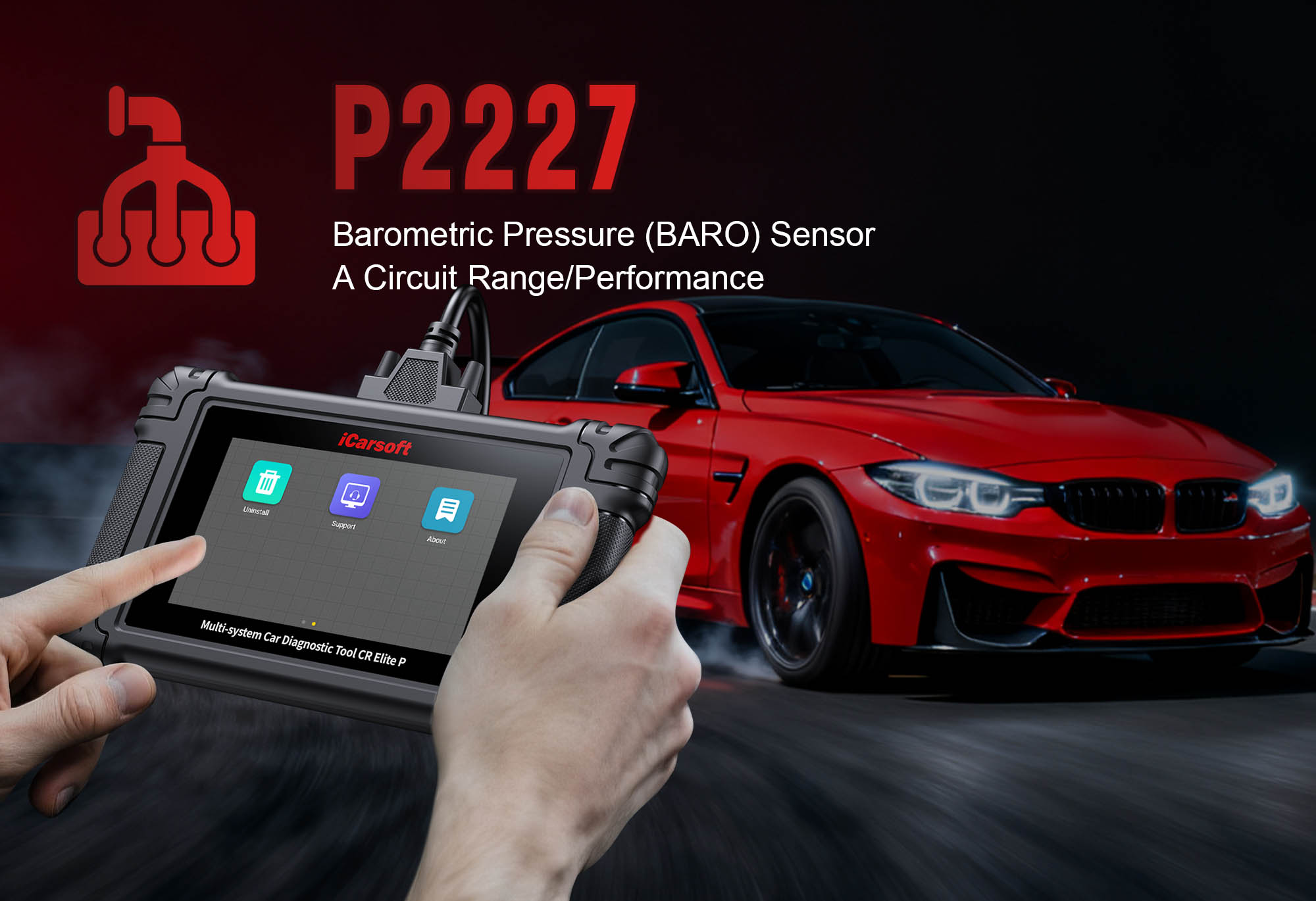
Diagnose & Clear P2227 with iCarsoft CR Elite P: Fix Barometric Pressure Sensor A Circuit Range/Performance
If your vehicle’s check engine light turns on, you notice sluggish acceleration at high altitudes, or experience erratic idle, a diagnostic scan will likely return P2227. This OBD-II code stands for "Barometric Pressure (BARO) Sensor A Circuit Range/Performance"—a critical fault indicating the Engine Control Module (ECM) is receiving abnormal voltage signals from the BARO sensor. The BARO sensor measures atmospheric pressure to adjust fuel delivery and ignition timing; a malfunction disrupts the ECM’s ability to optimize the air-fuel mixture, leading to poor performance, reduced fuel efficiency, and even stalling in extreme cases.
Basic scanners may only flag "BARO sensor fault" but can’t monitor real-time pressure data, test sensor circuits, or verify ECM communication—leaving you unable to tell if the issue is a faulty sensor, broken wiring, or a failed ECM. The iCarsoft CR Elite P, with its specialized BARO sensor diagnostics, live pressure tracking, and circuit integrity tests, solves this. Let’s break down how to diagnose and resolve P2227 with precision, leveraging the CR Elite P’s unique capabilities to restore your engine’s ability to adapt to altitude and atmospheric changes.
Understanding P2227: Causes & Key Symptoms
The BARO sensor works hand-in-hand with the mass airflow (MAF) and manifold absolute pressure (MAP) sensors to calculate air density—critical for adjusting fuel injection. When it malfunctions, the ECM uses default pressure values (e.g., sea-level pressure), which fail in high-altitude or variable weather conditions. Symptoms worsen in environments with changing atmospheric pressure:
Key Symptoms of P2227
-
Check Engine Light (CEL): The CEL illuminates to alert you to the BARO sensor’s abnormal signal—some vehicles also trigger a "Reduced Power" warning.
-
Sluggish Acceleration at High Altitudes: At elevations above 3,000 feet, the engine struggles to accelerate because the ECM uses incorrect pressure data (too much fuel for thin air).
-
Erratic Idle: The engine fluctuates between 500–1,000 RPM at idle, as the ECM misadjusts the air-fuel mixture.
-
Reduced Fuel Efficiency: Incorrect pressure readings cause the ECM to overfuel or underfuel the engine—mileage can drop by 10–20%.
-
Stalling in Extreme Weather: Heavy rain, fog, or sudden pressure drops (e.g., thunderstorms) exacerbate the sensor’s error, leading to stalling when starting or driving.
-
Poor Ignition Timing: Late or early ignition (caused by wrong pressure data) leads to engine knock (a pinging sound) under load.
Common Causes of P2227
|
Cause
|
Description
|
|
Faulty BARO Sensor
|
Internal component failure (e.g., damaged pressure diaphragm, broken circuitry) causes the sensor to send erratic voltage (typically 0.5–4.5V for analog sensors).
|
|
Damaged Wiring Harness
|
Frayed wires, rodent chew marks, or corrosion in the BARO sensor’s wiring create high resistance, disrupting voltage signals to the ECM.
|
|
Loose or Corroded Electrical Connector
|
The sensor’s connector (often mounted near the MAF/MAP sensor or ECM) becomes loose or rusted, breaking the electrical connection.
|
|
ECM Software Glitch
|
Outdated ECM firmware misinterprets valid BARO sensor signals, triggering false P2227 codes—common in 2018+ vehicles with advanced pressure monitoring.
|
|
Physical Damage to the Sensor
|
Impact from road debris (if the sensor is mounted in the front of the engine bay) or oil contamination (from a leaking valve cover) damages the sensor’s diaphragm.
|
|
Short Circuit in the Sensor Circuit
|
A short between the sensor’s power wire and ground wire causes constant 0V or 5V signals, which the ECM flags as a range fault.
|
Why iCarsoft CR Elite P Excels at Diagnosing P2227
The CR Elite P outperforms basic tools with features tailored to BARO sensor and pressure system diagnostics—critical for resolving P2227:
Live BARO Pressure Tracking
Monitors real-time atmospheric pressure (in kPa or psi) and sensor voltage, comparing readings to local weather data (e.g., 101 kPa at sea level) to identify anomalies.
BARO Sensor Circuit Test
Checks for open circuits, short circuits, and high resistance in the sensor’s power, ground, and signal wires—pinpoints electrical faults in seconds.
Sensor Calibration Validation
Verifies if the BARO sensor aligns with manufacturer specs (e.g., 0.5V = 50 kPa, 4.5V = 150 kPa) —out-of-calibration sensors often cause P2227.
AutoVIN Identify
Automatically retrieves your vehicle’s make, model, and BARO sensor type (analog vs. digital, standalone vs. integrated into MAP) in seconds.
Global Vehicle Coverage
Works with 500+ gasoline, diesel, and hybrid models from Ford, Chevrolet, Toyota, Honda, BMW—supports standalone and integrated BARO sensors.
ECM Firmware Update Checks
Alerts to outdated ECM software that misinterprets BARO signals, with links to manufacturer updates for false codes.
Altitude Simulation Test
Simulates high-altitude pressure (e.g., 80 kPa at 5,000 feet) to test sensor adaptation—confirms if the sensor handles changing conditions.
Step-by-Step: Diagnose P2227 with iCarsoft CR Elite P
-
1. Initial Visual Inspection of the BARO Sensor & Wiring
Start with a basic check to identify obvious issues:
1. Locate the BARO Sensor: Use Component Location > Engine > Sensors > BARO Sensor—common positions: near MAF/MAP, inside ECM, or behind front grille.
2. Check for Physical Damage: Inspect for cracks, oil stains, or debris—impact/oil ruins the pressure diaphragm.
3. Examine the Connector: Look for corrosion, bent pins, or looseness—clean with contact cleaner and resecure.
4. Inspect Wiring: Follow wires to ECM, checking for frays, rodent damage, or kinks—repair with heat-shrink tubing.
-
2. Connect the CR Elite P & Confirm P2227
1. Plug into OBD-II port. Power on and select AutoVIN Identify to detect engine type and BARO config (standalone/integrated).
2. Navigate to Engine > Fault Codes > Read Codes to confirm P2227. Tap Code Details for insights (e.g., "RAV4: BARO Voltage 0.2V (Normal 0.5–4.5V); Check Wiring").
3. Resolve related codes (e.g., P0106, P0113) first—MAP/IAT faults interact with BARO and may clear P2227.
-
3. Monitor Live BARO Sensor Data
Real-time data reveals valid signals:
1. Park in an open area (no garage/building blockage). Start engine, idle 5 minutes (warm ECM).
2. Navigate to Engine > Live Data > Sensors > BARO Sensor and monitor:
- Atmospheric Pressure: Match local weather (e.g., 101 kPa sea level); 10+ kPa off = faulty sensor.
- Sensor Voltage: Analog sensors: 0.5V=50 kPa, 4.5V=150 kPa; fixed 0V/5V = wiring/sensor failure.
- ECM vs. Sensor Pressure: "Calculated BARO" should match "Measured BARO" (±2 kPa)—mismatch = ECM issue.
-
4. Perform BARO Sensor Circuit Test
Check for electrical faults:
1. Engine off, disconnect BARO sensor connector.
2. Power Wire Test: Multimeter (DC Voltage) on power pin + ground. Ignition "ON": 5V (analog) or 12V (digital); 0V = blown fuse (check via Fuse Guide).
3. Ground Wire Test: Multimeter (Ohms) on ground pin + chassis; <1 ohm normal, >5 ohms = clean/replace ground strap.
4. Signal Wire Test: Multimeter (Ohms) on signal pin + ECM pin (via Wiring Diagram); <5 ohms normal, >10 ohms = damaged wire.
-
5. Run Altitude Simulation Test
Test sensor adaptation to changing pressure:
1. Vehicle parked, engine off. Navigate to Special Functions > Engine > BARO Sensor Altitude Test.
2. Select simulated altitude (e.g., 5,000 feet = 84 kPa) and start test.
3. Good Sensor: Voltage adjusts to match simulated pressure (e.g., 84 kPa = ~2.5V analog).
4. Faulty Sensor: Voltage stays same or changes <0.5V—replace sensor.
-
6. Update ECM Firmware (False Code Suspected)
Fix software-related misinterpretation:
1. Connect CR Elite P to Wi-Fi (System > Wi-Fi Settings).
2. Navigate to System > Update Manager > ECM Firmware—scan for updates (e.g., "F-150 2020–2023: BARO Calibration Update").
3. Install updates, restart engine. Clear P2227 and check if it returns.
-
7. Repair & Clear P2227
Fix the root cause:
- Faulty BARO Sensor: Replace with OEM part (via Part Lookup—e.g., Denso 5535102 for GM); replace parent component for integrated sensors.
- Wiring Faults: Repair with heat-shrink tubing; isolate short circuits.
- Loose/Corroded Connector: Clean and apply dielectric grease.
- ECM Glitch: Install updates (step 6) or dealer-reprogram ECM if needed.
Clear Code: Navigate to Engine > Fault Codes > Clear Codes and confirm P2227 deletion.
-
8. Validate the Repair
Ensure sensor adapts to pressure changes:
1. Start engine—no CEL or "Reduced Power" light.
2. Test drive in varying conditions:
- High-Altitude Test: Drive to 3,000+ feet—smooth acceleration.
- Weather Test: Drive in rain/fog—steady idle, no stalling.
3. Post-Repair Data: Confirm pressure matches local weather and voltage correlates to pressure (via live data).
4. Run I/M Readiness Test (under OBDII Functions) for emissions compliance.
Preventing P2227 Recurrence
The CR Elite P helps maintain BARO sensor health:
-
Regular Sensor Checks: Use Service Reminder to test the BARO sensor every 30,000 miles—catch early signal anomalies.
-
Wiring Protection: Inspect wiring every 15,000 miles for rodent damage/corrosion—use wire loom to shield vulnerable sections.
-
Connector Maintenance: Apply dielectric grease to the connector every 20,000 miles to prevent moisture-related corrosion.
-
ECM Update Alerts: Enable automatic Wi-Fi updates to install BARO calibration fixes promptly.
Conclusion
P2227’s BARO sensor circuit fault disrupts the engine’s ability to adapt to atmospheric changes, but the iCarsoft CR Elite P simplifies diagnosis with live pressure tracking, circuit tests, and altitude simulation. Whether replacing a faulty sensor, repairing wiring, or updating ECM software, this tool ensures you address the root cause—saving you from costly trial-and-error repairs and frustrating high-altitude performance issues.
For DIYers and professionals alike, the CR Elite P’s BARO-specific features, global coverage, and intuitive interface make it the ideal tool for resolving P2227. Restore smooth acceleration, improve fuel efficiency, and drive with confidence in any weather or altitude—all with one professional-grade diagnostic tool.
FAQs About P2227 Code
Q: Is the BARO sensor the same as the MAP sensor?
A: No—though some vehicles integrate BARO into the MAP sensor (called MAP/BARO combo sensors). The BARO measures atmospheric pressure, while the MAP measures intake manifold pressure. The CR Elite P’s Component Location clarifies if your sensor is standalone or integrated.
Q: Can I drive long distances with P2227?
A: Short trips (to a shop) are safe, but long drives—especially at high altitudes or in variable weather—risk stalling or engine knock. Fix P2227 within 100 miles to avoid worsening performance or damage.
Q: Why does P2227 return after sensor replacement?
A: Unresolved electrical issues—e.g., corroded wiring, loose ground, or outdated ECM software. Use the CR Elite P’s circuit test to retrace wiring and check for firmware updates post-replacement.
Q: How much does it cost to fix P2227?
A: Costs range from $50–$150 for a standalone BARO sensor, $100–$300 for wiring repairs, and $80–$200 for ECM reprogramming. The CR Elite P saves by avoiding unnecessary ECM replacements.