Fix P20E8: SCR NOx Sensor Circuit Fault – Trust iCarsoft CR MAX BT
Your diesel vehicle’s Check Engine Light flashes on, and a diagnostic scan returns P20E8—a code signaling trouble with the Selective Catalytic Reduction (SCR) NOx sensor. Defined as “SCR NOx Sensor Circuit Range/Performance (Bank 1, Sensor 2)”, this fault disrupts your vehicle’s emissions control system, risking reduced performance, increased fuel consumption, and even failed emissions tests. But with the iCarsoft CR MAX BT diagnostic tool, you can pinpoint the issue, fix it affordably, and get back on the road—whether you’re a DIY enthusiast or a professional mechanic.
The SCR NOx sensor measures nitrogen oxide (NOx) levels in the exhaust, working with the SCR system to reduce emissions (critical for diesel vehicles meeting Euro 6, EPA Tier 3, or similar standards). When the sensor’s circuit malfunctions, the Engine Control Module (ECM) can’t adjust urea (AdBlue) injection properly. Left unaddressed, P20E8 can trigger limp mode and costly repairs. Let’s break down everything you need to know about P20E8 and how the CR MAX BT simplifies resolution.
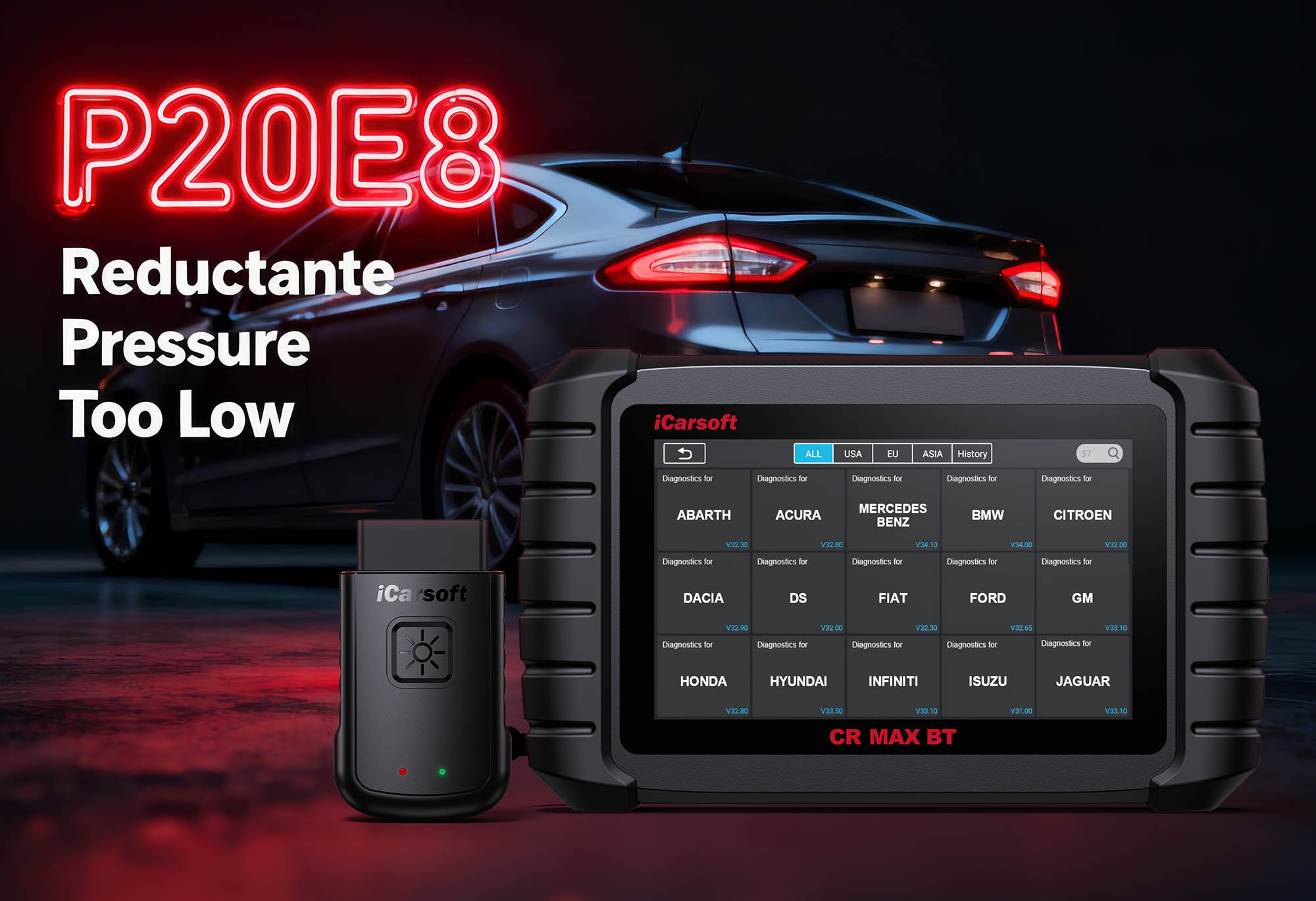 iCarsoft CR MAX BT running SCR system tests to diagnose P20E8 fault code in diesel vehicles
What Exactly Is the P20E8 Code?
P20E8 targets the SCR NOx sensor (Bank 1, Sensor 2)—typically the downstream sensor mounted after the SCR catalyst. It triggers when the sensor’s circuit sends signals outside the manufacturer’s acceptable range, or when the sensor fails to communicate with the ECM.
P20E8 is common in diesel vehicles across makes, with model-specific nuances:
-
Ford F-250 Power Stroke: Often linked to sensor wiring damage from exhaust heat.
-
Volkswagen Touareg TDI: Typically caused by a faulty NOx sensor or urea quality issues.
-
Mercedes-Benz E350 BlueTEC: Frequently stems from sensor calibration errors or ECM glitches.
The iCarsoft CR MAX BT uses Auto VIN technology to pull your vehicle’s exact SCR system specs, eliminating guesswork and ensuring targeted diagnostics.
Key Symptoms of P20E8 to Watch For
P20E8 disrupts emissions control, so symptoms are hard to miss:
-
Illuminated Check Engine Light: Often paired with “AdBlue System Fault” or “Reduced Engine Power” messages.
-
Increased Fuel Consumption: The ECM’s default fueling strategy (due to faulty sensor data) raises usage by 10–15%.
-
Limp Mode Activation: Some vehicles limit speed to 40–50 mph to protect the SCR system.
-
Failed Emissions Tests: High NOx levels cause non-compliance with strict emissions standards.
-
Urea (AdBlue) System Malfunction: The ECM may stop urea injection, triggering additional codes like P2047.
-
Rough Idle or Hesitation: Disrupted exhaust gas monitoring leads to unoptimized engine performance.
Common Causes of P20E8 (And How CR MAX BT Identifies Them)
P20E8 has five primary causes, and the CR MAX BT’s advanced features pinpoint the root issue:
|
Cause
|
Description
|
|
Faulty SCR NOx Sensor
|
Internal sensor failure from heat or contamination. The CR MAX BT’s sensor performance test checks voltage output against NOx levels to confirm faults.
|
|
Damaged Wiring/Connectors
|
Frayed wires, corroded terminals, or heat damage disrupt the circuit. The CR MAX BT’s circuit continuity test detects breaks/shorts in seconds.
|
|
Poor Urea (AdBlue) Quality
|
Contaminated or low urea disrupts sensor readings. The CR MAX BT’s AdBlue system test checks urea concentration and injection status.
|
|
ECM Malfunction
|
A glitch in the engine control module misinterprets sensor signals. The CR MAX BT’s ECM communication test identifies software errors.
|
|
SCR Catalyst Degradation
|
A clogged or failed catalyst affects NOx levels, confusing the sensor. The CR MAX BT’s live data monitoring tracks catalyst efficiency.
|
Why iCarsoft CR MAX BT Is the Best Tool for P20E8
Basic scanners only confirm “P20E8 is present”—the CR MAX BT goes further to diagnose and fix the issue. Here’s how it outperforms cheap tools:
NOx Sensor Testing
Monitor real-time sensor voltage and NOx readings (via text/graph) to spot anomalies against OEM specs.
AdBlue System Diagnostics
Check urea level, concentration, and injection performance (critical for resolving P20E8 in SCR-equipped vehicles).
Bi-Directional Control
Send commands to the sensor to verify responsiveness (3x faster than manual testing).
Auto VIN Identification
Automatically detects your vehicle’s make, model, and diesel engine type (e.g., Ford Power Stroke, VW TDI) for precise specs.
ECM Coding & Firmware Updates
Calibrate new sensors or update ECM software (saves $150–$300 in dealership fees).
58+ Vehicle Brand Compatibility
Works with Ford, VW, Mercedes-Benz, Chevy, BMW, and all major diesel makes.
Lifetime Free Updates
Access new SCR system specs and diagnostic features via Wi-Fi—no recurring fees.
NOx Sensor Circuit Testing
Check power supply, grounding, and wiring integrity without a separate multimeter.
Step-by-Step: Diagnose & Fix P20E8 with CR MAX BT
Resolving P20E8 is straightforward with the CR MAX BT:
-
1. Confirm P20E8 & Inspect Basics
1. Visually check the SCR NOx sensor (downstream of the SCR catalyst) for damage and ensure wiring/connectors are secure.
2. Verify AdBlue level and quality (use a urea tester if available).
3. Plug the CR MAX BT into your vehicle’s OBD-II port and pair via Bluetooth (connects in 10 seconds).
4. Select Auto VIN Identify to pull your vehicle’s SCR system specs.
5. Navigate to Engine > Fault Codes > Read Codes to confirm P20E8. Tap Code Details for vehicle-specific insights (e.g., “Ford F-250: Check sensor wiring near exhaust”).
-
2. Monitor Live SCR System Data
Start the engine and go to Engine > Live Data > Emissions System. Monitor:
- NOx Sensor Voltage: Should fluctuate with exhaust gas flow (steady 0V/5V = fault).
- AdBlue Injection Status: Should activate during driving (no activity = ECM glitch or sensor issue).
- SCR Catalyst Efficiency: Should stay above 80% (low = catalyst degradation).
-
3. Run Sensor & Circuit Tests
1. Go to Special Functions > Emissions Control > SCR System Diagnostics.
2. The CR MAX BT will perform a NOx sensor performance test (fails = faulty sensor).
3. Run a circuit continuity test (fails = wiring repair needed).
4. Conduct an AdBlue system test (fails = urea quality/level issue).
-
4. Repair & Validate the Fix
1. Address the root cause:
- Faulty Sensor: Replace with an OEM SCR NOx sensor and calibrate via the CR MAX BT’s coding function.
- Wiring Issues: Repair frayed wires or clean corroded connectors (use heat-resistant tape for wiring near exhaust).
- Urea Problems: Drain contaminated urea, refill with high-quality AdBlue, and reset the system via the CR MAX BT.
- ECM Glitch: Run One-Key Upgrade to install the latest firmware (free via Wi-Fi).
2. Clear P20E8 via Fault Codes > Clear Codes and test drive 50–100 miles.
3. Re-scan—stable sensor data confirms success.
FAQs: Your P20E8 Questions Answered
Q: Is it safe to drive with P20E8?
A: Short trips (5–10 miles) are manageable, but long-term driving risks limp mode and SCR catalyst damage. Avoid highways and heavy loads until fixed.
Q: How much does it cost to fix P20E8?
A: Costs vary:
- NOx sensor replacement: $350–$600 (parts + labor).
- Wiring repair: $150–$300.
- Dealership diagnostic + repair: $800–$1,500.
The CR MAX BT saves $200+ by letting you diagnose and handle simple fixes yourself.
Q: Why does P20E8 come back after sensor replacement?
A: You missed a secondary issue (e.g., damaged wiring, poor urea quality, or uncalibrated ECM). Use the CR MAX BT’s live data to find hidden faults.
Q: Can bad AdBlue cause P20E8?
A: Yes—contaminated, diluted, or low AdBlue disrupts NOx sensor readings. The CR MAX BT’s AdBlue system test confirms this.
Q: Does P20E8 affect gasoline vehicles?
A: No—P20E8 is exclusive to diesel vehicles with SCR (AdBlue) systems. Gasoline vehicles use different emissions control technology.
Q: Will P20E8 cause a failed emissions test?
A: Yes—faulty NOx sensors lead to high nitrogen oxide levels, which fail strict emissions standards (e.g., Euro 6, EPA Tier 3).
Q: Can the CR MAX BT calibrate a new NOx sensor?
A: Yes—its coding function calibrates new sensors to your ECM, eliminating dealership programming fees.
Q: How often should I update the CR MAX BT?
A: Update every 3 months via free Wi-Fi. New firmware includes SCR system specs for 2024+ diesel models and fixes ECM glitches that trigger false P20E8 codes.
Conclusion: Don’t Let P20E8 Derail Your Diesel Vehicle
P20E8 is a warning, not a death sentence for your SCR system. With the iCarsoft CR MAX BT, you can identify whether the issue is a faulty sensor, bad wiring, or urea problems—then fix it quickly and affordably. No more guesswork, no expensive dealership visits.
Invest in the CR MAX BT today to take control of P20E8—and keep your diesel vehicle emissions-compliant and performing at its best.