Fix P0091: Fuel Pressure Regulator Performance Fault – Trust iCarsoft CR MAX BT
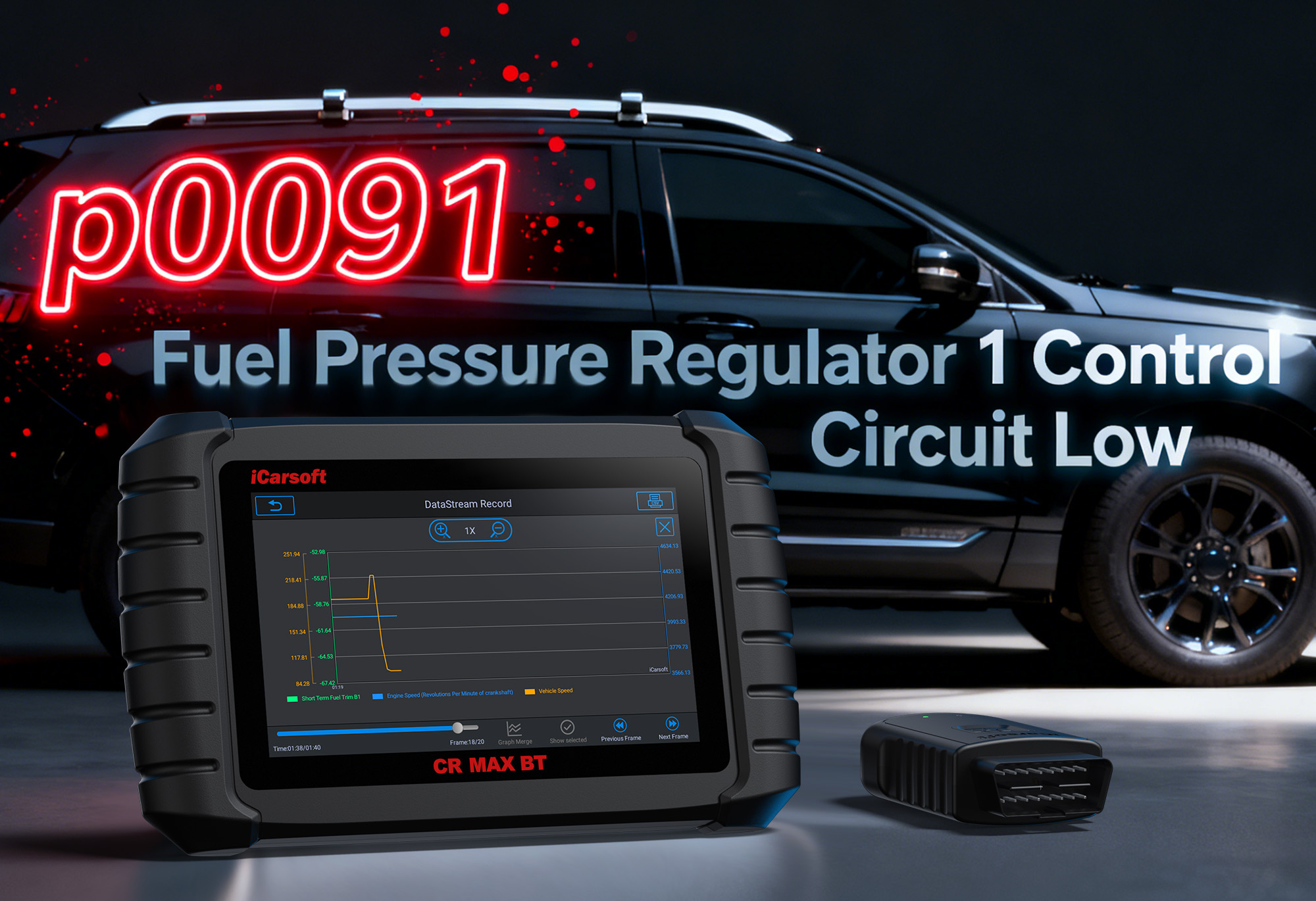
You’re accelerating onto the highway, and your engine sputters—losing power just when you need it most. The Check Engine Light flashes on, and a diagnostic scan reveals P0091, a code tied to your vehicle’s fuel delivery system. Defined as “Fuel Pressure Regulator Performance (Bank 1),” P0091 signals that the Engine Control Module (ECM) has detected abnormal fuel pressure from the regulator—a critical component that maintains steady fuel flow to the engine. Ignoring it can lead to severe engine damage, failed emissions tests, and even stalling. But with the iCarsoft CR MAX BT, you can diagnose, troubleshoot, and fix this issue like a pro—whether you’re a DIY enthusiast or a professional mechanic.
The fuel pressure regulator acts as a “pressure gatekeeper”: it ensures fuel pressure stays within the OEM range (typically 30–80 psi, depending on the engine) by returning excess fuel to the tank. When it malfunctions—sticking open (causing low pressure) or closed (causing high pressure)—the ECM detects the deviation and triggers P0091. This disrupts the air-fuel mixture, leading to poor performance and potential engine harm.
What Exactly Is the P0091 Code?
P0091 focuses on the fuel pressure regulator’s performance, activating when the ECM’s fuel pressure sensor detects readings that fall outside the acceptable range for 2–3 consecutive seconds. Unlike P0087 (low fuel pressure) or P0089 (high fuel pressure), P0091 specifically points to the regulator as the root cause—not the fuel pump or filter. It’s common in both gasoline and diesel engines, though diesel vehicles (with higher fuel pressure demands) are more prone to severe symptoms.
P0091 has make and model-specific trends tied to fuel system design:
-
Dodge Ram 6.7L Cummins P0091: Often linked to a stuck fuel pressure regulator in the common rail system (common in 2013–2022 models).
-
Ford Focus ST P0091: Typically caused by a faulty electronic pressure regulator or a clogged fuel return line (prevalent in 2013–2018 turbocharged variants).
-
Chevrolet Silverado 5.3L P0091: Frequently stems from a failing regulator solenoid or ECM software glitch (common in 2014–2023 models with direct injection).
-
Mercedes-Benz E350 BlueTEC P0091: Often due to a contaminated regulator or a leak in the fuel pressure sensor line (prevalent in 2010–2019 diesel models).
The iCarsoft CR MAX BT uses Auto VIN technology to pull your vehicle’s exact fuel pressure specs—including regulator range, sensor thresholds, and return line design—eliminating guesswork and ensuring targeted diagnostics.
Key Symptoms of P0091 to Watch For
P0091 disrupts fuel delivery, so symptoms are often immediate and impact driving safety. Be alert for these critical warning signs:
-
Illuminated Check Engine Light: The most consistent indicator—often paired with “Fuel System Fault” or “Reduced Power” messages on the dashboard.
-
Engine Power Loss: Noticeable hesitation during acceleration, especially at high speeds or under load (e.g., towing heavy cargo or climbing hills).
-
Engine Misfires: Uneven fuel distribution causes rough idling, shaking, or popping sounds from the exhaust pipe.
-
Stalling: The engine may shut off unexpectedly, especially at stops or low speeds—posing a significant risk in traffic.
-
Increased Fuel Consumption: A faulty regulator disrupts the ideal air-fuel ratio, increasing fuel consumption by 15–25%.
-
Strong Fuel Odor: A stuck-open regulator can leak fuel, creating a noticeable gasoline or diesel smell from the engine bay or exhaust.
-
Hard Starting: Low fuel pressure makes it difficult for the engine to start, requiring multiple key turns before ignition.
Common Causes of P0091 (And How CR MAX BT Identifies Them)
Faulty Fuel Pressure Regulator
Internal valve failure (stuck open/closed) disrupts pressure stability. The CR MAX BT’s real-time fuel pressure monitoring tracks deviations from OEM specs to pinpoint regulator malfunctions.
Clogged Fuel Return Line
Debris or old fuel blocks the line, causing dangerous pressure buildup. The CR MAX BT’s return flow test detects restricted flow and confirms line clogs without disassembly.
Malfunctioning Fuel Pressure Sensor
A faulty sensor misreports pressure data to the ECM. The CR MAX BT’s sensor accuracy test compares readings to OEM standards to identify calibration or hardware faults.
ECM Software Glitch
Outdated firmware misinterprets regulator performance data. The CR MAX BT’s ECM communication test identifies glitches and offers free firmware updates to resolve false code triggers.
Contaminated Fuel
Dirt, water, or degraded fuel damages the regulator’s internal valve. The CR MAX BT’s pressure spike analysis (via live data) reveals abnormal fluctuations linked to fuel contamination.
Why iCarsoft CR MAX BT Is the Best Tool for P0091
Basic code readers only confirm “P0091 is present”—the CR MAX BT goes deep into the fuel system to find the root cause. Here’s how it outperforms cheap scanners and even professional tools:
Fuel System-Specific Diagnostics
Supports 1,200+ fuel system configurations and pulls regulator specs tailored to your vehicle (e.g., Dodge’s 2000–3000 psi range for Cummins common rail diesels).
Live Fuel Pressure Monitoring
Track pressure in real time (via graph or text) to spot abnormalities—e.g., 20 psi when it should be 50 psi (low pressure) or 90 psi (high pressure) for gasoline engines.
Regulator Solenoid Bi-Directional Testing
Send commands to electronic regulators to confirm responsiveness—listen for a click and check pressure changes to rule out wiring or valve faults.
Fuel Return Flow Analysis
Measure return line flow to detect clogs—critical for fixing P0091 in diesel vehicles with high-pressure common rail systems.
Injector Balance Testing
Check if uneven fuel delivery (from pressure issues) is damaging injectors—prevents costly secondary repairs and engine damage.
Lifetime Free Wi-Fi Updates
Access new fuel system specs and ECM firmware for 2024+ vehicles—no recurring charges or subscription fees to stay up-to-date.
Step-by-Step: Diagnose & Fix P0091 with CR MAX BT
Step 1: Visual Inspection & Tool Connection
Ensure the fuel cap is tight; inspect fuel lines for leaks or cracks; replace the fuel filter if overdue. Plug CR MAX BT’s OBD-II adapter into the port and pair via Bluetooth (10-second connection).
Step 2: AutoVIN Identify & Code Confirmation
Select AutoVIN to pull your vehicle’s fuel system and regulator specs; navigate to Engine > Fault Codes > Read Codes to confirm P0091 and view model-specific troubleshooting insights.
Step 3: Live Fuel Pressure Data Monitoring
Start the engine and reach operating temperature (10–15 mins); drive 30–40 mph for 5 mins to trigger the ECM’s fuel system self-test. Go to Engine > Live Data > Fuel System to monitor fuel rail pressure, regulator solenoid voltage, return flow rate, and injector pulse width.
Step 4: Run Targeted Fuel System Diagnostics
Go to Special Functions > Fuel System > Regulator Diagnostics to run static pressure test, solenoid activation test, return line flow test, and sensor accuracy test—narrow down the exact cause of P0091.
Step 5: Repair the Root Cause
Replace the faulty fuel pressure regulator, flush clogged return lines, install a new pressure sensor, or update ECM firmware—follow CR MAX BT test results for precise, cost-effective repairs.
Step 6: Code Clear & Validation Test Drive
Erase P0091 via Engine > Fault Codes > Clear Codes; drive 100–150 miles (highway, city, and load testing if applicable). Recheck live pressure data with the CR MAX BT to confirm stable fuel pressure and restored engine performance.
FAQs: Your P0091 Questions Answered
Is it safe to drive with P0091?
No—P0091 risks sudden stalling or power loss, which is dangerous in traffic or at high speeds. If you must drive (e.g., to a repair shop), avoid highways, towing, and heavy acceleration. Fix it immediately to prevent engine damage.
How much does it cost to fix P0091?
Costs vary by cause and vehicle type: fuel pressure regulator replacement ($200–$500 for gasoline engines, $400–$800 for diesel common rails), return line repair ($100–$300), pressure sensor replacement ($150–$300), fuel system cleaning ($80–$150), dealership diagnostic + repair ($800–$1,500). The CR MAX BT saves $200+ by letting you diagnose and handle simple fixes yourself.
Why does P0091 come back after I clear it?
You didn’t fix the root cause—e.g., replacing the regulator but not cleaning a clogged return line, or installing a new sensor but not updating faulty ECM firmware. Use the CR MAX BT’s flow and pressure tests to find hidden issues that basic scanners miss.
Can bad fuel cause P0091?
Yes—contaminated fuel (dirt, water, or degraded fuel) can damage the regulator’s internal valve, causing it to stick open or closed. This is especially common in diesel vehicles, where even small debris can disrupt high-pressure common rail systems.
Does P0091 affect hybrid vehicles?
Yes—hybrid vehicles with gasoline engines (e.g., Toyota Prius) use fuel pressure regulators to maintain proper fuel flow. P0091 in hybrids often leads to reduced electric-gasoline coordination, increasing fuel consumption and triggering “Reduced Power” warnings.
Will P0091 cause a failed emissions test?
Yes—abnormal fuel pressure disrupts the ideal air-fuel mixture, increasing hydrocarbon (HC) and carbon monoxide (CO) emissions. This will fail strict standards like EPA Tier 3 or Euro 6. Fix P0091 with the CR MAX BT before your emissions inspection to avoid retest fees.
Can the CR MAX BT test fuel pressure without starting the engine?
Yes—its static fuel pressure test measures pressure with the ignition on (engine off). This lets you check for regulator leaks or sticking issues without starting the vehicle, saving time and reducing safety risks.
How often should I update the CR MAX BT for P0091 fixes?
Update every 3 months via free Wi-Fi. New firmware includes fuel system specs for 2024+ vehicles and ECM patches that fix glitches triggering false P0091 codes—especially common in turbocharged and direct-injection engines.
Final Thoughts: Fix P0091 Before It Damages Your Engine
P0091 is not a code to ignore—it’s a critical warning that your fuel delivery system is compromised, risking sudden power loss, stalling, and expensive engine repairs. With the iCarsoft CR MAX BT, you can skip the dealership’s costly diagnostic fees and pinpoint the exact cause in minutes, whether it’s a faulty regulator, clogged line, or sensor failure.
No more guessing, no more overpaying for unnecessary parts. Invest in the CR MAX BT today to resolve P0091 quickly, restore your engine’s performance, and protect your vehicle from long-term damage.