Fix P2001 Code: NOx Adsorber Efficiency Below Threshold (Bank 2) – iCarsoft CR MAX BT Gets It Done
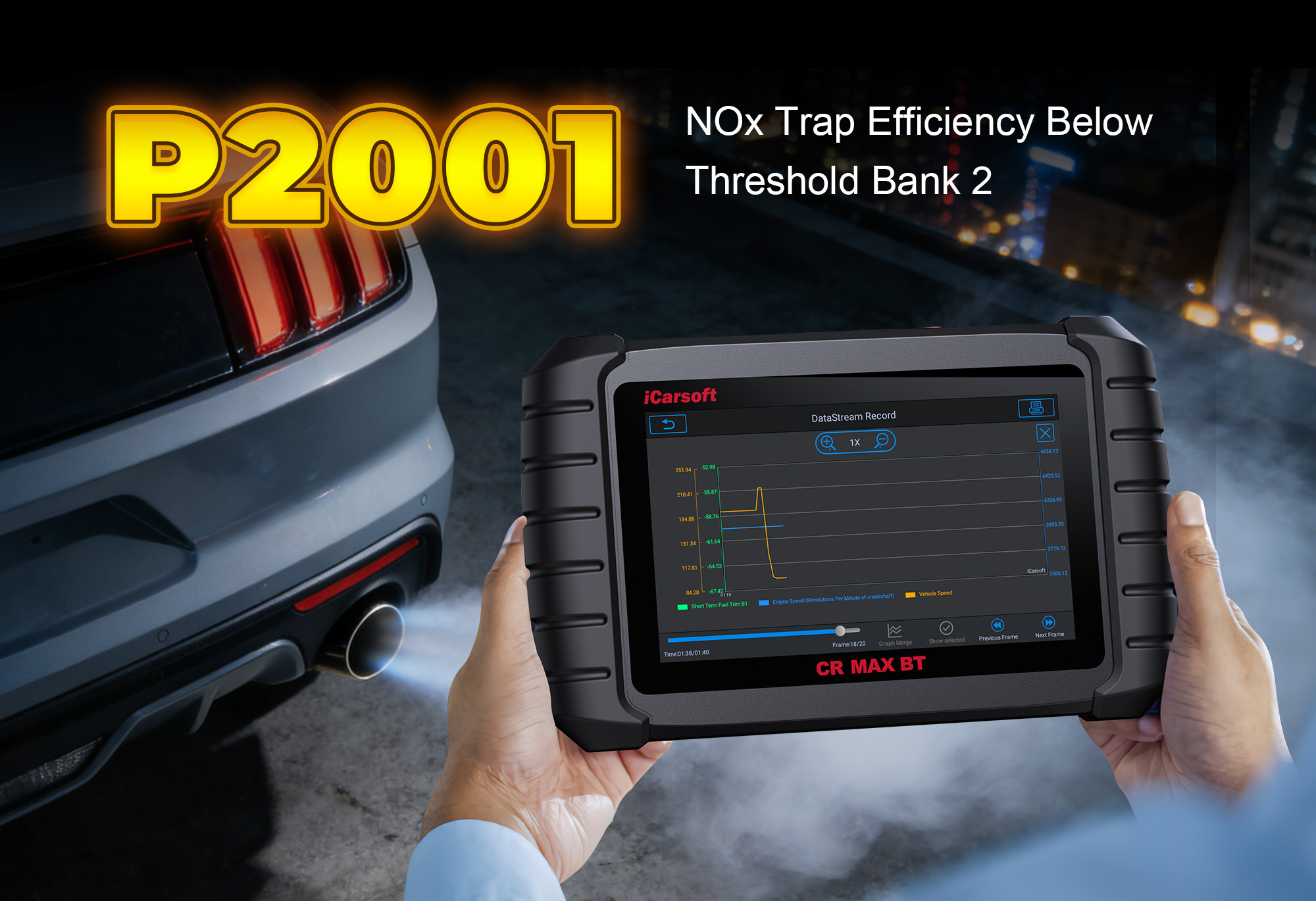
Your check engine light blares to life, and your diesel truck sputters with reduced power—you scan it, and P2001 pops up. This code, defined as “NOx Adsorber Efficiency Below Threshold (Bank 2),” is a critical emissions fault that threatens failed inspections, costly aftertreatment damage, and even legal penalties in strict regions like California or Europe. The NOx adsorber (a key component in diesel and select gasoline hybrid vehicles) is supposed to trap harmful nitrogen oxides, but when its efficiency drops, your vehicle becomes a pollution risk—and a money pit if you rely on dealerships. Fortunately, the iCarsoft CR MAX BT OBD2 Scanner (available at icarsoft.com) lets you diagnose, fix, and clear P2001 like a pro—no expensive shop visits required.
Let’s cut through the jargon: “Bank 2” refers to the second cylinder bank (check your owner’s manual for location, critical for V6/V8 engines). The NOx adsorber’s job is to convert toxic NOx into harmless nitrogen and oxygen—when it fails to meet the Engine Control Module (ECM)’s efficiency standards, P2001 triggers. This isn’t a code to ignore: left unfixed, it leads to DPF regeneration failures, 15-20% worse fuel economy, and a $2,000+ bill for a new adsorber. But with the CR MAX BT, you’ll pinpoint the root cause (not just the code) and save hundreds—even thousands.
What Exactly Is OBD2 Code P2001?
P2001 is a generic OBD-II code that spells trouble for your vehicle’s emissions system. Here’s a breakdown of the key terms to understand:
-
NOx Adsorber: A emissions component found in most post-2010 diesel vehicles (e.g., Ford F-350, Chevrolet Silverado HD, BMW X5 xDrive35d) and some gasoline hybrids. It traps nitrogen oxides (NOx) and converts them to non-toxic gases during regeneration cycles.
-
Bank 2: The cylinder bank that does NOT contain the #1 cylinder (refer to your vehicle’s service manual for exact placement—critical for dual-bank engines).
-
Efficiency Below Threshold: The ECM runs periodic tests to verify the adsorber’s performance. If its NOx reduction rate falls below the manufacturer’s minimum (usually 70-80%), P2001 triggers.
The ECM uses NOx sensors and exhaust temperature sensors to monitor the adsorber. P2001 isn’t just a “sensor fault”—it’s a sign the adsorber itself (or its supporting components) is failing. It’s most common in high-mileage diesel vehicles, those using low-quality fuel, or trucks that rarely drive long enough to complete regeneration cycles (e.g., city-only commutes).
Key Symptoms of P2001 You Can’t Ignore
P2001 doesn’t always cause obvious drivability issues at first—but its symptoms worsen quickly. Watch for these red flags:
-
Illuminated Check Engine Light: The first and most reliable sign—often paired with “Emissions System Fault” or “Reduced Power Mode” warnings.
-
Failed Emissions Tests: Automatic failure in CARB, Euro 6d, or EPA Tier 3 regions—you won’t pass until P2001 is fixed.
-
Reduced Engine Power: The ECM activates limp mode to limit NOx production, making your vehicle sluggish (a nightmare for towing or highway driving).
-
Poor Fuel Economy: Inefficient regeneration cycles waste fuel—expect a 15-20% drop in MPG.
-
DPF Regeneration Failures: A faulty NOx adsorber disrupts the Diesel Particulate Filter (DPF) cleaning process, leading to filter clogging (a $1,000+ repair).
-
Sulfuric Exhaust Odor: Unconverted NOx or a damaged adsorber creates a strong “rotten egg” smell from the tailpipe.
Top Causes of P2001 (And How CR MAX BT Identifies Them)
P2001 isn’t a “one-size-fits-all” fault—its root cause varies by vehicle. The CR MAX BT cuts through the guesswork by targeting these common culprits:
NOx Adsorber Aging/Clogging (40% of Cases)
Over time, pollutant buildup or material degradation reduces efficiency. The CR MAX BT’s real-time efficiency monitoring compares actual vs. target performance to confirm a failing adsorber.
Faulty Exhaust Temperature Sensor
Inaccurate temperature data disrupts regeneration (the adsorber needs specific heat to clean itself). The CR MAX BT tests sensor accuracy against OEM specs to spot this issue.
Leaking Fuel Injectors
Leaky injectors create excessive NOx, overwhelming the adsorber. The CR MAX BT’s fuel trim analysis detects rich fuel conditions linked to this problem.
Outdated ECM Firmware
Glitchy or old firmware mismanages regeneration cycles. The CR MAX BT checks for updates and lets you install them for free—fixing software-related P2001 triggers.
Exhaust Leaks Near Bank 2
Gaps in the exhaust distort sensor readings, tricking the ECM into thinking the adsorber is failing. The CR MAX BT’s pressure tests detect leaks without disassembly.
Poor Fuel Quality
High-sulfur diesel damages the adsorber’s catalyst. The CR MAX BT cross-references fuel trim data to rule out this avoidable cause.
Why iCarsoft CR MAX BT Is the Best Tool for P2001
Basic OBD scanners only “read” P2001—they can’t tell you if the issue is a $80 sensor or a $2,000 adsorber. The CR MAX BT delivers professional-grade diagnostics tailored to NOx adsorber faults, making it the top choice for DIYers and mechanics:
Diesel & Gas Compatibility
Works with 99% of 1996+ vehicles—including P2001-prone diesels (Ford Power Stroke, Chevy Duramax, RAM Cummins) and gasoline hybrids with NOx adsorbers.
Bank-Specific NOx Diagnostics
Targets Bank 2 directly, reading P2001 and related codes (P2000-P2009) + freeze-frame data (adsorber efficiency, exhaust temp, regeneration status) to pinpoint faults.
Bidirectional Regeneration Tests
Trigger manual NOx adsorber regeneration remotely—verify if the adsorber works without dealer-only tools (saves hours of labor).
Real-Time Efficiency Monitoring
Track Bank 2 adsorber performance in real time via a user-friendly graph—see exactly when efficiency drops below threshold.
Wireless BT & AutoVIN
30ft Bluetooth range lets you monitor data while inspecting the exhaust; AutoVIN pulls your vehicle’s exact specs to eliminate guesswork.
Lifetime Free Updates
Stay compatible with 2024+ vehicles and new emissions standards (Euro 6d, EPA Tier 3)—no subscription fees, ever.
Pro Tip: 70% of P2001 cases are NOT caused by a faulty NOx adsorber. The CR MAX BT’s sensor and leak tests save you from replacing a $2,000 part when a $80 sensor or $15 gasket is the real issue.
Real Customer Reviews: How CR MAX BT Fixed P2001
“I drive a 2020 Ford F-350 diesel, and P2001 hit right before my emissions test. The dealer quoted $350 for diagnosis + $2,100 for a new NOx adsorber. I bought the CR MAX BT, ran the tests, and found a faulty exhaust temperature sensor. Replaced it for $90, ran a manual regeneration, and cleared the code. Passed emissions and saved $2,360! The wireless feature let me monitor regeneration while working under the truck.”
— Mark T., DIY Diesel Truck Owner
“As a fleet manager for a delivery company, P2001 is a weekly headache. The CR MAX BT cuts diagnostic time from 2 hours to 15 minutes. It works on all our trucks (Ford, Chevy, RAM) and tells me immediately if it’s a sensor, leak, or adsorber. We haven’t replaced a single adsorber since buying these scanners—just cheap, easy fixes. Worth every penny for fleet efficiency!”
— Sarah L., Commercial Fleet Manager
“I’m not mechanically inclined, but my 2019 BMW X5 xDrive35d threw P2001, and I panicked. The CR MAX BT’s step-by-step prompts walked me through the tests—I found poor fuel quality was the issue. Switched to premium diesel, ran a regeneration test, and cleared the code. Avoided a $1,400 shop bill. The app is so intuitive, even beginners can use it!”
— James K., Luxury Diesel SUV Owner
Step-by-Step: Diagnose & Clear P2001 with CR MAX BT
Step 1: Safety First & Visual Check
Turn off the engine and let the exhaust cool completely (safety first!). Inspect Bank 2’s exhaust system for leaks, corrosion, or damaged sensors (NOx and temperature sensors near the adsorber).
Step 2: Connect the CR MAX BT
Plug the scanner’s OBD-II adapter into your vehicle’s port (under the dashboard) and pair it with your phone/tablet via Bluetooth (10-second connection).
Step 3: Auto Scan & Code Confirmation
Launch the app, use AutoVIN to pull your vehicle’s specs, and run an Auto Scan. Confirm P2001 and check for related codes (P2000-P2009) that might hint at the root cause.
Step 4: Monitor Live NOx Adsorber Data
Access “Live Data” and select “Emissions > NOx Adsorber (Bank 2).” Track efficiency, exhaust temperature, and sensor readings—abnormal values point to the fault (e.g., low temp = faulty sensor).
Step 5: Run Bidirectional Regeneration Test
Use the “Special Functions” menu to trigger manual regeneration. If it fails, the adsorber or sensors are faulty; if it succeeds, the issue is likely firmware or fuel quality.
Step 6: Fix the Root Cause
Replace faulty sensors, repair exhaust leaks, update ECM firmware via the scanner, or switch to high-quality fuel. Avoid replacing the adsorber unless tests confirm it’s failed.
Step 7: Clear P2001 & Validate
Use “Quick Erase” to clear the code. Take a 50-mile test drive (include highway driving to activate regeneration) and rescan—if P2001 doesn’t return, you’re good to go!
FAQs: Your P2001 & CR MAX BT Questions Answered
Is it safe to drive with P2001?
Short trips (under 10 miles) are safe, but long drives risk DPF clogging, aftertreatment damage, or reduced power. Fix it immediately if you plan to tow or drive on highways.
How much does it cost to fix P2001?
Costs range from $80 (sensor replacement) to $2,500 (dealer adsorber + labor). The CR MAX BT saves you from overpaying by pinpointing cheap fixes (e.g., sensors, leaks) instead of costly parts.
Will the CR MAX BT work on my gasoline hybrid?
Yes—fully compatible with gasoline hybrids equipped with NOx adsorbers (e.g., Toyota Prius Prime, Honda Clarity). It diagnoses P2001 and optimizes hybrid-specific emissions systems.
Can the CR MAX BT distinguish between adsorber and sensor faults?
Absolutely. Regeneration tests and live efficiency data show if the adsorber is failing (regeneration fails, efficiency stays low) or if a sensor is faulty (inaccurate temp/NOx readings).
Do I need mechanical experience to use the CR MAX BT?
No—its step-by-step prompts, AutoVIN, and intuitive app make it beginner-friendly. Thousands of non-mechanics use it to fix P2001 without professional help.
Will P2001 clear on its own?
No—it’s a persistent fault tied to reduced adsorber efficiency. Clearing it without fixing the root cause (e.g., sensor, leak) will make it return within days.
What other emissions codes can the CR MAX BT diagnose?
Beyond P2001, it handles DPF faults, catalytic converter inefficiency, EVAP system issues, and all NOx adsorber codes (P2000-P2009)—ideal for comprehensive emissions checks.
How often should I update the CR MAX BT?
Update every 3 months via free Wi-Fi. New firmware adds support for 2024+ vehicles and fixes glitches that cause false P2001 triggers—critical for diesel trucks with advanced emissions systems.
Final Thoughts: Don’t Let P2001 Break the Bank
P2001 is a scary code, but it doesn’t have to be a financial disaster. The iCarsoft CR MAX BT gives you the power to diagnose and fix the issue at home—avoiding dealership markup and unnecessary part replacements. Whether you’re a DIY diesel owner, a fleet manager, or a beginner, this scanner turns a complex emissions fault into a simple fix.
Invest in the CR MAX BT today to:
-
Pinpoint P2001’s root cause (sensor, leak, fuel, or adsorber).
-
Save $500+ on dealership diagnostic fees.
-
Pass emissions tests with confidence.
-
Protect your vehicle’s aftertreatment system (and your wallet) long-term.
Ready to tackle P2001 head-on? Get the iCarsoft CR MAX BT now and take control of your vehicle’s emissions system. Have questions about P2001 or the CR MAX BT? Drop a comment below—we’re here to help!