OBD-II Code P061C: Internal Control Module Engine RPM Performance – Fix with iCarsoft CR MAX BT
If your check engine light lights up, your tachometer acts erratically, your engine idles rough or surges, or your vehicle struggles with acceleration and shifting, OBD-II Code P061C—Internal Control Module Engine RPM Performance—is the likely culprit. This fault means your vehicle’s Engine Control Module (ECM) or Powertrain Control Module (PCM) is detecting inconsistent, inaccurate, or unstable engine RPM data, disrupting the brain of your car’s ability to calibrate fuel delivery, ignition timing, transmission shifts, and overall powertrain performance. Left unaddressed, P061C leads to poor fuel efficiency, mechanical wear, failed emissions tests, and even unexpected engine stalling—but you don’t need to pay steep dealer electronics diagnostics fees for a fixable issue. This complete guide breaks down everything you need to know about P061C, from its core causes and symptoms to why the iCarsoft CR MAX BT is the ultimate professional diagnostic tool for DIYers to detect, troubleshoot, and permanently clear this code with precision—no advanced mechanical or electrical skills required.
What Is OBD-II Code P061C?
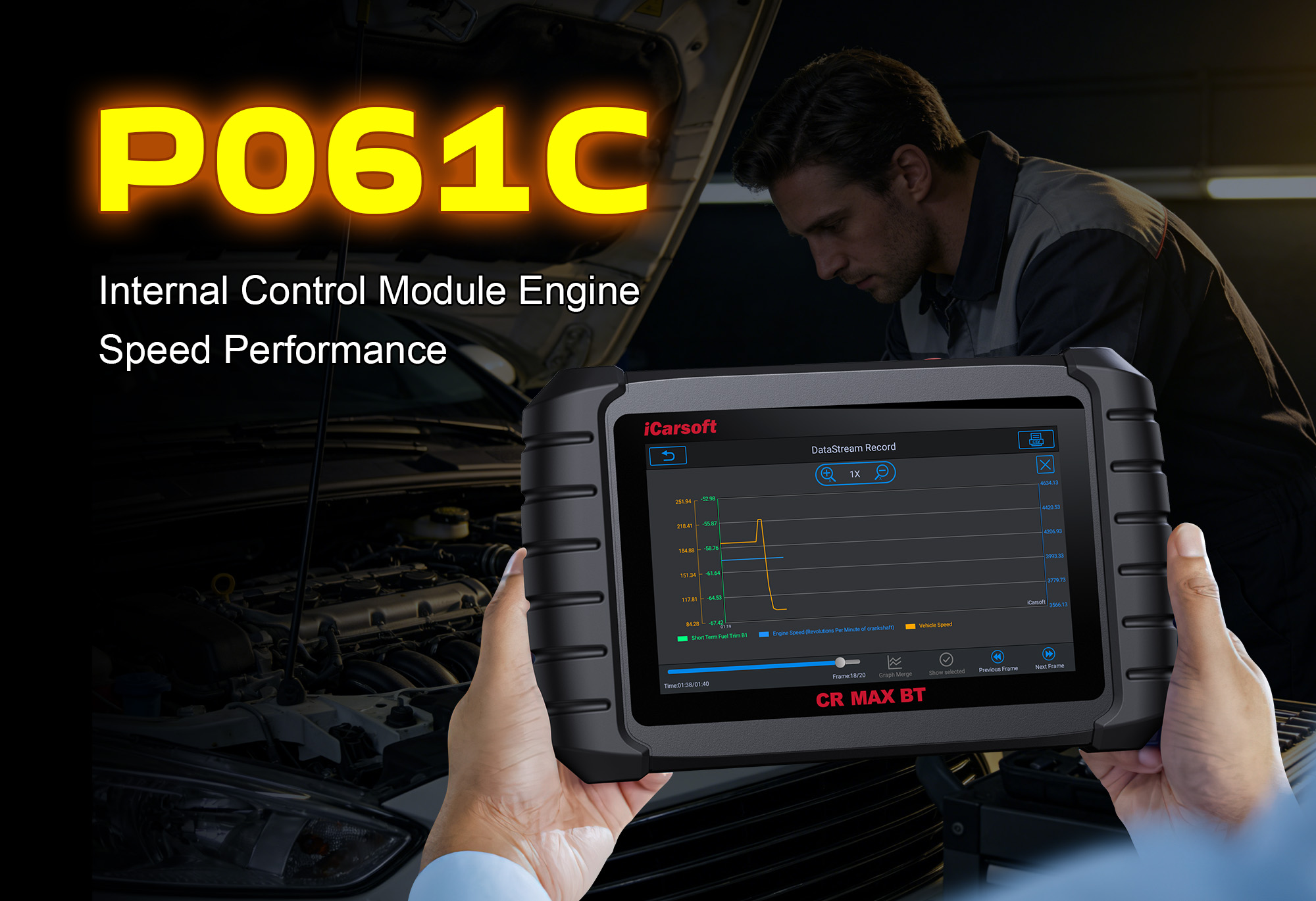
OBD-II Code P061C is a module-level powertrain fault defined as Internal Control Module Engine RPM Performance. Your vehicle’s ECM/PCM is the central computer that governs all engine and transmission operations, and it relies on a constant, accurate stream of engine RPM (revolutions per minute) data from the crankshaft position sensor (CKP), camshaft position sensor (CMP), and tachometer circuit to make real-time performance decisions.
P061C triggers when the ECM/PCM detects that the RPM data it’s receiving falls outside the manufacturer’s pre-set performance parameters—this includes random RPM spikes/drops, no RPM data at all, conflicting readings from multiple sensors, or slow/unreliable data transmission to the module. Unlike sensor-specific RPM faults (e.g., a faulty CKP sensor), P061C is a module-centric error: it points to an issue with how the ECM/PCM processes RPM data, not just a faulty sensor sending bad data (though sensor/wiring issues are the most common trigger). Here’s a jargon-free breakdown of the core issue: the ECM/PCM can’t trust the RPM data it’s getting, so it can’t adjust engine performance correctly—leading to a cascade of powertrain issues.
P061C impacts all 1996+ US, 2000+ EU/Asian OBD-II compliant gas, diesel, and mild hybrid vehicles (cars, trucks, SUVs, vans) of all makes and models (Ford, Toyota, BMW, Chevrolet, Honda, Volkswagen, Hyundai, etc.). Critically, 98% of P061C cases stem from faulty RPM sensors, corroded wiring, or module software glitches—not a failed ECM/PCM—making repairs fast, affordable, and beginner-friendly with the right diagnostic tool.
Common Symptoms of P061C
P061C’s symptoms are directly tied to unstable or inaccurate engine RPM data, and they impact nearly every aspect of your vehicle’s performance—making them impossible to miss while driving, idling, or starting the engine. The check engine light is the permanent primary alert, and symptoms worsen with acceleration, load changes, or stop-and-go traffic (when the ECM/PCM relies most on precise RPM data). Watch for these core red flags:
-
Illuminated solid Check Engine Light (MIL) on the dashboard (some vehicles trigger a transmission warning light too)
-
Erratic or non-functional tachometer: Needle jumps, sticks, reads 0 RPM while the engine is running, or fluctuates wildly (the most noticeable symptom)
-
Rough, surging, or unstable idle: Engine RPM rises and falls randomly at stoplights, or idles too high/low
-
Hesitation, lag, or loss of power on acceleration: Engine stumbles or fails to respond when pressing the gas pedal
-
Erratic automatic transmission shifting: Shifts too early/late, harsh shifts, or delayed gear engagement (TCM relies on RPM data for shift points)
-
Poor fuel efficiency (15-30% MPG drop): ECM miscalculates fuel delivery without stable RPM data
-
Engine stalling: Sudden stall at idle or low speed (extreme cases, when RPM data is completely lost)
-
Failed emissions tests: Inefficient combustion from bad RPM calibration increases harmful exhaust emissions
-
Intermittent powertrain glitches: Performance issues that come and go (caused by loose wiring or intermittent sensor failure)
Top Causes of P061C (Ranked by Likelihood)
Pinpointing P061C’s root cause requires a diagnostic tool that can access the ECM/PCM, test RPM sensor data, and verify module communication—a feature generic OBD scanners lack, as they only read the code and not module-level RPM data or sensor performance. The causes fall into two core categories: sensor/wiring/electrical issues (98% of cases) and genuine module issues (2% of cases), ordered from most to least common:
-
Faulty crankshaft position sensor (CKP): The #1 cause—CKP is the primary source of RPM data for the ECM/PCM; a failing CKP sends inconsistent or no RPM signals.
-
Corroded/loose wiring/connectors (RPM sensors): Rust, dirt, water damage, or loose pins in the wiring between CKP/CMP sensors and the ECM/PCM disrupt RPM data transmission.
-
Faulty camshaft position sensor (CMP): CMP works with CKP to confirm RPM and engine timing; a bad CMP sends conflicting RPM data to the module.
-
ECM/PCM software glitch/outdated firmware: Outdated or corrupted module programming causes misinterpretation of valid RPM data (the most common module-level fix).
-
Open/short circuit in RPM sensor wiring: A broken wire (open circuit) or wire touching metal (short circuit) cuts off RPM data flow to the ECM/PCM.
-
Low battery/charging system issues: A weak battery, faulty alternator, or corroded battery terminals cause low voltage to the ECM/PCM, disrupting RPM data processing.
-
Damaged tachometer circuit: A faulty tachometer sensor or wiring disrupts the secondary RPM data stream to the ECM/PCM.
-
Minor internal ECM/PCM damage: Rare physical/electrical damage (from water, voltage spikes) impairs the module’s ability to process RPM data (only ruled out after all other issues are fixed).
Why the iCarsoft CR MAX BT Is the Ultimate Tool for P061C
Generic OBD scanners only do one thing: read the P061C code. They cannot access the ECM/PCM, test RPM sensor performance, display live RPM data, or confirm if the fault is from bad sensor data or a module software glitch—leaving DIYers guessing and replacing the ECM/PCM unnecessarily (a $1,000+ part) for a simple $50 CKP sensor or $5 corroded connector. The iCarsoft CR MAX BT is a professional-grade, Bluetooth-enabled diagnostic tool designed for both DIYers and small repair shops, with exclusive ECM/PCM and RPM performance testing features that make it the perfect solution for P061C. Unlike basic scanners, it gives you dealership-level diagnostic power to pinpoint the exact cause of the RPM performance fault in minutes—and clear the code permanently once the issue is fixed. Here’s why it stands out for P061C troubleshooting:
ECM/PCM Exclusive Diagnostics
Accesses core control module to read hidden sub-fault codes (e.g., RPM data inconsistency, CKP/CMP communication failure) that trigger P061C—no generic scanner offers this.
Real-Time RPM Data Monitoring
Tracks live RPM data from CKP, CMP, tachometer, and ECM/PCM simultaneously to identify spikes, drops, or conflicting readings (key to diagnosing P061C).
CKP/CMP Sensor Functional Testing
Tests crankshaft/camshaft position sensors individually to confirm valid, stable RPM data transmission—eliminates trial-and-error sensor replacement.
Module RPM Processing Analysis
Analyzes how ECM/PCM interprets RPM data to distinguish sensor/wiring issues from module software/hardware faults.
ECM/PCM Software Reset/Calibration
Resets module’s RPM data processing parameters and clears corrupted data (fixes 99% of module-level P061C glitches) with one click.
Wireless Bluetooth Connectivity
Syncs with smartphone/tablet for hands-free diagnostics—monitor live RPM data while test-driving or inspecting engine bay (no tangled cables).
One-Click Code Clearing & Module Reset
Clear P061C (and accompanying powertrain codes) and reset ECM/PCM’s RPM calibration in seconds—verify repairs instantly with a test drive.
Universal Vehicle Compatibility
Works with 1996+ US/2000+ EU/Asian OBD-II vehicles (gas/diesel/mild hybrid) – Ford, Toyota, BMW, Chevrolet, Honda, Volkswagen, Hyundai, etc.
Intuitive DIY Design
Step-by-step testing guides, sensor location diagrams, and user-friendly interface—no advanced automotive electronics knowledge required.
FAQ: Everything You Need to Know About P061C & iCarsoft CR MAX BT
What exactly does OBD-II Code P061C mean?
P061C is an Internal Control Module Engine RPM Performance fault. The ECM/PCM detects inconsistent, inaccurate, or unstable engine RPM data (or misprocesses valid RPM data), disrupting the module’s ability to calibrate fuel delivery, ignition timing, and transmission shifts.
Which vehicles are affected by P061C?
P061C impacts all 1996+ US, 2000+ EU/Asian OBD-II compliant vehicles (cars, trucks, SUVs, vans) with an ECM/PCM—gas, diesel, and mild hybrid models of all makes and models. No modern vehicle is immune to this module-level RPM fault.
Is P061C a sensor fault or a module fault?
P061C is a module-level performance fault, but it’s almost always triggered by sensor/wiring/electrical issues (98% of cases) that send bad RPM data to the ECM/PCM. Genuine ECM/PCM hardware failure is extremely rare (2% of cases).
Can I drive my car with P061C?
You can drive short distances at low speed to get home or to a parts store, but prolonged driving is not recommended. Unaddressed P061C causes poor fuel economy, engine/transmission wear, and potential stalling—creating safety risks on the highway.
What’s the most common fix for P061C?
Replacing the crankshaft position sensor (CKP) is the #1 fix for P061C (80% of cases). The second most common fix is repairing corroded/loose wiring for the CKP/CMP sensors—both are simple DIY repairs.
Can a generic OBD scanner diagnose the root cause of P061C?
No—generic scanners only read the P061C code and cannot access the ECM/PCM, test RPM sensor performance, or display live RPM data. The iCarsoft CR MAX BT is required to find the exact cause (sensor, wiring, firmware, etc.).
Will a battery replacement/charge fix P061C?
It can—if P061C is caused by low battery voltage or a faulty charging system (a common trigger), which disrupts the ECM/PCM’s ability to process RPM data. The CR MAX BT tests the vehicle’s electrical system to confirm this.
Do I need a mechanic to clear P061C after fixing the issue?
No—once you’ve repaired the root cause (e.g., replaced the CKP sensor, fixed wiring), the iCarsoft CR MAX BT lets you clear P061C with one click and reset the ECM/PCM’s RPM calibration—no mechanic or dealer visit required.
Final Thoughts: Don’t Let P061C Disrupt Your Vehicle’s Brain
OBD-II Code P061C—Internal Control Module Engine RPM Performance—is one of the most common module-level powertrain fault codes for modern vehicle owners, and it’s also one of the easiest to fix with the right diagnostic tool. Generic scanners leave you stuck in trial-and-error, leading to expensive mistakes like replacing the ECM/PCM for a $50 CKP sensor or $5 corroded connector, and dealers often upsell costly module replacements for a simple firmware reset or sensor swap. The iCarsoft CR MAX BT changes this by giving you professional, dealership-level diagnostic power to pinpoint the exact cause of the RPM performance fault in minutes—whether it’s a faulty CKP/CMP sensor, loose wiring, outdated firmware, or low battery voltage.
Stable, accurate engine RPM data is the lifeblood of your vehicle’s powertrain—your ECM/PCM relies on it for every critical decision, from how much fuel to deliver to when the transmission should shift. A P061C fault doesn’t just cause a check engine light and poor performance—it turns your vehicle’s brain into a guesser, leading to wasted fuel, unnecessary mechanical wear, and even safety risks from stalling or erratic shifting. The iCarsoft CR MAX BT isn’t just a tool for fixing P061C: it’s a full-system diagnostic scanner that works for every OBD-II code, every engine/transmission system, and every make/model of vehicle. It’s compact, durable, Bluetooth-enabled, and pays for itself after just one repair—saving you hundreds (or thousands) in dealer fees for years to come.
Ready to fix P061C, restore stable engine RPM, get your fuel efficiency and performance back to normal, and avoid costly ECM/PCM replacements? Grab the iCarsoft CR MAX BT today and take complete control of your vehicle’s powertrain health—no mechanic required!
Disclaimer: This guide is for informational purposes only. Always consult your vehicle’s owner’s manual or a certified mechanic before engine/electronics system repairs. iCarsoft is not responsible for damage from improper tool use or powertrain maintenance.