OBD-II Code P0560: System Voltage Malfunction – Diagnose & Fix with iCarsoft CR MAX BT
If your check engine light illuminates, your vehicle’s electrical components act erratically, your battery dies unexpectedly, or your engine struggles to start and stall at idle, OBD-II Code P0560—System Voltage Malfunction—is the critical issue you’re facing. This fault means your vehicle’s Engine Control Module (ECM) or Powertrain Control Module (PCM) has detected an abnormal voltage level in the vehicle’s main electrical system (12V charging/battery system)—either too high (overcharging) or too low (undercharging). Your car’s entire powertrain, electrical, and onboard computer systems rely on a stable 12.6V (battery) and 13.5–14.5V (charging) voltage supply; a P0560 malfunction disrupts every electrical function, from the ignition and fuel system to the radio, lights, and ECM itself. Left unaddressed, P0560 leads to dead batteries, failed alternators, fried electrical components, and even complete engine shutdown—but you don’t need to pay steep dealer electrical diagnostics fees for a fixable issue. This complete guide breaks down everything you need to know about P0560, from its core causes and symptoms to why the iCarsoft CR MAX BT is the DIYer’s ultimate professional diagnostic tool to detect, troubleshoot, and permanently clear this code with precision—no advanced electrical or mechanical skills required.
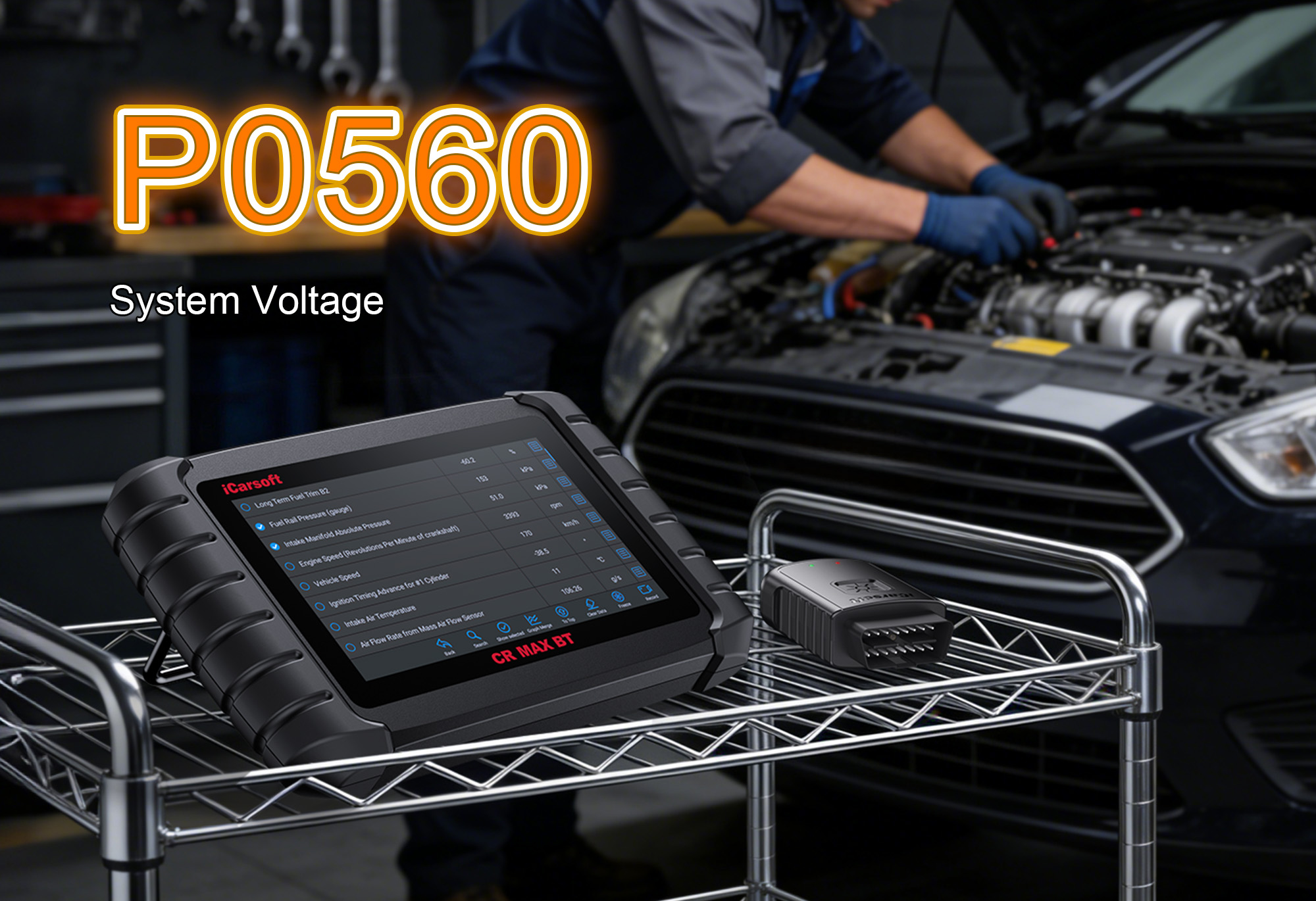
What Is OBD-II Code P0560?
OBD-II Code P0560 is a universal electrical system fault defined as System Voltage Malfunction. All modern 1996+ OBD-II compliant vehicles (gas, diesel, mild hybrid) rely on a 12V lead-acid battery and an alternator to power the electrical system and recharge the battery while the engine is running. The ECM/PCM continuously monitors the system’s voltage in real time, with strict manufacturer-set parameters:
-
Static battery voltage: 12.4–12.7V (engine off)
-
Charging voltage: 13.5–14.5V (engine running, alternator active)
P0560 triggers when the ECM/PCM detects that the system voltage falls outside this normal range for a sustained period—either dropping below 12V (undercharging) or spiking above 15V (overcharging). Unlike battery or alternator-specific codes (e.g., P0620, alternator control circuit), P0560 is a general system voltage fault: it alerts you to abnormal voltage but does not specify the root cause (battery, alternator, wiring, etc.). This makes it a common code across all makes and models (Ford, Toyota, BMW, Chevrolet, Honda, Volkswagen, Hyundai, Ram, etc.), and critically, 99% of P0560 cases stem from a faulty battery, failing alternator, or corroded wiring—not a failed ECM/PCM—making repairs fast, affordable, and beginner-friendly with the right diagnostic tool.
A system voltage malfunction is not just an electrical nuisance: your vehicle’s ECM/PCM, sensors, and control modules cannot operate correctly with unstable voltage. Undercharging leads to a drained battery and loss of power to critical systems, while overcharging cooks the battery and fries sensitive electronics (e.g., O2 sensors, infotainment systems, even the ECM itself). P0560 is a warning sign of an impending electrical failure, and addressing it early saves you from costly replacement parts down the line.
Common Symptoms of P0560
P0560’s symptoms are all electrical in nature and range from mild to severe, depending on whether the system is undercharging or overcharging. The check engine light is the first and most consistent alert, and symptoms will worsen as the voltage issue progresses—eventually leading to a dead battery or complete electrical failure. Both undercharging (low voltage) and overcharging (high voltage) trigger P0560, and you may experience a mix of these core red flags:
-
Illuminated solid Check Engine Light (MIL) on the dashboard (may be accompanied by a battery/charging system warning light)
-
Dimming or flickering interior/exterior lights: Headlights, taillights, or dash lights fade when the engine is idle or brighten when revving (classic undercharging sign)
-
Weak or slow engine cranking: Battery struggles to start the engine, or the engine turns over sluggishly (undercharging)
-
Unexpected battery death: Battery dies overnight or after short drives, even after a jump start (undercharging)
-
Electrical component malfunctions: Radio cuts out, power windows/locks work slowly, infotainment system freezes, or dashboard gauges act erratically
-
Engine stalling or rough idle: ECM loses power or misprocesses sensor data due to unstable voltage, causing stalling at idle or low speed
-
Burning smell from the engine bay: A hot, overcharging alternator or swollen battery emits a sulfur/rotten egg smell (overcharging)
-
Swollen/bulging car battery: Battery case expands from overcharging (a dangerous sign that the battery may leak or fail)
-
Loss of power accessories: Air conditioning, heated seats, or other power-hungry accessories stop working or operate poorly
-
Intermittent powertrain glitches: Hesitation on acceleration, misfires, or erratic shifting (ECM cannot calibrate performance with unstable voltage)
Top Causes of P0560 (Ranked by Likelihood)
Pinpointing P0560’s root cause requires a diagnostic tool that can monitor live system voltage and test the charging/battery system—a feature generic OBD scanners lack, as they only read the code and not real-time electrical data. P0560 is exclusively tied to the vehicle’s 12V charging/battery system and wiring, and the causes are ordered from most to least common (the first five account for 99% of all P0560 cases):
-
Faulty car battery: The #1 cause—a worn, old, or damaged battery (3+ years old) cannot hold a charge, leading to undercharging and low system voltage.
-
Failing alternator/alternator voltage regulator: The alternator recharges the battery; a failing alternator (or its internal voltage regulator) causes undercharging (no power) or overcharging (too much power).
-
Corroded/loose battery terminals/cables: Rust, dirt, or loose connections at the positive/negative battery terminals create high resistance, disrupting voltage flow (the most common easy fix for P0560).
-
Damaged/frayed wiring in the charging system: Broken, shorted, or frayed wires between the battery, alternator, and ECM cause voltage drops or spikes.
-
Loose alternator belt: A slipping or loose serpentine belt fails to spin the alternator properly, preventing it from recharging the battery (undercharging).
-
Faulty alternator fuse/relay: A blown fuse or failed relay in the alternator control circuit cuts power to the alternator, leading to undercharging.
-
Corroded ground straps: A bad engine/frame ground strap disrupts the electrical system’s ground connection, causing unstable voltage.
-
ECM/PCM software glitch: Extremely rare—outdated module firmware misreads system voltage data (easily fixed with a reset via the iCarsoft CR MAX BT).
Why the iCarsoft CR MAX BT Is the Ultimate Tool for P0560
Generic OBD scanners only do one thing for P0560: read the code. They cannot monitor live system voltage, test the alternator’s charging output, or check the battery’s health—leaving DIYers guessing and replacing parts unnecessarily (e.g., a $300 alternator for a $5 battery terminal cleaning). The iCarsoft CR MAX BT is a Bluetooth-enabled, professional-grade diagnostic tool optimized for automotive electrical system diagnostics, with exclusive charging/battery system testing features that make it the only tool you need to fix P0560 for good. Unlike basic scanners, it gives you dealership-level electrical diagnostic power to pinpoint the exact cause of the system voltage malfunction in minutes—and clear the code permanently once the issue is fixed. Here’s why it stands out for P0560 troubleshooting:
Real-Time System Voltage Monitoring
Tracks live battery/charging voltage (engine off/on) in real time—instantly shows undercharging/overcharging (the single most critical feature for P0560).
Battery Health Testing
Runs comprehensive battery load test to check capacity, cranking power, and charge-holding ability—confirms if faulty battery is the root cause.
Alternator Charging Output Testing
Measures alternator’s exact charging voltage/current output to verify 13.5–14.5V range—identifies failing alternators/regulators (no trial-and-error replacement).
Charging System Circuit Diagnostics
Tests battery terminals/cables/alternator wiring for high resistance/corrosion/open/short circuits—finds hidden wiring issues generic scanners miss.
Fuse/Relay Electrical Testing
Scans fuse/relay panels to detect blown alternator fuses/failed relays (an often-missed cause of undercharging).
Wireless Bluetooth Connectivity
Syncs with smartphone/tablet for hands-free diagnostics—monitor live voltage while revving engine/inspecting battery/alternator (no tangled cables).
One-Click Code Clearing & ECM/PCM Reset
Clear P0560 and reset ECM/PCM electrical calibration in seconds—verify repairs with instant live voltage test drive.
Universal Vehicle Compatibility
Works with 1996+ US/2000+ EU/Asian OBD-II vehicles (gas/diesel/mild hybrid)—all makes/models (cars, trucks, SUVs, vans).
Intuitive Electrical Diagnostic Guides
Step-by-step charging system workflows, battery/alternator diagrams, corrosion repair tips—no advanced electrical knowledge needed.
FAQ: Everything You Need to Know About P0560 & iCarsoft CR MAX BT
What exactly does OBD-II Code P0560 mean?
P0560 is a System Voltage Malfunction fault. The ECM/PCM detects that the vehicle’s 12V electrical system voltage is outside the normal range (12.4–14.5V)—either too low (undercharging) or too high (overcharging).
Which vehicles are affected by P0560?
P0560 is a universal OBD-II code that impacts all 1996+ US, 2000+ EU/Asian OBD-II compliant vehicles (cars, trucks, SUVs, vans) with a 12V battery/alternator system—gas, diesel, and mild hybrid models of all makes and models.
Is P0560 a battery issue or an alternator issue?
P0560 can be either (or both). It’s a general voltage fault that alerts you to abnormal voltage, but the root cause is almost always a faulty battery, failing alternator, or corroded wiring. The iCarsoft CR MAX BT tests both to confirm the issue.
Can I drive my car with P0560?
You can drive short distances at low speed to get home or to a parts store, but prolonged driving is not recommended. Undercharging will drain the battery and leave you stranded, while overcharging will fry sensitive electrical components (including the ECM).
What’s the cheapest and most common fix for P0560?
Cleaning corroded/loose battery terminals (cost: $0–$10) is the most common easy fix for P0560. The second most common fix is replacing a worn battery (cost: $100–$200)—both are simple DIY repairs.
Can a generic OBD scanner diagnose the root cause of P0560?
No—generic scanners only read the P0560 code and cannot monitor live system voltage, test the battery/alternator, or check for corroded wiring. The iCarsoft CR MAX BT is required to find the exact cause.
Will a jump start fix P0560?
A jump start will temporarily start the engine if the battery is dead (undercharging), but it will not fix the root cause of P0560 (faulty battery, alternator, etc.). The code will return until the underlying voltage issue is repaired.
Do I need a mechanic to clear P0560 after fixing the issue?
No—once you’ve repaired the root cause (e.g., cleaned battery terminals, replaced the battery/alternator), the iCarsoft CR MAX BT lets you clear P0560 with one click and reset the ECM/PCM’s electrical system calibration—no mechanic or dealer visit required.
Final Thoughts: Don’t Let P0560 Fry Your Electrical System
OBD-II Code P0560—System Voltage Malfunction—is one of the most common and easiest electrical codes to fix for DIYers, but it’s also one of the most dangerous to ignore. Generic scanners leave you stuck in trial-and-error, leading to expensive mistakes like replacing a brand-new alternator for a simple battery terminal cleaning, and dealers often upsell costly charging system services for a $5 wire brush repair. The iCarsoft CR MAX BT changes this by giving you professional, dealership-level electrical diagnostic power to pinpoint the exact cause of the system voltage malfunction in minutes—whether it’s a corroded terminal, faulty battery, failing alternator, or loose wiring.
A stable 12V electrical system is the backbone of your vehicle’s entire operation—every sensor, computer, and electrical component relies on consistent voltage to work correctly. P0560 is not just a check engine light: it’s a warning that your battery or alternator is failing, and ignoring it will lead to stranded drives, fried electronics, and thousands in costly repairs. The iCarsoft CR MAX BT isn’t just a tool for fixing P0560: it’s a full-system diagnostic scanner that works for every OBD-II code, every engine/electrical system, and every make/model of vehicle. It’s compact, Bluetooth-enabled, durable, and pays for itself after just one repair—saving you hundreds (or thousands) in dealer fees for years to come.
Ready to fix P0560, restore a stable 12V electrical system, avoid dead batteries and fried electronics, and get your vehicle’s electrical and powertrain performance back to factory specs? Grab the iCarsoft CR MAX BT today and take complete control of your vehicle’s electrical system health—no mechanic required!
Disclaimer: This guide is for informational purposes only. Always consult your vehicle’s owner’s manual or a certified mechanic before electrical system repairs. iCarsoft is not responsible for damage from improper tool use or battery/alternator maintenance.