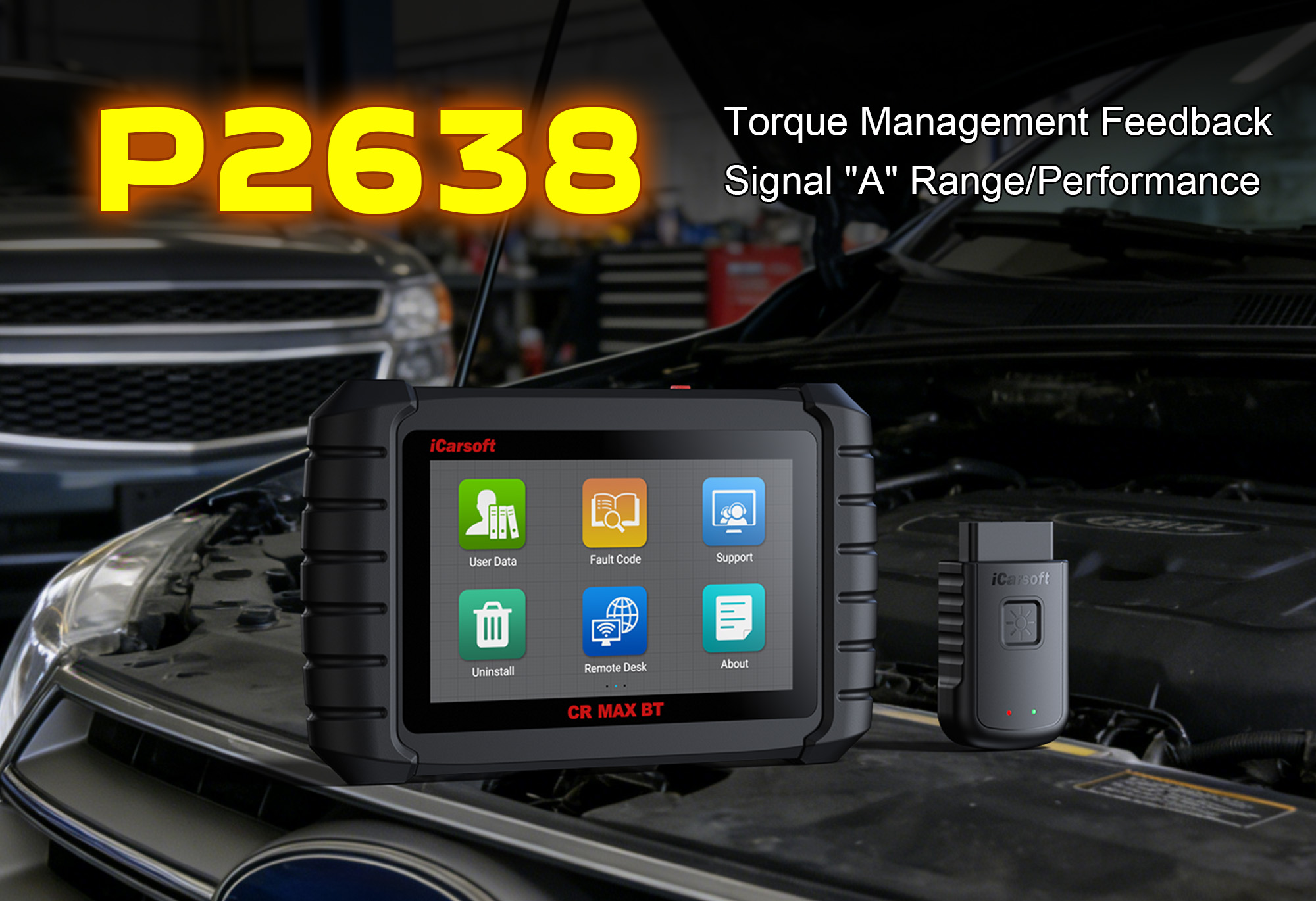
OBD-II Code P2638: Torque Management Feedback Signal 'A' Range/Performance – Fix with iCarsoft CR MAX BT
If your check engine light blinks on, your vehicle loses power during acceleration, your transmission shifts erratically, or you notice reduced throttle response, OBD-II Code P2638—Torque Management Feedback Signal 'A' Range/Performance—is the critical powertrain fault you’re facing. This code flags a malfunction in your vehicle’s torque management system, a core component that balances engine torque, transmission load, and drivetrain performance to protect vital components and ensure smooth operation. The Engine Control Module (ECM) and Transmission Control Module (TCM) rely on accurate feedback from Signal 'A' (a key torque sensor/ circuit) to adjust torque output, shift timing, and throttle response; out-of-range or erratic signal data disrupts the entire torque management system. Left unaddressed, P2638 leads to excessive drivetrain wear, poor fuel efficiency, and even permanent engine/transmission damage—but you don’t need to pay steep dealer powertrain diagnostics fees for a fixable sensor or wiring issue. This complete guide breaks down everything you need to know about P2638, from its core causes and symptoms to why the iCarsoft CR MAX BT is the DIYer’s ultimate professional diagnostic tool to detect, troubleshoot, and permanently clear this code with precision—no advanced mechanical or electrical skills required.
What Is OBD-II Code P2638?
OBD-II Code P2638 is a powertrain-specific fault defined as Torque Management Feedback Signal 'A' Range/Performance. Modern vehicles use a sophisticated torque management system to regulate engine torque output and match it to transmission load, drivetrain capacity, and driving conditions—preventing damage to the transmission, clutch, differential, and other drivetrain parts. Signal 'A' is the primary feedback circuit/sensor that sends real-time torque data from the engine/transmission to the ECM and TCM, acting as the “communication link” for the torque management system.
The ECM and TCM are programmed with strict manufacturer-set range parameters for Signal 'A’'s feedback data. P2638 triggers when these modules detect that the signal’s readings fall outside this normal operating range (too high, too low, or fluctuating erratically) for a sustained period, or when the signal’s performance is inconsistent (e.g., slow response to torque changes, intermittent data drops). Unlike circuit-specific torque management codes (e.g., P2639, Signal 'B' fault), P2638 is a Range/Performance fault for the primary Signal 'A': it means the circuit/sensor has power and basic communication but is sending inaccurate torque feedback—not a complete electrical failure.
This code impacts all 1996+ US, 2000+ EU/Asian OBD-II compliant gas, diesel, and mild hybrid vehicles (Ford, Toyota, BMW, Chevrolet, Honda, Volkswagen, Hyundai, Ram, etc.)—cars, trucks, SUVs, and vans with automatic, manual, or DCT transmissions. Critically, 98% of P2638 cases stem from a faulty torque sensor, corroded wiring, or a dirty throttle body—not a failed ECM/TCM or total drivetrain breakdown—making repairs fast, affordable, and beginner-friendly with the right diagnostic tool. A faulty Signal 'A' doesn’t just cause poor performance: it forces the ECM/TCM to default to a “safe mode” with reduced torque output, leading to sluggish acceleration and unnecessary drivetrain stress.
Common Symptoms of P2638
P2638’s symptoms are directly tied to torque management system malfunction and are most noticeable during acceleration, hard throttle, or transmission shifting—when the ECM/TCM relies most on accurate Signal 'A' feedback. The check engine light is the primary alert, and symptoms will worsen rapidly if the fault is unaddressed, often leading to a reduced power “limp mode” to protect the powertrain. Some symptoms may be intermittent (caused by loose wiring) but will become persistent as the issue progresses. Watch for these core red flags:
-
Illuminated solid or flashing Check Engine Light (MIL) on the dashboard
-
Reduced engine power/throttle response: Sluggish acceleration, even with heavy throttle input (the most common symptom)
-
Erratic transmission shifting: Harsh upshifts/downshifts, delayed gear engagement, or shifting at incorrect RPMs
-
Engine hesitation or bogging: Engine stumbles when accelerating from a stop or during highway passing
-
Powertrain “safe mode”/limp mode: Vehicle limits torque output to a low level, preventing hard acceleration
-
Poor fuel efficiency: ECM miscalculates fuel delivery due to inaccurate torque data (10-25% MPG drop)
-
Intermittent power surges: Sudden brief bursts of power during steady acceleration (from erratic signal data)
-
Transmission slipping: Clutch/gear slippage under load (TCM can’t adjust load to match torque output)
-
Drivetrain vibration: Vibration from the engine/transmission bay under acceleration (misaligned torque/load balance)
-
Loss of cruise control functionality: Cruise control cuts out or fails to engage (relies on stable torque feedback)
Top Causes of P2638 (Ranked by Likelihood)
Pinpointing P2638’s root cause requires a diagnostic tool that can monitor live Torque Management Feedback Signal 'A' data and test the sensor/circuit performance—a feature generic OBD scanners lack, as they only read the code and not powertrain-specific torque data. P2638 is directly tied to Signal 'A’'s sensor, wiring, or the components that feed it torque data, and the causes are ordered from most to least common (the first four account for 98% of all P2638 cases):
-
Faulty Torque Management Feedback Sensor (Signal 'A'): The #1 cause—a worn, damaged, or contaminated primary torque sensor loses its ability to measure torque accurately, sending out-of-range feedback to the ECM/TCM.
-
Corroded/loose wiring/connectors (Signal 'A' circuit): Rust, dirt, water damage, or loose pins in the sensor’s electrical connector/wiring cause inconsistent communication and erratic signal data.
-
Dirty/clogged throttle body or throttle position sensor (TPS): A dirty throttle body or faulty TPS sends inaccurate engine load data to the torque management system, skewing Signal 'A' feedback.
-
Faulty transmission torque converter clutch (TCC) sensor: The TCC sensor provides load data to Signal 'A'; a failing sensor disrupts torque feedback and triggers the range fault.
-
Open/short circuit in the Signal 'A' wiring harness: A frayed, broken, or shorted wire in the harness cuts off or distorts torque signal data to the ECM/TCM.
-
Low engine oil pressure or dirty transmission fluid: Reduced fluid pressure disrupts powertrain component operation, leading to inaccurate torque/load measurements for Signal 'A'.
-
ECM/TCM calibration mismatch: A minor misalignment between the ECM and TCM (from unupdated firmware) causes misinterpretation of valid Signal 'A' data.
-
Minor internal transmission/engine wear: Rare—slight wear on clutch packs or engine components causes abnormal torque output (severe wear triggers other powertrain codes).
Why the iCarsoft CR MAX BT Is the Ultimate Tool for P2638
Generic OBD scanners only do one thing for P2638: read the code. They cannot monitor live Torque Management Feedback Signal 'A' data, test the sensor’s performance, or access the ECM/TCM’s hidden torque management fault data—leaving DIYers guessing and replacing expensive parts unnecessarily (e.g., a $1,500 torque converter for a $70 signal sensor). The iCarsoft CR MAX BT is a Bluetooth-enabled, professional-grade diagnostic tool optimized for powertrain and torque management system diagnostics—including Signal 'A' testing—with exclusive ECM/TCM and torque feedback features that make it the only tool you need to fix P2638 for good. Unlike basic scanners, it gives you dealership-level powertrain diagnostic power to pinpoint the exact cause of the Signal 'A' range/performance fault in minutes—and clear the code permanently once the issue is fixed. Here’s why it stands out for P2638 troubleshooting:
Real-Time Signal 'A' Feedback Monitoring
Tracks live Torque Management Feedback Signal 'A' data in real time—instantly shows high/low/fluctuating readings (the single most critical feature for P2638).
Signal 'A' Sensor Performance Testing
Runs comprehensive test of sensor response time/accuracy/range to confirm if it’s the root cause—no disassembly or multimeter required.
ECM/TCM Dual Module Diagnostics
Accesses both ECM and TCM to read hidden sub-fault codes/torque management performance data that trigger P2638—a feature no generic scanner offers.
Throttle Body/TPS Calibration & Testing
Tests throttle position sensor and provides guided throttle body cleaning/calibration (a top P2638 trigger) for all makes/models.
Wiring/Circuit Electrical Testing
Tests Signal 'A' circuit for corrosion/low voltage/open/short circuits/intermittent connectivity—finds hidden wiring issues generic scanners miss.
ECM/TCM Sync & Calibration
Resets and syncs ECM/TCM torque management parameters post-repair—ensures accurate torque feedback and smooth powertrain operation.
Wireless Bluetooth Connectivity
Syncs with smartphone/tablet for hands-free diagnostics—monitor Signal 'A' data while test-driving/inspecting engine/transmission bay (no tangled cables).
One-Click Code Clearing & Powertrain Reset
Clears P2638 and accompanying powertrain codes in seconds—verify repair with instant live torque feedback test.
Universal Vehicle Compatibility
Works with 1996+ US/2000+ EU/Asian OBD-II gas/diesel/mild hybrid vehicles—all makes/models, all transmission types (automatic/manual/DCT/CVT).
Intuitive Torque Management Diagnostic Guides
Step-by-step sensor testing workflows, Signal 'A' sensor location diagrams, throttle body cleaning tips—no advanced powertrain knowledge needed.
FAQ: Everything You Need to Know About P2638 & iCarsoft CR MAX BT
What exactly does OBD-II Code P2638 mean?
P2638 is Torque Management Feedback Signal 'A' Range/Performance. The ECM/TCM detect that the primary torque feedback signal’s readings are outside the manufacturer’s normal range, or the signal’s performance is inconsistent (erratic, slow response).
Which vehicles are affected by P2638?
P2638 impacts all 1996+ US, 2000+ EU/Asian OBD-II compliant vehicles (cars, trucks, SUVs, vans) with a torque management system—gas, diesel, mild hybrid models, all transmission types (automatic, manual, DCT/CVT).
Is P2638 a serious powertrain fault?
It’s a critical warning sign—not an immediate total failure. Ignoring P2638 leads to excessive drivetrain wear, reduced power, and eventual engine/transmission damage, but fixing it early (sensor/wiring/throttle body) is a simple, affordable repair.
Can I drive my car with P2638?
You can drive short distances at low speed to get home or to a parts store, but avoid hard acceleration, highway passing, and heavy loads. The vehicle may go into limp mode, and continued driving causes unnecessary powertrain stress.
What’s the cheapest and most common fix for P2638?
Replacing the Torque Management Feedback Signal 'A' sensor (cost: $60–$80) is the #1 fix for P2638. The second most common fix is cleaning the throttle body/TPS (cost: $0–$10)—both are simple DIY repairs for most vehicles.
Can a generic OBD scanner diagnose the root cause of P2638?
No—generic scanners only read the P2638 code and cannot monitor live Signal 'A' data, test the torque sensor, or access the ECM/TCM’s torque management data. The iCarsoft CR MAX BT is required to find the exact cause.
Will cleaning the throttle body fix P2638?
It can—if P2638 is caused by a dirty throttle body or faulty TPS (a top trigger) that sends inaccurate engine load data to Signal 'A'. The CR MAX BT will confirm if the throttle body is the issue before you replace the sensor.
Do I need a mechanic to clear P2638 after fixing the issue?
No—once you’ve repaired the root cause (e.g., replaced the sensor, cleaned the throttle body), the iCarsoft CR MAX BT lets you clear P2638 with one click and reset the ECM/TCM’s torque management calibration—no mechanic or dealer visit required.
Final Thoughts: Don’t Let P2638 Rob Your Vehicle of Power
OBD-II Code P2638—Torque Management Feedback Signal 'A' Range/Performance—is one of the most common powertrain fault codes for modern vehicles, and it’s also one of the easiest to fix early with the right diagnostic tool. Generic scanners leave you stuck in trial-and-error, leading to expensive mistakes like replacing a torque converter for a $70 signal sensor, and dealers often upsell costly powertrain rebuilds for a simple throttle body cleaning or sensor swap. The iCarsoft CR MAX BT changes this by giving you professional, dealership-level powertrain diagnostic power to pinpoint the exact cause of the Signal 'A' range fault in minutes—whether it’s a faulty sensor, corroded wiring, a dirty throttle body, or a bad TCC sensor.
Accurate Torque Management Feedback Signal 'A' data is the lifeblood of a smooth, powerful powertrain—your ECM and TCM cannot balance engine torque and transmission load without it, and incorrect signal data leads to reduced performance and unnecessary wear on vital drivetrain components. P2638 is not just a check engine light: it’s your vehicle’s way of warning you that the torque management system is out of sync, and addressing it early saves you from a $2,000+ powertrain repair or replacement. The iCarsoft CR MAX BT isn’t just a tool for fixing P2638: it’s a full-system diagnostic scanner that works for every OBD-II code, every engine/transmission/drivetrain system, and every make/model of vehicle. It’s compact, Bluetooth-enabled, durable, and pays for itself after just one repair—saving you hundreds (or thousands) in dealer fees for years to come.
Ready to fix P2638, restore full throttle response and torque output, protect your powertrain from costly wear, and get your vehicle’s performance back to factory specs? Grab the iCarsoft CR MAX BT today and take complete control of your vehicle’s powertrain health—no mechanic required!
Disclaimer: This guide is for informational purposes only. Always consult your vehicle’s owner’s manual or a certified mechanic before powertrain system repairs. iCarsoft is not responsible for damage from improper tool use or torque management system maintenance.