OBD-II Code P0139: O2 Sensor Circuit Slow Response (Bank 1, Sensor 2) – Fix with iCarsoft CR Eagle
If your check engine light illuminates, your vehicle fails an emissions test, or you notice decreased fuel efficiency and rough idle, OBD-II Code P0139—O2 Sensor Circuit Slow Response (Bank 1, Sensor 2)—is the critical emissions and fuel system fault demanding your attention. This code flags a delayed response from the downstream oxygen (O2) sensor in Bank 1, a key component that monitors exhaust gas oxygen levels post-catalytic converter to verify emissions efficiency. The Engine Control Module (ECM) relies on fast, accurate feedback from this sensor to fine-tune air-fuel ratios; a slow response disrupts this calibration, leading to wasted fuel, increased emissions, and potential catalytic converter damage. Left unaddressed, P0139 causes persistent check engine lights, failed emissions tests, and long-term engine wear—but you don’t need to pay steep dealer diagnostics fees for a fixable sensor, wiring, or exhaust issue. This complete guide breaks down everything you need to know about P0139, from its core causes and telltale symptoms to why the iCarsoft CR Eagle is the DIYer’s ultimate professional diagnostic tool to detect, troubleshoot, and permanently clear this code with precision—no advanced mechanical or electrical skills required.
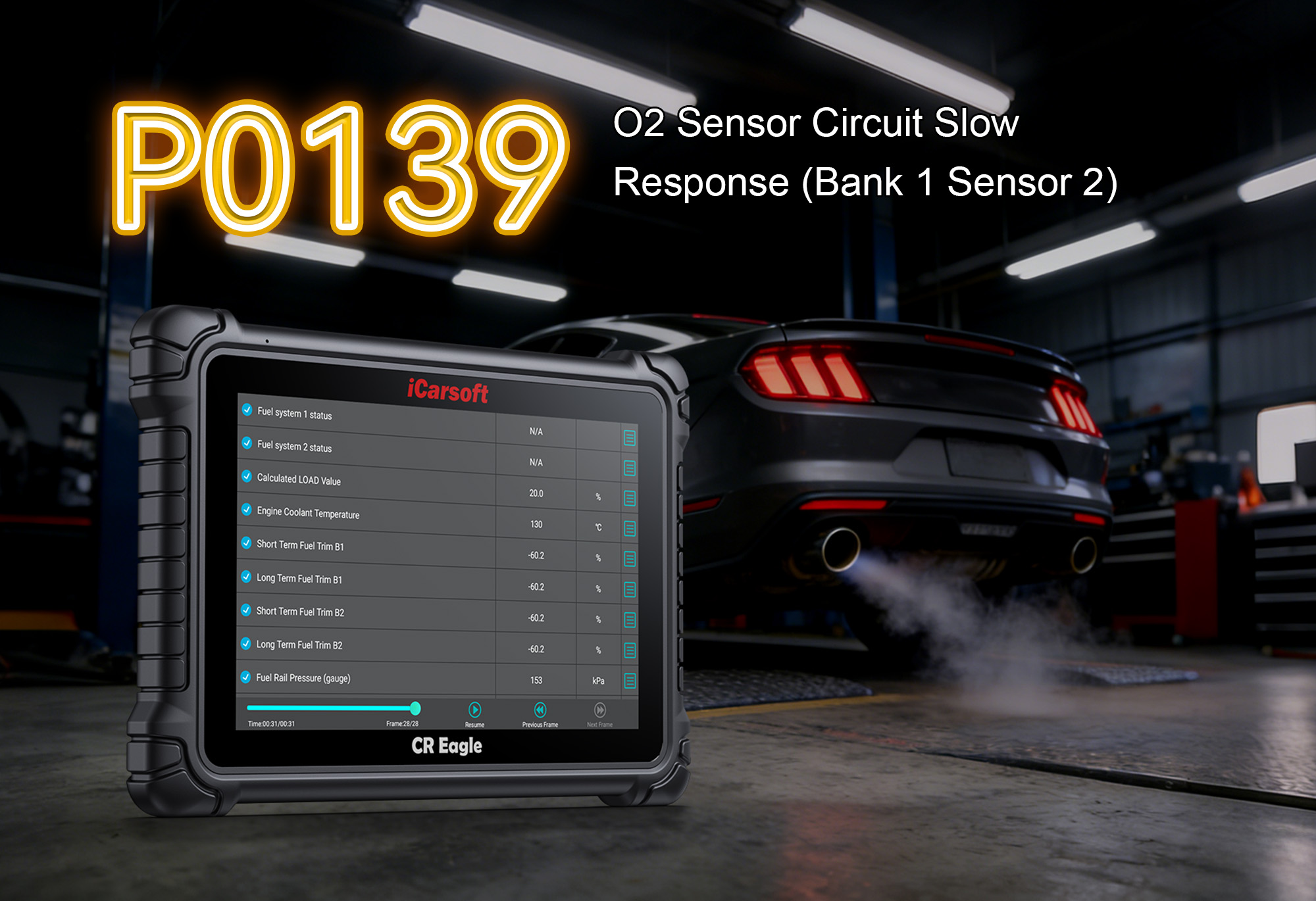
What Is OBD-II Code P0139?
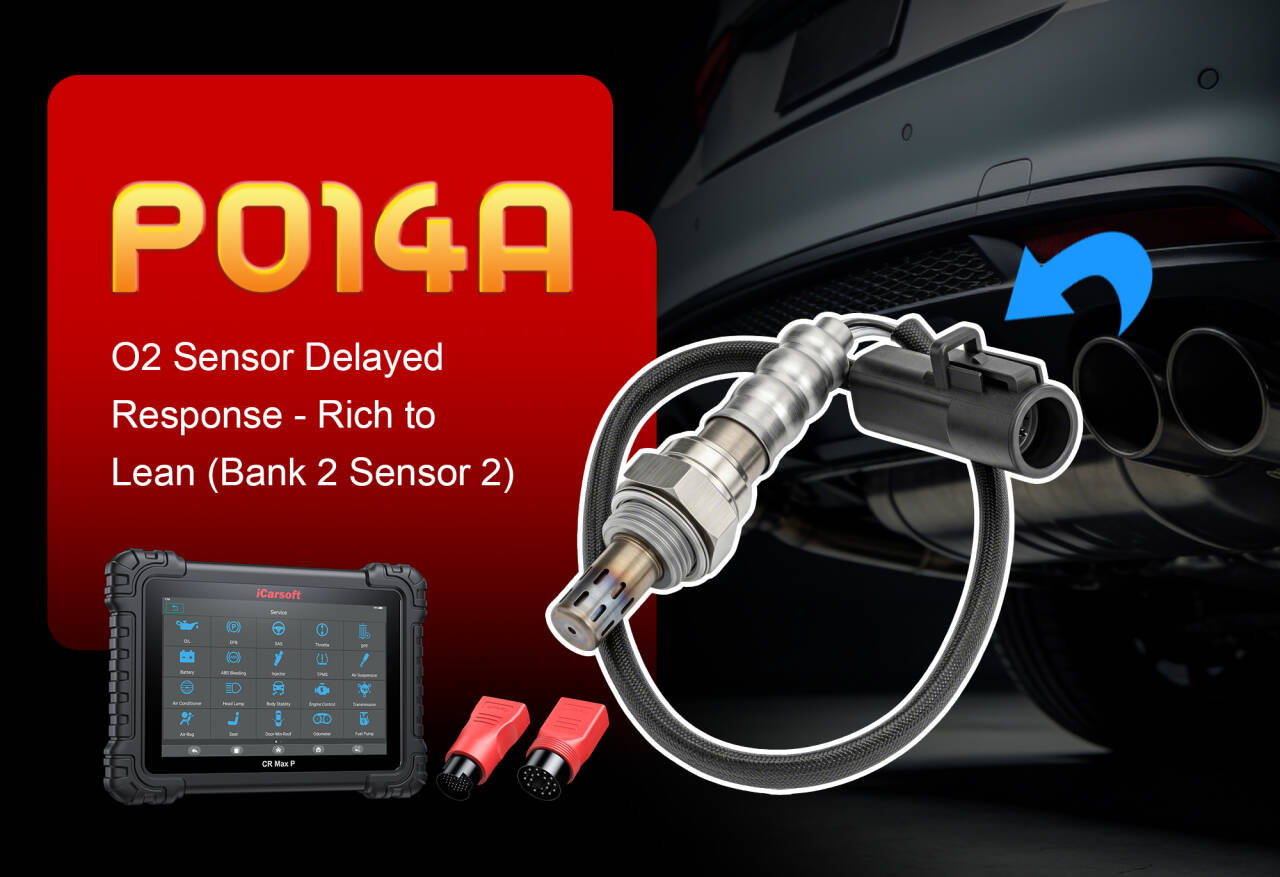
OBD-II Code P0139 is an emissions and fuel system-specific fault defined as O2 Sensor Circuit Slow Response (Bank 1, Sensor 2). To understand this code, it’s critical to decode the sensor’s location:
-
Bank 1: The engine bank containing the number 1 cylinder (varies by make/model, but typically the driver’s side in V6/V8 engines, or the only bank in inline-4 engines).
-
Sensor 2: The downstream O2 sensor—mounted after the catalytic converter (unlike the upstream Sensor 1, which sits before the cat to monitor raw exhaust).
The downstream O2 sensor’s primary job is to confirm the catalytic converter is reducing harmful emissions (HC, CO, NOx) by comparing its oxygen readings to the upstream sensor. A healthy O2 sensor switches between lean (high oxygen) and rich (low oxygen) readings rapidly (0.1–0.9V) in response to exhaust gas changes. P0139 triggers when the ECM detects that the Bank 1, Sensor 2 circuit’s response time is slower than the manufacturer’s threshold (typically >1–2 seconds to switch between lean/rich). This delay means the sensor can’t provide real-time feedback, leaving the ECM unable to adjust air-fuel ratios effectively or verify catalytic converter performance.
P0139 impacts all 1996+ US, 2000+ EU/Asian OBD-II compliant gasoline vehicles (cars, trucks, SUVs, minivans) from every major manufacturer (GM, Ford, Toyota, Honda, Volkswagen, Chrysler, Hyundai, etc.). Critically, 98% of P0139 cases stem from a faulty downstream O2 sensor, contaminated exhaust, or corroded wiring—not a failed catalytic converter or ECM—making repairs fast, affordable, and beginner-friendly with the right diagnostic tool. A slow-response O2 sensor doesn’t just trigger a warning light: it forces the ECM into a “limp fuel map,” wasting gas and increasing emissions.
Common Symptoms of P0139
P0139’s symptoms are directly tied to delayed O2 sensor feedback and impaired air-fuel ratio calibration—and while they may be subtle at first, they worsen over time. The check engine light is the immediate primary alert, and symptoms are most noticeable during acceleration (when exhaust gas composition changes rapidly) or emissions testing (where sensor response time is critical). Watch for these core red flags, all linked to the Bank 1, Sensor 2 slow response:
-
Illuminated solid Check Engine Light (MIL) on the dashboard (no flashing MIL—this is not a misfire fault)
-
Decreased fuel efficiency: 10–25% drop in MPG (ECM over-fuels to compensate for unreliable sensor data)
-
Failed emissions test: Automatic failure due to non-compliant O2 sensor response or increased emissions
-
Rough idle or engine hesitation: Inconsistent air-fuel ratios cause stalling or bogging at low RPM
-
Catalytic converter warning light: Some vehicles trigger a dedicated “Catalyst Efficiency” alert (model-dependent)
-
No noticeable performance issues: Common in early stages—only the check engine light is present
-
Increased exhaust emissions: Higher HC/CO levels (detectable during emissions testing)
-
Sensor “flatlining”: O2 sensor reads a steady voltage (no switching) under normal driving conditions
Top Causes of P0139 (Ranked by Likelihood)
Pinpointing P0139’s root cause requires a diagnostic tool that can monitor live O2 sensor voltage and response time—a feature generic OBD scanners lack, as they only read the code and not sensor-specific performance data. P0139 is caused by sensor degradation, exhaust contamination, or electrical issues that slow the sensor’s response, and the causes are ordered from most to least common (the first four account for 98% of all P0139 cases):
-
Faulty Bank 1, Sensor 2 O2 sensor: The #1 cause—worn, contaminated, or aged O2 sensor (50,000–100,000 mile lifespan) loses its ability to switch rapidly between lean/rich readings.
-
Exhaust leaks near the sensor: A leak in the exhaust pipe after the catalytic converter (before the O2 sensor) introduces outside air, skewing readings and slowing response.
-
Corroded/loose wiring/connectors: Rust, water damage, or loose pins in the sensor’s electrical connector increase resistance, delaying signal transmission to the ECM.
-
Contaminated exhaust (oil/coolant): Oil or coolant entering the exhaust (from a leaking valve cover gasket or head gasket) coats the sensor’s sensing element, slowing its response.
-
Frayed sensor wiring harness: Physical damage (from heat, road debris, or engine movement) to the sensor’s wiring disrupts signal flow.
-
Catalytic converter efficiency loss: Minor catalyst degradation (not failure) can alter exhaust gas composition, slowing sensor response (triggers P0139 alongside catalyst codes).
-
Low battery/charging system voltage: Insufficient 12V power to the sensor’s heating element (critical for fast warm-up and response) delays performance.
-
Minor ECM calibration glitch: Extremely rare—a temporary software fault misinterprets sensor response time (easily fixed with a reset via the iCarsoft CR Eagle).
Why the iCarsoft CR Eagle Is the Ultimate Tool for P0139
Generic OBD scanners only do one thing for P0139: read the code. They cannot monitor live O2 sensor voltage, measure response time, or test the sensor’s heating element—leaving DIYers guessing and replacing both upstream/downstream sensors unnecessarily (e.g., a $200 upstream sensor for a faulty $80 downstream unit). The iCarsoft CR Eagle is a professional-grade diagnostic tool optimized for emissions and O2 sensor diagnostics, with exclusive sensor response time testing and live voltage monitoring features that make it the only tool you need to fix P0139 for good. Unlike basic scanners, it gives you dealership-level access to the ECM’s O2 sensor data, letting you instantly verify if Bank 1, Sensor 2 is the culprit—no guesswork required. Here’s why it stands out for P0139 troubleshooting:
Live O2 Sensor Voltage & Response Time Monitoring
Displays real-time voltage (0–1V) for Bank 1, Sensor 2 and measures its switch time between lean/rich readings—directly confirming the slow response (critical for P0139).
O2 Sensor Heating Element Testing
Verifies the sensor’s internal heating element (12V power draw) is working—cold sensors take longer to respond, mimicking P0139.
Bank 1/Sensor 2 Location Guidance
Provides make/model-specific diagrams to identify the downstream sensor’s exact position (critical for DIYers new to O2 sensor replacement).
Exhaust Leak Detection Aids
Compares upstream vs. downstream O2 sensor readings to flag abnormal air intrusion (a top P0139 cause).
ECM O2 Sensor Calibration
Resets the ECM’s air-fuel ratio calibration after sensor replacement—ensuring fast, accurate feedback from the new sensor.
One-Click Code Clearing
Clears P0139 + accompanying emissions/fuel codes in seconds—verify repair with post-fix test drive (factory-spec sensor response).
Wiring/Connector Circuit Testing
Scans the sensor’s electrical circuit for corrosion/high resistance/open/short circuits—finding hidden wiring issues generic scanners miss.
Universal Vehicle Compatibility
Works with 1996+ US/2000+ EU/Asian OBD-II gasoline vehicles (all makes/models)—no emissions-specific scanners needed.
Intuitive O2 Sensor Diagnostic Guides
Step-by-step sensor testing workflows, replacement tips, exhaust leak inspection instructions—no advanced emissions knowledge required.
Full Vehicle System Coverage
Beyond O2 sensor diagnostics, scans all major vehicle systems (engine/transmission/ABS/airbag)—added value for full fault detection.
FAQ: Everything You Need to Know About P0139 & iCarsoft CR Eagle
What exactly does OBD-II Code P0139 mean?
P0139 means the Bank 1, Sensor 2 (downstream) O2 sensor’s circuit has a slow response time. The ECM detects the sensor takes too long to switch between lean (high oxygen) and rich (low oxygen) readings, disrupting air-fuel ratio calibration and emissions monitoring.
Which vehicles are affected by P0139?
P0139 impacts all 1996+ US, 2000+ EU/Asian OBD-II compliant gasoline vehicles (cars, trucks, SUVs, minivans) with a downstream O2 sensor in Bank 1—all major makes and models. Diesel vehicles (with NOx sensors) do not trigger this code.
What’s the difference between Bank 1, Sensor 1 and Sensor 2?
Sensor 1 is the upstream O2 sensor (before the catalytic converter) that monitors raw exhaust for air-fuel ratio adjustments. Sensor 2 is the downstream sensor (after the cat) that verifies catalyst efficiency—P0139 only affects Sensor 2.
Can I drive my car with P0139?
Yes—you can drive the vehicle normally, but prolonged operation with P0139 is not ideal. It causes decreased fuel efficiency, increased emissions, and may lead to catalytic converter damage over time. You’ll also fail emissions tests.
What’s the cheapest and most common fix for P0139?
Replacing the Bank 1, Sensor 2 O2 sensor (cost: $70–$100) is the #1 fix for P0139. The second most common fix is cleaning/correcting a corroded connector (cost: $0–$5)—both simple DIY repairs.
Can a generic OBD scanner diagnose the root cause of P0139?
No—generic scanners only read the P0139 code and cannot monitor sensor response time, test the heating element, or compare upstream/downstream readings. The iCarsoft CR Eagle is required to pinpoint the exact issue.
Will an O2 sensor cleaner fix P0139?
It may temporarily improve response if the sensor is lightly contaminated, but it won’t fix a worn or faulty sensor (the most common cause of P0139). Replacement is the permanent solution for degraded sensors.
Do I need a mechanic to clear P0139 after fixing the issue?
No—once you’ve repaired the root cause (e.g., replaced the sensor, cleaned the connector, fixed an exhaust leak), the iCarsoft CR Eagle lets you clear P0139 with one click and reset the ECM’s O2 sensor calibration—no mechanic or dealer visit required.
Final Thoughts: Don’t Let P0139 Waste Fuel & Fail Your Emissions Test
OBD-II Code P0139—O2 Sensor Circuit Slow Response (Bank 1, Sensor 2)—is one of the most common emissions fault codes for modern gasoline vehicles, and it’s also one of the easiest and cheapest to fix early with the right diagnostic tool. Generic scanners leave you stuck in trial-and-error, leading to expensive mistakes like replacing a catalytic converter for a $80 O2 sensor, and dealers often upsell unnecessary sensor replacements for a simple connector cleaning. But P0139 doesn’t have to be a costly repair: the iCarsoft CR Eagle is designed specifically for O2 sensor and emissions diagnostics, with exclusive response time testing and live voltage monitoring that unlock the exact root cause in minutes.
The downstream O2 sensor is a small but critical component for fuel efficiency and emissions compliance—its fast response ensures the ECM can fine-tune air-fuel ratios and verify catalytic converter performance. A slow-response sensor wastes gas, increases pollution, and puts you at risk of emissions test failure. P0139 is not just a check engine light: it’s your vehicle’s way of warning you of a small, easy-to-fix issue—before it becomes a major emissions system problem. The iCarsoft CR Eagle isn’t just a tool for fixing P0139: it’s a full emissions diagnostic scanner that streamlines all O2 sensor testing, code clearing, and calibration for your gasoline vehicle. It’s rugged, portable, easy to use, and pays for itself after just one dealership diagnostic fee saved—making it an essential tool for every car owner who wants to save fuel, pass emissions, and maintain their vehicle’s performance.
Ready to fix P0139, restore fuel efficiency, pass emissions testing, and protect your catalytic converter? Grab the iCarsoft CR Eagle today—no mechanic required!
Buy iCarsoft CR Eagle Now →
Disclaimer: This guide is for informational purposes only. Always consult your vehicle’s owner’s manual or a certified automotive technician before O2 sensor/exhaust system repairs. iCarsoft is not responsible for damage from improper tool use or emissions system maintenance.