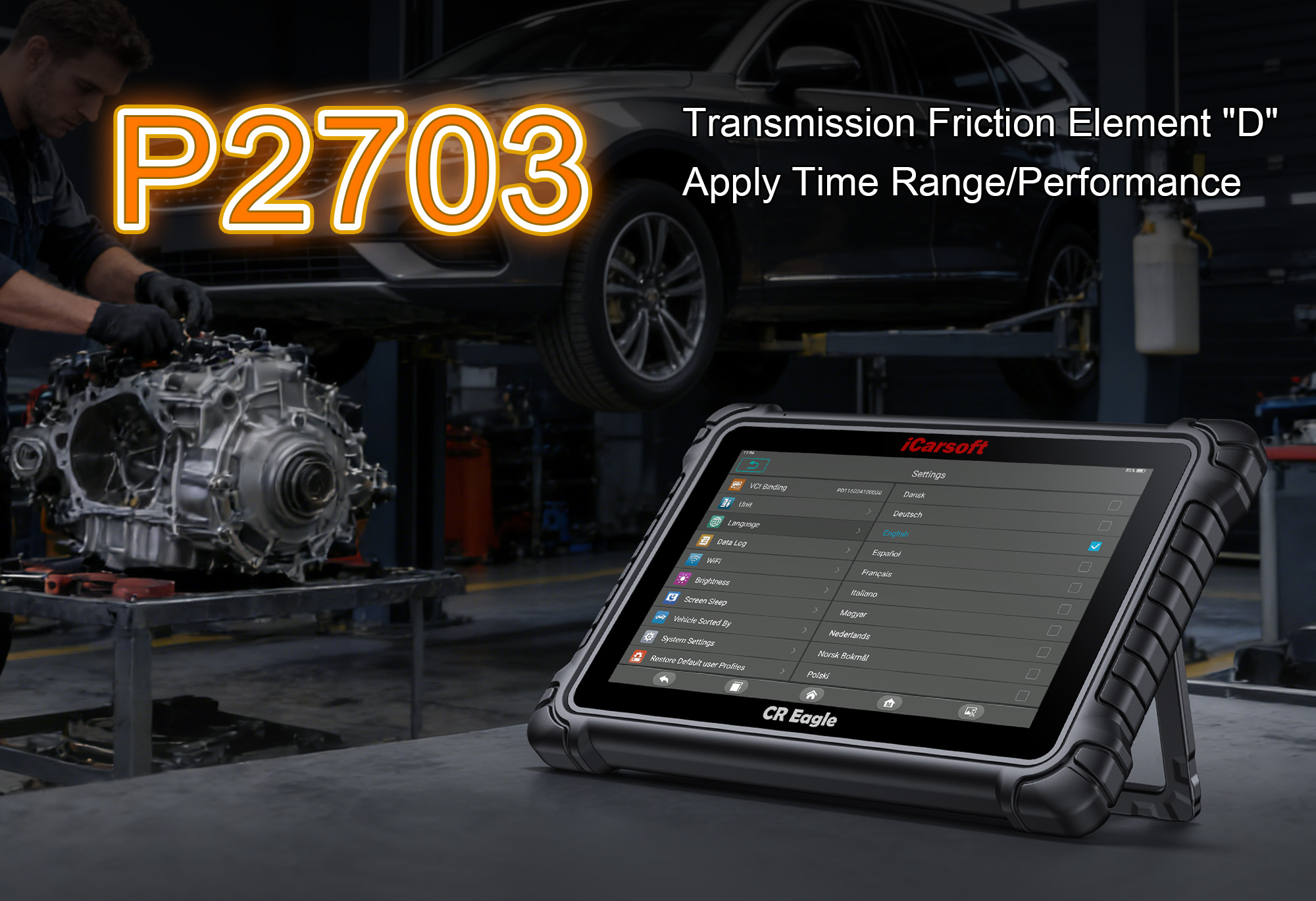
OBD-II Code P2703: Transmission Friction Element "D" Apply Time Range/Performance – Fix with iCarsoft CR Eagle
If your check engine light or transmission warning light illuminates, your vehicle shifts harshly or hesitates between gears, or you notice delayed gear engagement, OBD-II Code P2703—Transmission Friction Element "D" Apply Time Range/Performance—is the critical transmission fault demanding your immediate attention. This code flags an abnormal apply time (engagement duration) for Transmission Friction Element "D," a core component (clutch pack, brake band, or pressure plate) that enables smooth gear shifts in automatic, CVT, and DCT transmissions. The Transmission Control Module (TCM) relies on precise, calibrated apply time for this friction element to ensure seamless gear transitions; a range/performance fault means the element engages too slowly, too quickly, or inconsistently—disrupting hydraulic balance and causing transmission stress. Left unaddressed, P2703 leads to premature clutch wear, burnt transmission fluid, and even limp mode activation—but you don’t need to pay steep dealer transmission diagnostics fees for a fixable fluid, solenoid, or valve issue. This complete guide breaks down everything you need to know about P2703, from its core causes and telltale symptoms to why the iCarsoft CR Eagle is the DIYer’s ultimate professional diagnostic tool to detect, troubleshoot, and permanently clear this code with precision—no advanced mechanical or transmission expertise required.
What Is OBD-II Code P2703?
OBD-II Code P2703 is a transmission-specific fault defined as Transmission Friction Element "D" Apply Time Range/Performance. Modern automatic, CVT, and dual-clutch transmissions use a network of friction elements (labeled A through Z) that engage/disengage to shift gear ratios. Friction Element "D" is a dedicated component responsible for specific gear transitions—typically low-to-mid gear shifts, overdrive engagement, or reverse gear (varies by make/model)—and its performance directly impacts driving smoothness.
The TCM is programmed with strict manufacturer-set parameters for how long Friction Element "D" should take to engage (apply time, usually 0.2–1 second) under different driving conditions (load, speed, temperature). P2703 triggers when the TCM detects that the element’s apply time falls outside this normal range (too slow, causing delayed shifts; or too fast, causing harsh shifts) or is inconsistent (fluctuating apply times between identical driving scenarios). Unlike a "stuck on/off" fault (which prevents engagement entirely), P2703 is a performance/range issue: the element still engages, but not at the optimal speed—indicating a problem with hydraulic pressure, fluid quality, or electrical control (solenoid/valve operation).
P2703 impacts all 1996+ US, 2000+ EU/Asian OBD-II compliant vehicles with automatic, CVT, or DCT transmissions (Ford, GM, Toyota, Honda, Volkswagen, Chrysler, Hyundai, BMW, etc.)—cars, trucks, SUVs, and vans of all sizes. Critically, 98% of P2703 cases stem from contaminated transmission fluid, a faulty pressure control solenoid, or a clogged valve body—not a failed transmission core—making repairs fast, affordable, and beginner-friendly with the right diagnostic tool. An abnormal apply time for Friction Element "D" doesn’t just trigger a warning light: it creates excessive friction between moving parts, leading to irreversible wear on clutches and gears over time.
Common Symptoms of P2703
P2703’s symptoms are exclusively tied to the abnormal engagement of Friction Element "D" and are most noticeable during gear shifts that rely on this component. The check engine light or dedicated transmission warning light is the immediate primary alert, and symptoms will worsen with every drive—especially under load (acceleration, towing) or after the transmission warms up. Watch for these core red flags, all linked to the Transmission Friction Element "D" Apply Time fault:
-
Illuminated solid Check Engine Light (MIL) or transmission warning light on the dashboard
-
Harsh or jerky gear shifts: Abrupt engagement when shifting between gears controlled by Friction Element "D" (the most common symptom)
-
Delayed gear engagement: 1–3 second hesitation when shifting from Park to Drive/Reverse or between specific gear ratios
-
Inconsistent shift quality: Shifts vary between smooth and harsh (apply time fluctuates)
-
Transmission slipping: Momentary revving without speed increase during shifts (element engages too slowly)
-
Limp mode activation: Transmission locks into 2nd/3rd gear to prevent further internal damage (severe cases)
-
Burning transmission fluid smell: Overheating fluid from excessive friction during abnormal engagement
-
Reduced engine power: ECM limits power to lower transmission load and minimize stress on Friction Element "D"
-
Noisy shifts: Clunking or grinding sounds during gear transitions (element engaging too quickly or unevenly)
Top Causes of P2703 (Ranked by Likelihood)
Pinpointing P2703’s root cause requires a diagnostic tool that can monitor live hydraulic pressure and Friction Element "D" apply time—a feature generic OBD scanners lack, as they only read the code and not transmission-specific hydraulic/mechanical data. P2703 is caused by hydraulic, fluid, or electrical issues that disrupt the element’s engagement speed, and the causes are ordered from most to least common (the first four account for 98% of all P2703 cases):
-
Contaminated/degraded transmission fluid: The #1 cause—old, dirty fluid with debris/sludge clogs hydraulic passages, slowing pressure delivery to Friction Element "D" or causing erratic flow.
-
Faulty pressure control solenoid (for Friction Element "D"): An electrical or mechanical failure of the solenoid disrupts hydraulic pressure modulation, leading to abnormal apply time.
-
Clogged valve body or hydraulic passage: Debris or sludge blocks the valve that controls pressure to Friction Element "D," delaying or speeding up engagement.
-
Low transmission fluid level: Insufficient fluid causes inadequate pressure distribution, leading to slow or inconsistent apply time.
-
Worn Friction Element "D" components: Minor wear on clutch plates or pressure plates (not total failure) increases engagement time (rare for P2703 alone).
-
Faulty TCM (Transmission Control Module) signal: A minor electrical glitch in the TCM sends incorrect pressure commands to the solenoid (rare—no full TCM failure).
-
Damaged hydraulic line/hose: A pinched or restricted hydraulic line disrupts pressure flow to Friction Element "D."
-
Worn transmission filter: A clogged filter restricts fluid flow, leading to pressure buildup and abnormal apply time.
Why the iCarsoft CR Eagle Is the Ultimate Tool for P2703
Generic OBD scanners only do one thing for P2703: read the code. They cannot monitor live hydraulic pressure to Friction Element "D," measure apply time, or test solenoid/valve operation—leaving DIYers guessing and replacing expensive parts unnecessarily (e.g., a $2,000 transmission rebuild for a $100 solenoid replacement). The iCarsoft CR Eagle is a professional-grade diagnostic tool optimized for transmission hydraulic and mechanical diagnostics, with exclusive TCM, HCU (Hydraulic Control Unit), and friction element testing features that make it the only tool you need to fix P2703 for good. Unlike basic scanners, it gives you dealership-level transmission diagnostic power to pinpoint the exact cause of Friction Element "D"’s abnormal apply time in minutes—and clear the code permanently once the issue is resolved. Here’s why it stands out for P2703 troubleshooting:
Real-Time Friction Element "D" Apply Time Monitoring
Measures the exact engagement duration of Friction Element "D" in real time, comparing it to factory parameters to confirm if it’s too slow/too fast (critical for P2703).
Hydraulic Pressure Tracking
Monitors live hydraulic pressure to Friction Element "D," identifying low pressure (delayed shifts) or high pressure (harsh shifts) that cause the apply time fault.
Pressure Control Solenoid Active Testing
Manually activates the solenoid for Friction Element "D" via the TCM, verifying if the solenoid is faulty or the issue is hydraulic/fluid-related (no multimeter required).
TCM Exclusive Diagnostic Data
Accesses the TCM to read hidden sub-fault codes, hydraulic pressure history, and solenoid performance data that trigger P2703—no generic scanner offers this.
Transmission Fluid Health & Level Checks
Provides make/model-specific guided fluid level checks and alerts for contaminated/degraded fluid (top P2703 trigger) with real-time fluid temperature readings.
Valve Body/Hydraulic Circuit Testing
Scans the entire hydraulic control system for clogs, pressure blockages, and abnormal flow to Friction Element "D"’s circuit—finding hidden hydraulic issues generic scanners miss.
TCM Reset & Calibration
Resets the TCM’s hydraulic pressure calibration and clears corrupted fault data after repairs—ensuring proper apply time for Friction Element "D" post-fix.
One-Click Code Clearing
Clears P2703 + accompanying transmission/electrical codes in seconds—verify repair with live shift test (factory-spec apply time for Friction Element "D").
Universal Transmission Compatibility
Works with 1996+ US/2000+ EU/Asian OBD-II automatic/CVT/DCT transmissions (all makes/models)—no vehicle-specific scanners needed.
Intuitive Transmission Diagnostic Guides
Step-by-step Friction Element "D" testing workflows, solenoid/valve body location diagrams, fluid change/flush tips—no advanced transmission knowledge required.
FAQ: Everything You Need to Know About P2703 & iCarsoft CR Eagle
What exactly does OBD-II Code P2703 mean?
P2703 means Transmission Friction Element "D" has an apply time range/performance fault. The TCM detects the element’s engagement duration is outside factory-calibrated parameters (too slow, too fast, or inconsistent), disrupting smooth gear shifts.
Which vehicles are affected by P2703?
P2703 impacts all 1996+ US, 2000+ EU/Asian OBD-II compliant vehicles with automatic, CVT, or DCT transmissions (cars, trucks, SUVs, vans). Manual transmissions do not trigger this code (no electronic friction elements).
Is P2703 a serious transmission fault?
Yes—P2703 is a critical warning sign. Abnormal apply time creates excessive friction between transmission components, leading to rapid clutch/gear wear, burnt fluid, and potential catastrophic transmission failure if left unaddressed.
Can I drive my car with P2703?
You can drive short distances at low speed to get home or to a parts store, but prolonged driving is not recommended. Harsh/slipping shifts cause unnecessary wear, and limp mode may activate unexpectedly, creating safety risks.
What’s the cheapest and most common fix for P2703?
A transmission fluid flush/change (cost: $100–$180) is the #1 fix for P2703 (caused by contaminated fluid). The second most common fix is replacing the pressure control solenoid (cost: $80–$120)—both simple DIY repairs for most vehicles.
Can a generic OBD scanner diagnose the root cause of P2703?
No—generic scanners only read the P2703 code and cannot monitor apply time, hydraulic pressure, or test the solenoid. The iCarsoft CR Eagle is required to find the exact cause of the apply time fault.
Will a transmission fluid additive fix P2703?
No—fluid additives only mask minor issues and will not resolve the root cause (clogged passages, faulty solenoid, or worn components). A flush/change and targeted repair are necessary for a permanent fix.
Do I need a mechanic to clear P2703 after fixing the issue?
No—once you’ve repaired the root cause (e.g., fluid flush, solenoid replacement, filter change), the iCarsoft CR Eagle lets you clear P2703 with one click and reset the TCM’s hydraulic pressure calibration—no mechanic or dealer visit required.
Final Thoughts: Don’t Let P2703 Destroy Your Transmission’s Smooth Shifts
OBD-II Code P2703—Transmission Friction Element "D" Apply Time Range/Performance—is one of the most damaging transmission fault codes for modern automatic/CVT/DCT vehicles, as it creates unrelenting friction and wear on core components. Generic scanners leave you stuck in trial-and-error, leading to expensive mistakes like a full transmission rebuild for a simple fluid flush, and dealers often upsell costly overhauls for a $100 solenoid replacement. But P2703 doesn’t have to mean a transmission disaster: the iCarsoft CR Eagle is designed specifically for transmission hydraulic and mechanical diagnostics, with exclusive apply time monitoring and solenoid testing features that let you pinpoint the exact cause in minutes—no guesswork, no costly mistakes.
Transmission Friction Element "D" is the backbone of smooth gear shifting for specific ratios, and its precise apply time is critical for the transmission’s longevity. An abnormal engagement speed turns this essential component into a source of wear, burning fluid and damaging gears and clutches at an alarming rate. P2703 is not just a warning light: it’s your vehicle’s desperate plea for immediate repair to avoid a total transmission failure that can cost thousands to fix. The iCarsoft CR Eagle isn’t just a tool for fixing P2703: it’s a full-system transmission diagnostic scanner that works for every OBD-II transmission code, every hydraulic/mechanical issue, and every make/model of vehicle. It’s rugged, easy to use, and pays for itself after just one repair—saving you hundreds (or thousands) in dealer fees and preventing irreversible transmission damage.
Ready to fix P2703, restore smooth, precise gear shifting, protect your transmission from catastrophic failure, and get your vehicle’s performance back to factory specs? Grab the iCarsoft CR Eagle today and take complete control of your vehicle’s transmission health—no mechanic required!
Disclaimer: This guide is for informational purposes only. Always consult your vehicle’s owner’s manual or a certified automotive technician before transmission fluid/solenoid/valve body repairs. iCarsoft is not responsible for damage from improper tool use or transmission system maintenance.