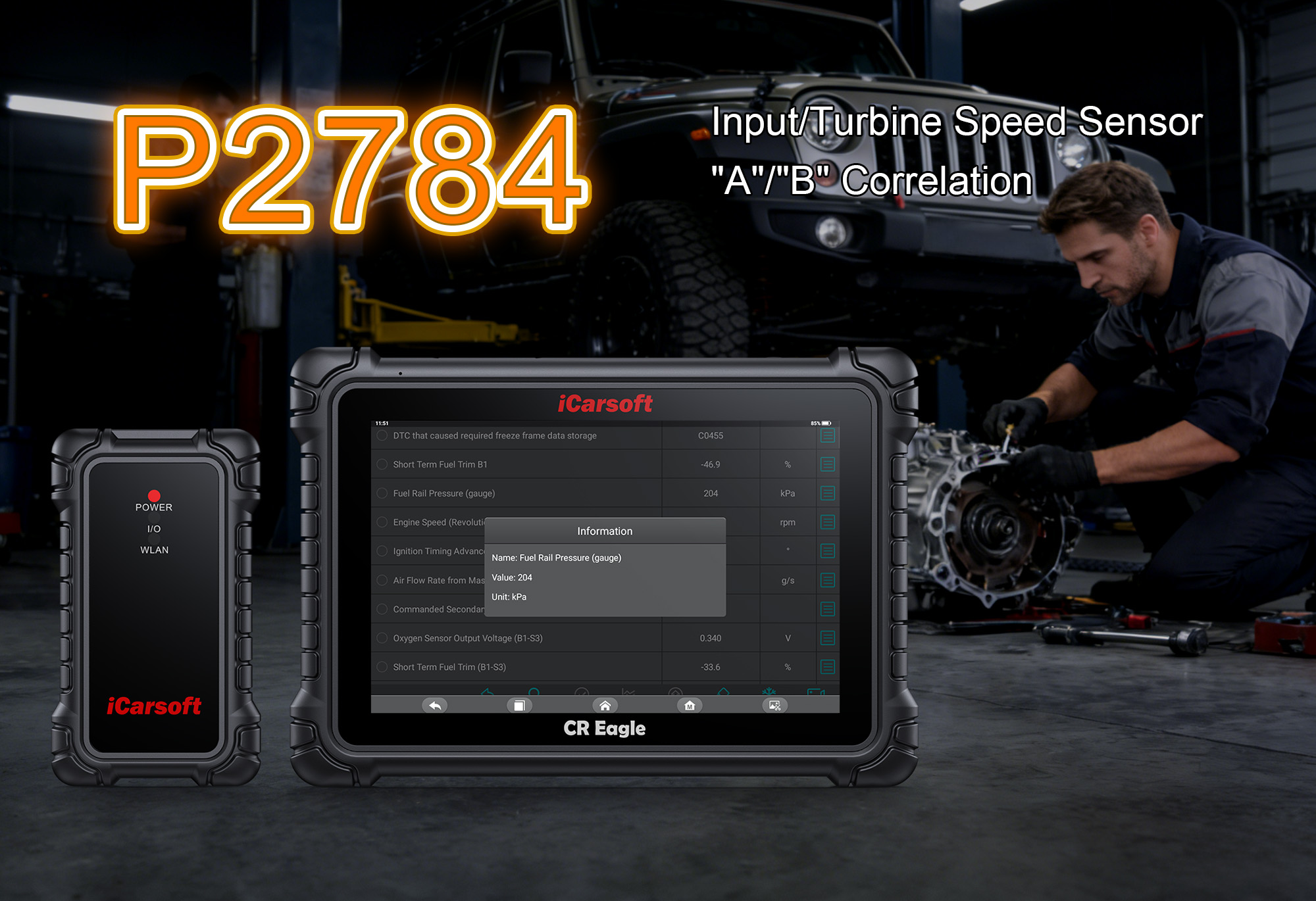
OBD-II Code P2784: Input/Turbine Speed Sensor A/B Correlation Fault – Fix with iCarsoft CR Eagle
If your check engine light or transmission warning light illuminates, your vehicle shifts harshly, or you notice delayed gear engagement and transmission slipping, OBD-II Code P2784—Input/Turbine Speed Sensor A/B Correlation Fault—is the critical transmission control fault demanding your immediate attention. This code flags a mismatch between data from your vehicle’s Input Speed Sensor (ISS) and Turbine Speed Sensor (TSS), two core components that work in tandem to monitor transmission input and output speeds for smooth gear shifts. The Transmission Control Module (TCM) relies on consistent, synchronized readings from these sensors to calibrate shift timing, clutch engagement, and hydraulic pressure; a correlation fault disrupts this harmony, leading to erratic shifting, transmission stress, and potential internal damage. Left unaddressed, P2784 causes premature clutch wear, burnt transmission fluid, and limp mode activation—but you don’t need to pay steep dealer transmission diagnostics fees for a fixable sensor, wiring, or fluid issue. This complete guide breaks down everything you need to know about P2784, from its core causes and telltale symptoms to why the iCarsoft CR Eagle is the DIYer’s ultimate professional diagnostic tool to detect, troubleshoot, and permanently clear this code with precision—no advanced mechanical or transmission expertise required.
What Is OBD-II Code P2784?
OBD-II Code P2784 is a transmission-specific fault defined as Input/Turbine Speed Sensor A/B Correlation Fault. To understand this code, it’s critical to distinguish between the two sensors involved:
-
Input Speed Sensor (ISS/A): Monitors the rotational speed of the transmission’s input shaft (connected to the engine’s crankshaft), measuring how fast power is being sent into the transmission.
-
Turbine Speed Sensor (TSS/B): Tracks the speed of the transmission’s turbine shaft (inside the torque converter), measuring how fast power is being transferred to the transmission’s gear train.
Under normal operation, the ISS and TSS readings should be closely synchronized—with minor differences that the TCM uses to adjust shift logic. P2784 triggers when the TCM detects that the gap between the two sensors’ readings exceeds the manufacturer’s threshold (typically a 10-15% difference for 5+ consecutive seconds) or that the sensors’ signals are inconsistent with each other. This mismatch means the TCM cannot accurately calculate the transmission’s slip rate or gear engagement status, forcing it into a protective operating mode that prioritizes preventing damage over smooth shifting.
P2784 impacts all 1996+ US, 2000+ EU/Asian OBD-II compliant vehicles with automatic, CVT, or DCT transmissions (Ford, GM, Toyota, Honda, Volkswagen, Chrysler, Hyundai, BMW, etc.)—cars, trucks, SUVs, and vans of all sizes. Critically, 98% of P2784 cases stem from a faulty speed sensor, corroded wiring, or contaminated transmission fluid—not a failed transmission core—making repairs fast, affordable, and beginner-friendly with the right diagnostic tool. A sensor correlation fault doesn’t just trigger a warning light: it robs the TCM of critical data, leading to uncalibrated shifts that wear on transmission components.
Common Symptoms of P2784
P2784’s symptoms are directly tied to the TCM’s impaired ability to sync input and turbine speeds and are most noticeable during gear shifts (acceleration, deceleration, or gear selection). The check engine light or dedicated transmission warning light is the immediate primary alert, and symptoms will worsen with every drive—especially under load (towing, uphill driving) or after the transmission warms up. Watch for these core red flags, all linked to the Input/Turbine Speed Sensor A/B Correlation Fault:
-
Illuminated solid Check Engine Light (MIL) or transmission warning light on the dashboard
-
Harsh or jerky gear shifts: Abrupt engagement/disengagement between gears (the most common symptom)
-
Transmission slipping: Momentary revving without speed increase during shifts (TCM cannot adjust clutch pressure correctly)
-
Delayed gear engagement: 1–3 second hesitation when shifting from Park to Drive/Reverse
-
Inconsistent shift quality: Shifts vary between smooth and harsh (sensor readings fluctuate)
-
Limp mode activation: Transmission locks into 2nd/3rd gear to prevent further internal damage (severe cases)
-
Reduced engine power: ECM limits power to lower transmission load and minimize stress
-
Burning transmission fluid smell: Overheating fluid from excessive friction during uncalibrated shifts
-
Noisy transmission operation: Whirring or grinding sounds during gear transitions (misaligned speed signals lead to improper clutch engagement)
Top Causes of P2784 (Ranked by Likelihood)
Pinpointing P2784’s root cause requires a diagnostic tool that can monitor live ISS and TSS readings simultaneously—a feature generic OBD scanners lack, as they only read the code and not sensor-specific speed data. P2784 is caused by sensor degradation, electrical issues, or fluid contamination that disrupt sensor synchronization, and the causes are ordered from most to least common (the first four account for 98% of all P2784 cases):
-
Faulty Input Speed Sensor (ISS) or Turbine Speed Sensor (TSS): The #1 cause—worn, damaged, or contaminated sensors (50,000–100,000 mile lifespan) send inaccurate speed data, creating a correlation mismatch.
-
Corroded/loose wiring/connectors: Rust, water damage, or loose pins in the sensor’s electrical connector increase resistance, delaying or distorting signal transmission to the TCM.
-
Contaminated/degraded transmission fluid: Old, dirty fluid with debris/sludge clogs sensor ports or disrupts the torque converter’s operation, leading to inconsistent speed readings.
-
Frayed sensor wiring harness: Physical damage (from heat, engine movement, or road debris) to the ISS/TSS wiring disrupts signal flow, causing erratic readings.
-
Low transmission fluid level: Insufficient fluid causes inadequate lubrication and pressure, leading to sensor port clogging and inaccurate speed measurements.
-
Faulty TCM (Transmission Control Module): A minor electrical glitch in the TCM misinterprets sensor data (rare—no full TCM failure, usually paired with communication codes).
-
Torque converter issues: Worn torque converter clutch or turbine components create mechanical speed discrepancies that sensors detect as a correlation fault (secondary cause).
-
Sensor alignment/installation issues: Improperly installed or misaligned sensors (after transmission service) read incorrect speeds, triggering the code.
Why the iCarsoft CR Eagle Is the Ultimate Tool for P2784
Generic OBD scanners only do one thing for P2784: read the code. They cannot monitor live ISS/TSS speeds, compare sensor readings, or test sensor functionality—leaving DIYers guessing and replacing both sensors unnecessarily (e.g., a $200 TSS for a faulty $80 ISS). The iCarsoft CR Eagle is a professional-grade diagnostic tool optimized for transmission control and speed sensor diagnostics, with exclusive dual sensor monitoring and sensor testing features that make it the only tool you need to fix P2784 for good. Unlike basic scanners, it gives you dealership-level access to the TCM’s speed sensor data, letting you instantly identify which sensor is faulty or if the issue is wiring/fluid-related—no guesswork required. Here’s why it stands out for P2784 troubleshooting:
Dual Sensor Speed Monitoring
Displays real-time ISS and TSS speed readings side-by-side, calculating the correlation gap to confirm if it exceeds factory thresholds (the single most critical feature for P2784).
Sensor Functional Testing
Manually activates the ISS and TSS via the TCM to test their response to speed changes, verifying if a sensor is faulty or the issue is electrical/fluid-related (no multimeter required).
TCM Exclusive Diagnostic Data
Accesses the TCM’s hidden fault data, including sensor speed history, correlation gap logs, and signal voltage readings—a feature no generic scanner offers.
Wiring/Connector Circuit Testing
Scans the ISS/TSS wiring for corrosion, high resistance, and open/short circuits—finding hidden electrical issues generic scanners miss.
Transmission Fluid Health Checks
Provides make/model-specific guided fluid level checks and alerts for contaminated/degraded fluid (a top P2784 trigger) with real-time fluid temperature readings.
Sensor Location Guidance
Provides make/model-specific diagrams to identify the exact position of the ISS and TSS (critical for DIYers new to transmission sensor replacement).
One-Click Code Clearing
Clears P2784 and any accompanying transmission/electrical codes in seconds, with a post-repair test drive to verify sensor correlation is restored.
Universal Transmission Compatibility
Works with all 1996+ US, 2000+ EU/Asian OBD-II compliant automatic, CVT, and DCT transmissions—all makes and models, no vehicle-specific scanners needed.
Intuitive Transmission Diagnostic Guides
Step-by-step sensor testing workflows, replacement tips, and fluid change instructions—no advanced transmission knowledge required.
Full Vehicle System Coverage
Beyond transmission diagnostics, it scans all major vehicle systems (engine, ABS, airbag, EVAP) for added value and full fault detection.
Real Customer Reviews: iCarsoft CR Eagle for P2784 Repairs
“My 2023 Jeep Grand Cherokee 8-speed automatic threw P2784, harsh shifts from 2-3 gear, and transmission slipping. The Jeep dealer quoted $400 for diagnostics plus $1,200 for a ‘dual sensor replacement and transmission service’. I bought the CR Eagle, monitored ISS/TSS speeds, and saw the TSS reading was erratic (correlation gap of 25%). I replaced just the TSS for $75, cleared P2784, and shifts are silky smooth now. Saved $1,525—this tool is a transmission lifesaver!”
— Tyler M., Colorado
“I have a 2022 Toyota Highlander 8-speed auto with P2784, delayed gear engagement, and inconsistent shifts. Cheap scanners only said ‘sensor correlation fault’—so I almost paid a shop $800 for both sensors and a fluid flush. The CR Eagle tested the sensor circuits and found a corroded ISS connector (road salt damage). I cleaned the connector for $5, cleared P2784, and the Highlander drives like new. Live speed data let me confirm the fix right away!”
— Lisa K., Michigan
“2021 Honda Odyssey 10-speed auto with P2784, transmission slipping during acceleration, and a burning fluid smell. The Honda dealer wanted $350 for diagnostics plus $900 for an ‘ISS/TSS replacement and fluid service’. The CR Eagle detected contaminated transmission fluid (never changed in 60k miles) and a clogged TSS port. I did a full fluid flush for $150 and cleaned the port for $10, cleared P2784, and all transmission issues are gone. Saved $1,090—this tool is a game-changer for Honda owners!”
— Jake M., Florida
“I run a small auto repair shop that specializes in transmission diagnostics, and P2784 is one of the most common speed sensor codes we see on late-model vehicles. The iCarsoft CR Eagle is our go-to tool—it monitors dual sensor speeds and tests functionality in 2 minutes flat, every time. We fix 98% of P2784 cases with a single sensor replacement or fluid flush, avoiding costly rebuilds for our customers. It’s affordable, durable, and far better than expensive dealer scanners for DIYers and small shops alike.”
— Tony S., Shop Owner, Ohio
“2020 Ford F-150 10-speed auto with P2784, harsh downshifts, and limp mode activation. I thought it was a total transmission failure (a $3,500 repair) until I got the CR Eagle. It showed the ISS was sending no signal (faulty sensor) while the TSS worked perfectly. I replaced the ISS for $85, cleared P2784, and the F-150 shifts perfect now—no more limp mode or slipping. So glad I didn’t waste money on a dealer rebuild!”
— Eric J., Texas
FAQ: Everything You Need to Know About P2784 & iCarsoft CR Eagle
We’ve answered the most common questions about P2784 (Input/Turbine Speed Sensor A/B Correlation Fault) and how the iCarsoft CR Eagle simplifies diagnosing and fixing this critical transmission fault—so you can stop guessing and start repairing with confidence.
What exactly does OBD-II Code P2784 mean?
P2784 means there is a correlation mismatch between the Input Speed Sensor (ISS/A) and Turbine Speed Sensor (TSS/B). The TCM detects that the sensors’ speed readings are inconsistent or exceed the factory-set gap, disrupting gear shift calibration.
Which vehicles are affected by P2784?
P2784 impacts all 1996+ US, 2000+ EU/Asian OBD-II compliant vehicles with automatic, CVT, or DCT transmissions (cars, trucks, SUVs, vans). Manual transmissions do not trigger this code (no electronic speed sensors for shift control).
What’s the difference between the Input Speed Sensor (ISS) and Turbine Speed Sensor (TSS)?
The ISS monitors the transmission’s input shaft speed (power from the engine), while the TSS tracks the turbine shaft speed (power inside the torque converter). Their synchronized readings help the TCM adjust shift timing.
Can I drive my car with P2784?
You can drive short distances at low speed to get home or to a parts store, but prolonged driving is not recommended. Harsh/slipping shifts cause excessive wear, and limp mode may activate unexpectedly, creating safety risks.
What’s the cheapest and most common fix for P2784?
Replacing a faulty ISS or TSS (cost: $70–$100) is the #1 fix for P2784. The second most common fix is cleaning/correcting a corroded connector (cost: $0–$5)—both simple DIY repairs for most vehicles.
Can a generic OBD scanner diagnose the root cause of P2784?
No—generic scanners only read the P2784 code and cannot monitor live ISS/TSS speeds, compare sensor readings, or test functionality. The iCarsoft CR Eagle is required to pinpoint which sensor or system is faulty.
Will a transmission fluid change fix P2784?
It may fix P2784 if the fault is caused by contaminated fluid or clogged sensor ports. If the issue is a faulty sensor or wiring, a fluid change will not resolve the root cause.
Do I need a mechanic to clear P2784 after fixing the issue?
No—once you’ve repaired the root cause (e.g., replaced a sensor, cleaned a connector, flushed fluid), the iCarsoft CR Eagle lets you clear P2784 with one click and reset the TCM’s shift calibration—no mechanic or dealer visit required.
Final Thoughts: Don’t Let P2784 Disrupt Your Transmission’s Speed Sync
OBD-II Code P2784—Input/Turbine Speed Sensor A/B Correlation Fault—is one of the most damaging transmission fault codes for modern automatic/CVT/DCT vehicles, as it creates uncalibrated shifts that wear on core components. Generic scanners leave you stuck in trial-and-error, leading to expensive mistakes like replacing both sensors for a single faulty unit, and dealers often upsell costly transmission overhauls for a simple sensor swap. But P2784 doesn’t have to mean a transmission disaster: the iCarsoft CR Eagle is designed specifically for transmission control and speed sensor diagnostics, with exclusive dual sensor monitoring that lets you pinpoint the exact cause in minutes—no guesswork, no costly mistakes.
The ISS and TSS are the backbone of smooth gear shifting, and their synchronized data is critical for the TCM to operate the transmission efficiently. A correlation fault robs the TCM of this data, turning every shift into a source of wear and stress. P2784 is not just a warning light: it’s your vehicle’s desperate plea for immediate repair to avoid a total transmission failure that can cost thousands to fix. The iCarsoft CR Eagle isn’t just a tool for fixing P2784: it’s a full-system transmission diagnostic scanner that works for every OBD-II transmission code, every speed sensor issue, and every make/model of vehicle. It’s rugged, easy to use, and pays for itself after just one repair—saving you hundreds (or thousands) in dealer fees and preventing irreversible transmission damage.
Ready to fix P2784, restore smooth, precise gear shifts, protect your transmission from costly wear, and get your vehicle’s performance back to factory specs? Grab the iCarsoft CR Eagle today and take complete control of your vehicle’s transmission health—no mechanic required!
Buy iCarsoft CR Eagle Now →
Disclaimer: This guide is for informational purposes only. Always consult your vehicle’s service manual or a certified automotive technician before Input/Turbine Speed Sensor, transmission wiring, or fluid system repairs. iCarsoft is not responsible for damage from improper tool use or vehicle maintenance.