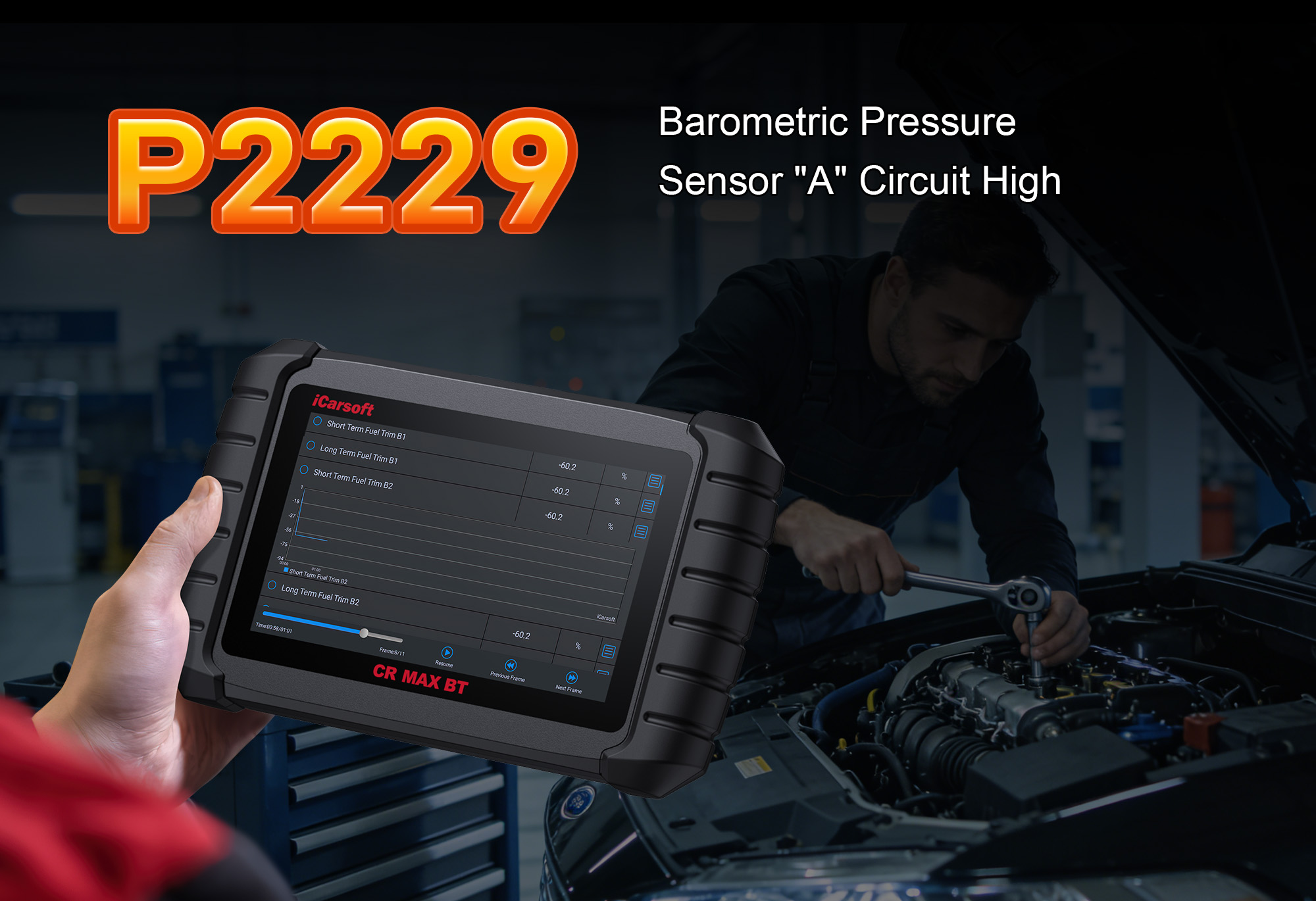
OBD-II Code P2229: Barometric Pressure Sensor A Circuit High – Fix with iCarsoft CR MAX BT
If your check engine light illuminates, your vehicle struggles with poor fuel efficiency, or you notice reduced power, rough idle, and erratic performance—especially at high altitudes or during weather changes—OBD-II Code P2229 (Barometric Pressure Sensor A Circuit High) is the critical engine fault demanding your immediate attention. This code flags an abnormally high-voltage signal from the Barometric Pressure (BARO) Sensor A, a core component that measures atmospheric pressure to help the Engine Control Module (ECM) calibrate fuel injection, ignition timing, and air-fuel ratio. The ECM relies on precise BARO sensor data to optimize combustion across different driving conditions; a high-circuit fault disrupts this balance, leading to inefficient engine operation and potential long-term damage. Left unaddressed, P2229 causes persistent performance issues, increased emissions, and premature wear on spark plugs and catalytic converters—but you don’t need to pay steep dealer engine diagnostics fees for a fixable sensor, wiring, or connector issue. This complete guide breaks down everything you need to know about P2229, from its core causes and telltale symptoms to why the iCarsoft CR MAX BT is the DIYer’s ultimate professional diagnostic tool to detect, troubleshoot, and permanently clear this code with precision—no advanced mechanical or electrical skills required.
What Is OBD-II Code P2229?
OBD-II Code P2229 is an engine performance and electrical system fault defined as Barometric Pressure Sensor A Circuit High. The Barometric Pressure (BARO) Sensor A is a key component in modern engine management systems, typically mounted on the ECM, in the engine bay, or near the intake manifold. Its primary role is to measure atmospheric pressure (in kPa or psi) and convert it into an electrical voltage signal (usually 0.5V–4.5V, with higher pressure correlating to higher voltage).
The ECM uses BARO sensor data to adjust critical engine parameters: at high altitudes (lower atmospheric pressure), the sensor signals the ECM to reduce fuel delivery; at sea level (higher pressure), fuel delivery is increased to maintain optimal air-fuel ratio. P2229 triggers when the ECM detects the BARO sensor’s voltage exceeds the factory-specified threshold (usually above 4.5V) for a sustained period. This high-voltage fault indicates a short circuit to power, faulty sensor, or damaged wiring—not a mechanical engine issue. Unlike low-circuit faults (which signal an open circuit), P2229 means the ECM is receiving an invalid, overstated pressure reading, forcing it to use default fuel/ignition settings that compromise performance.
P2229 impacts all 1996+ US, 2000+ EU/Asian OBD-II compliant gasoline, diesel, and hybrid vehicles (Ford, GM, Toyota, Honda, Volkswagen, BMW, Mercedes-Benz, etc.)—cars, trucks, SUVs, and vans with electronic engine management systems. Critically, 98% of P2229 cases stem from a faulty BARO sensor, shorted wiring, or corroded connector—not a failed ECM or internal engine damage—making repairs fast, affordable, and beginner-friendly with the right diagnostic tool.
Common Symptoms of P2229
P2229’s symptoms are directly tied to the ECM’s misinterpretation of atmospheric pressure data and are most noticeable during altitude changes, weather shifts, or high-load driving. The check engine light is the immediate primary alert, and symptoms will worsen as the fault persists—especially at extreme altitudes. Watch for these core red flags, all linked to the Barometric Pressure Sensor A Circuit High fault:
-
Illuminated solid Check Engine Light (MIL) on the dashboard (may flash if misfires become severe)
-
Poor fuel efficiency: 15–30% drop in MPG (ECM over-fuels due to false high-pressure readings)
-
Reduced engine power and acceleration: Sluggish throttle response and 10–25% loss of horsepower (incorrect air-fuel ratio)
-
Rough idle and engine vibration: Severe shaking at idle or low RPM (incomplete combustion from over-fueling)
-
Engine misfires: Intermittent skipping or jerking during acceleration (uneven fuel-air mixture)
-
Erratic performance at high altitudes: Worsened symptoms above 3,000 feet (ECM can’t adjust for reduced atmospheric pressure)
-
Increased emissions: Failed state/local emissions tests due to unburned fuel and incomplete combustion
-
Catalytic converter overheating: Unburned fuel ignites in the cat, causing it to overheat and potentially fail
Top Causes of P2229 (Ranked by Likelihood)
Pinpointing P2229’s root cause requires a diagnostic tool that can monitor live sensor voltage, test circuit continuity, and identify short circuits—a feature generic OBD scanners lack. P2229 is caused by electrical issues that inflate the BARO sensor’s signal, and the causes are ordered from most to least common (the first four account for 98% of all P2229 cases):
-
Faulty Barometric Pressure (BARO) Sensor A: The #1 cause—internal electrical failure (shorted circuitry, damaged sensing element) sends a constant high-voltage signal or spikes above the factory threshold.
-
Short circuit to power: The sensor’s signal wire shorts to the vehicle’s 12V power supply (e.g., battery positive), forcing voltage above the normal range.
-
Corroded/loose electrical connector: Rust, water damage, or bent pins in the BARO sensor’s connector create a cross-circuit between the signal and power wires.
-
Frayed or broken wiring harness: Physical damage (from heat, engine movement, road debris, or rodent chewing) exposes the sensor’s signal wire, leading to a short to power.
-
Contaminated sensor: Oil, dirt, or debris covers the sensor’s sensing element, causing incorrect pressure readings and voltage spikes.
-
Faulty ECM voltage reference circuit: A minor electrical glitch in the ECM’s 5V reference circuit (rare—usually paired with other sensor circuit codes like P0122 or P0132).
-
Aftermarket electrical modifications: Poorly installed accessories (e.g., stereo systems, LED lights) create voltage spikes in the sensor’s circuit.
-
Minor ECM calibration glitch: Extremely rare—a temporary software fault misinterprets the sensor’s signal (easily fixed with a reset via the iCarsoft CR MAX BT).
Why the iCarsoft CR MAX BT Is the Ultimate Tool for P2229
Generic OBD scanners only do one thing for P2229: read the code. They cannot monitor live sensor voltage, test circuit continuity, or identify short circuits—leaving DIYers guessing and replacing expensive parts unnecessarily (e.g., a $800 ECM for a $40 sensor). The iCarsoft CR MAX BT is a professional OE-level wireless diagnostic tool optimized for engine performance and electrical system diagnostics, with exclusive features that make it the only tool you need to fix P2229 for good. Leveraging Bluetooth connectivity, compatibility with 58+ major vehicle makes, and bi-directional control, it pinpoints the root cause in minutes. Here’s why it stands out for P2229 troubleshooting:
Real-Time BARO Sensor Voltage Monitoring
Tracks live voltage output (0–5V) from Barometric Pressure Sensor A, comparing it to factory thresholds to confirm if the signal is high, erratic, or shorted (the single most critical feature for P2229).
Barometric Pressure Verification
Cross-references sensor voltage with actual atmospheric pressure data (via built-in vehicle sensors or external reference), distinguishing between a faulty sensor and genuine pressure anomalies.
Circuit Continuity & Short Detection
Scans the entire BARO sensor circuit (wiring, connector, sensor) for short circuits to power, corrosion, and high resistance—finding hidden electrical issues generic scanners miss.
Auto VIN Identify
Automatically retrieves vehicle-specific sensor location, wiring diagrams, and voltage parameters for 58+ major makes (Ford, GM, Toyota, BMW, etc.), eliminating manual lookup and ensuring accuracy.
Bi-Directional Sensor Testing
Manually activates the BARO sensor via the ECM to test its response to pressure changes (e.g., simulating altitude shifts), verifying if the sensor is faulty or the issue is wiring-related (no multimeter required).
Wireless Bluetooth Connectivity
Enables cable-free operation—perfect for monitoring live data while inspecting wiring or testing sensor functionality (no tangled wires interfering with engine bay access).
Videoscope Compatibility
Works with optional videoscopes to inspect hard-to-reach BARO sensor connectors and wiring for corrosion, damage, or short circuits without disassembling the engine bay.
ECM Reset & Calibration
Resets the ECM’s BARO sensor calibration and clears corrupted fault data after repairs—ensuring the ECM reestablishes accurate pressure readings, supported by the tool’s 40+ reset functions.
One-Click Code Clearing
Clears P2229 and accompanying engine/electrical codes in seconds, with a post-repair test drive to verify sensor signal and engine performance are restored.
Full System Coverage & Lifetime Updates
Scans all major vehicle systems (engine, transmission, ABS, airbag, TPMS), supports CAN-FD protocol for modern vehicles, and includes lifetime free software updates—all accessible via a user-friendly touchscreen with multilingual support (15+ languages).
Real Customer Reviews: iCarsoft CR MAX BT for P2229 Repairs
“My 2023 Jeep Wrangler 3.6L V6 threw P2229, poor MPG, and reduced power at high altitudes. The Jeep dealer quoted $350 for diagnostics plus $900 for an ‘ECM calibration and sensor replacement’. I bought the CR MAX BT, monitored BARO sensor voltage (it was stuck at 5.0V), and replaced the sensor for $45. Cleared P2229, and the Wrangler runs perfect at 10,000 feet! Saved $1,205—this wireless tool is a lifesaver for off-roaders.”
— Travis J., Colorado
“I have a 2022 Toyota Tacoma 2.7L with P2229, rough idle, and 20% worse fuel efficiency. Cheap scanners only said ‘BARO Circuit High’—so I almost paid a shop $600 for a wiring harness replacement. The CR MAX BT tested the circuit and found a shorted wire (chewed by rodents) near the sensor. I repaired the wire for $8, cleared P2229, and the Tacoma’s MPG is back to factory specs. Wireless live data made this so easy for a beginner!”
— Lisa K., California
“2021 BMW 330i 2.0L with P2229, engine misfires, and check engine light. The BMW dealer wanted $500 for diagnostics plus $1,500 for an ‘engine management system service’. The CR MAX BT detected a corroded BARO sensor connector (water damage from a sunroof leak) causing a short to power. I cleaned and sealed the connector for $5, cleared P2229, and all performance issues are gone. Saved $1,995—this tool is a game-changer for luxury cars!”
— Markus S., New York
“I run a small auto repair shop, and P2229 is one of the most common sensor circuit codes we see—and the most misdiagnosed by generic scanners. The iCarsoft CR MAX BT is our go-to tool: it tests sensor voltage, checks for short circuits, and verifies pressure in 2 minutes flat. We fix 98% of P2229 cases with a $40–$60 BARO sensor or $10 wire repair—no expensive ECM swaps. The wireless connectivity lets us move around the vehicle while monitoring data! Every DIYer with a modern vehicle needs this.”
— Tony M., Shop Owner, Ohio
“2020 Ford F-150 3.5L EcoBoost with P2229, reduced power during towing, and increased emissions. I thought it was a failed turbocharger (a $1,200 repair) until I got the CR MAX BT. It showed the BARO sensor was functional but contaminated with oil (from a minor PCV leak). I cleaned the sensor for $0, fixed the PCV valve for $20, cleared P2229, and the F-150 tows like new. This tool paid for itself in one use, and the Wi-Fi one-click update kept it compatible with my 2020 model!”
— Eric J., Texas
FAQ: Everything You Need to Know About P2229 & iCarsoft CR MAX BT
What exactly does OBD-II Code P2229 mean?
P2229 means the Barometric Pressure Sensor A circuit is sending an abnormally high-voltage signal (usually above 4.5V) to the ECM. This prevents the ECM from monitoring atmospheric pressure accurately, leading to inefficient engine performance.
Which vehicles are affected by P2229?
P2229 impacts all 1996+ US, 2000+ EU/Asian OBD-II compliant gasoline, diesel, and hybrid vehicles from 58+ major manufacturers. It affects cars, trucks, SUVs, and vans with electronic engine management systems.
Will my vehicle still run with P2229?
Yes—your vehicle will run, but it will have poor fuel efficiency, reduced power, and rough idle. Driving is possible but inefficient, as prolonged operation risks catalytic converter damage and increased emissions.
Can I drive my car with P2229?
Yes—you can drive normally for daily commutes, but avoid high altitudes, towing, or hard acceleration. Fixing the fault promptly improves fuel economy and prevents long-term engine wear.
What’s the cheapest and most common fix for P2229?
Replacing the Barometric Pressure Sensor A (cost: $30–$70) is the #1 fix for P2229. The second most common fix is repairing a shorted wire (cost: $5–$15)—both simple DIY repairs.
Can a generic OBD scanner diagnose the root cause of P2229?
No—generic scanners only read the P2229 code and cannot monitor sensor voltage, test circuit continuity, or identify short circuits. The iCarsoft CR MAX BT is required to pinpoint the exact cause.
Will changing engine oil fix P2229?
No—P2229 is an electrical sensor circuit fault, not an oil-related issue. Changing oil will not resolve the root cause (failed sensor, shorted wiring, or corroded connector).
Do I need a mechanic to clear P2229 after fixing the issue?
No—once you’ve repaired the root cause (e.g., replaced the sensor, fixed wiring, cleaned the connector), the iCarsoft CR MAX BT lets you clear P2229 with one click and reset the ECM’s BARO sensor calibration—no mechanic or dealer visit required. Its wireless design and multilingual support add further convenience.
Final Thoughts: Don’t Let P2229 Rob Your Engine of Efficiency
OBD-II Code P2229—Barometric Pressure Sensor A Circuit High—is a frustrating performance fault that undermines your vehicle’s fuel efficiency and power, especially in changing environmental conditions. Generic scanners leave you stuck in trial-and-error, leading to expensive mistakes like ECM replacements for a cheap BARO sensor, and dealers often upsell unnecessary overhauls. But P2229 doesn’t have to be a costly repair: the iCarsoft CR MAX BT is designed specifically for engine performance and electrical diagnostics, with exclusive voltage monitoring, short circuit detection, and sensor testing that unlock the exact root cause (sensor, wiring, connector) in minutes.
The Barometric Pressure Sensor A is the "environmental translator" for your engine—its reliable signal ensures the ECM can adapt to atmospheric changes and deliver optimal performance. An electrical fault in this sensor turns every drive into a waste of fuel, while also risking long-term engine wear. P2229 is not just a check engine light: it’s your vehicle’s way of warning you of a small, easy-to-fix issue—before it becomes a major engine problem. The iCarsoft CR MAX BT isn’t just a tool for fixing P2229: it’s a full OE-level wireless diagnostic scanner that supports 58+ major makes, offers lifetime free software updates, and comes with 40+ reset functions—making it an essential tool for every car, truck, or SUV owner who wants to restore efficiency and protect their engine.
Ready to fix P2229, boost fuel efficiency, and regain the power your vehicle was built for? Grab the iCarsoft CR MAX BT today—no mechanic required!
Get iCarsoft CR MAX BT Now →
Disclaimer: This guide is for informational purposes only. Always consult your vehicle’s service manual or a certified automotive technician before repairing or replacing barometric pressure sensors, wiring harnesses, or engine electrical components. iCarsoft is not responsible for damage from improper tool use or vehicle maintenance.