Diagnose & Clear P2195 with iCarsoft CR MAX BT: Fix Oxygen Sensor Signal Stuck Rich (Bank 1 Sensor 1)
If your check engine light illuminates and you notice decreased fuel efficiency or a rough idle, a scan may return P2195. This OBD-II code stands for "Oxygen Sensor Signal Stuck Rich (Bank 1 Sensor 1)"—indicating the Engine Control Module (ECM) has detected that the upstream oxygen (O₂) sensor in Bank 1 is consistently reporting a fuel-rich mixture, even when the ECM adjusts the air-fuel ratio to correct it.
The upstream O₂ sensor (located before the catalytic converter) monitors the air-fuel mixture exiting the engine, sending real-time data to the ECM. A properly functioning sensor fluctuates between rich (high fuel) and lean (high oxygen) readings, typically between 0.1V and 0.9V. When P2195 occurs, the sensor remains stuck above 0.6V (rich), signaling an imbalance that can damage the catalytic converter, reduce MPG, and increase emissions.
Basic scanners may only flag "O₂ sensor rich" but can’t analyze signal patterns or compare bank data. The iCarsoft CR MAX BT—with its waveform analysis, dual-bank comparison, and fuel trim monitoring—solves this. Let’s explore how to diagnose and resolve P2195 using this advanced tool.
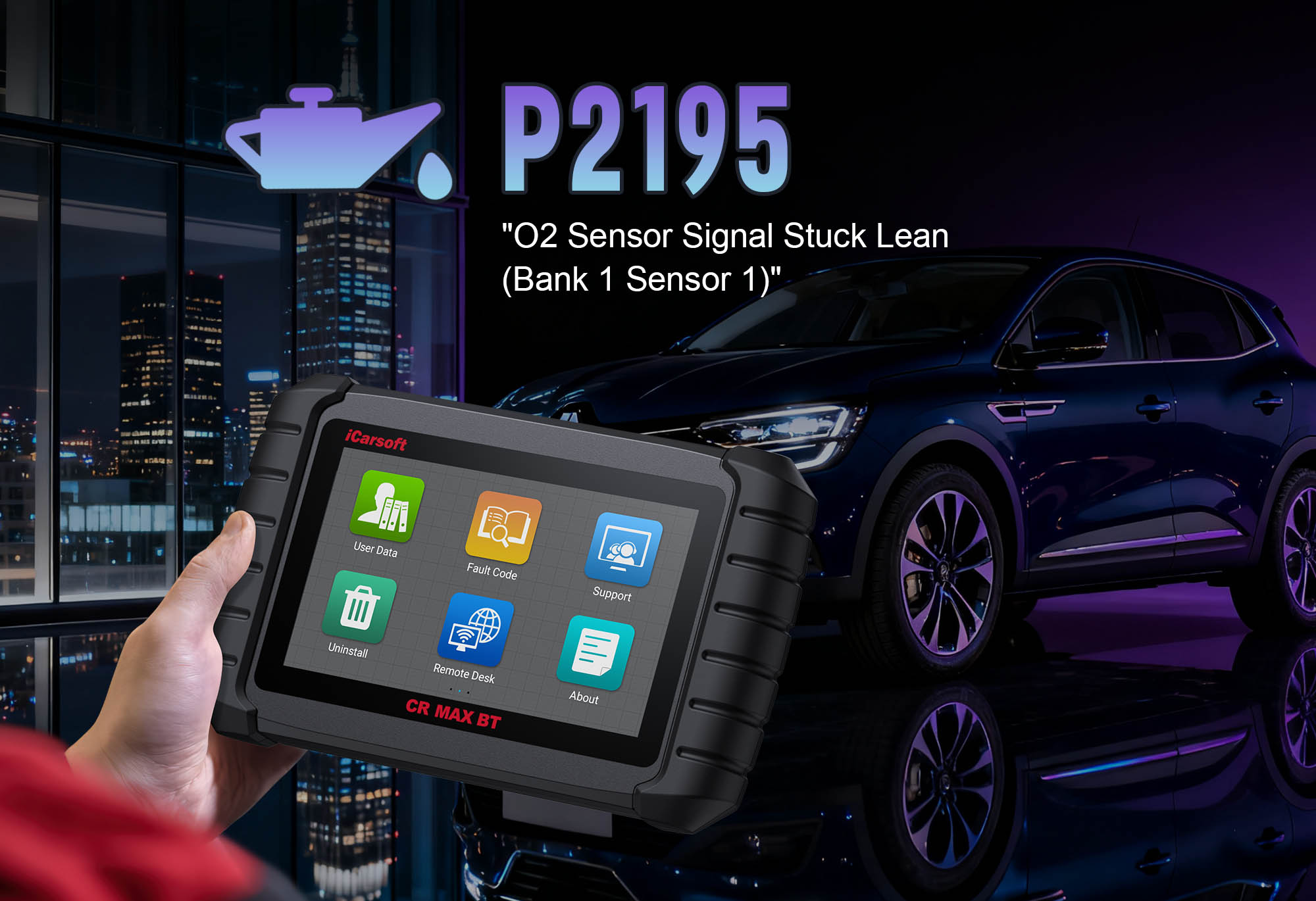 iCarsoft CR MAX BT: Analyzing O₂ sensor waveform to diagnose P2195 (Bank 1 Sensor 1)
Understanding P2195: Causes & Key Symptoms
A stuck-rich O₂ sensor disrupts the ECM’s ability to balance the air-fuel mixture, leading to distinct performance issues:
Key Symptoms of P2195
-
Check Engine Light: Illuminates when the O₂ sensor shows a rich signal for 2+ minutes without fluctuation, even after ECM adjustments.
-
Decreased Fuel Efficiency: A persistently rich mixture can lower MPG by 15–25% as unburned fuel exits the engine.
-
Rough Idle or Hesitation: Excess fuel can cause misfires, especially at idle or low speeds.
-
Catalytic Converter Overheating: Unburned fuel ignites in the converter, raising temperatures and risking damage (may trigger a "Converter Overheat" warning).
-
Strong Fuel Odor: Rich mixtures often produce a noticeable gasoline smell from the exhaust.
-
Sooty Exhaust: Black smoke or soot around the tailpipe indicates unburned fuel.
Common Causes of P2195
-
Faulty Upstream O₂ Sensor (Bank 1 Sensor 1): Internal failure (e.g., worn electrode) prevents the sensor from detecting oxygen correctly, sticking in a rich reading.
-
Fuel System Issues: A stuck-open fuel injector, high fuel pressure, or a faulty fuel pressure regulator floods the engine with excess fuel.
-
Vacuum Leaks: Unmetered air entering the engine (via cracked hoses or gaskets) tricks the ECM into adding more fuel, creating a rich mixture.
-
Air Intake Restriction: A clogged air filter or blocked intake manifold reduces airflow, skewing the air-fuel ratio rich.
-
Engine Oil Contamination: Oil entering the combustion chamber (from worn piston rings or valve seals) creates a rich signal.
-
Wiring/Connector Damage: Corroded or broken wires in the O₂ sensor circuit disrupt signal transmission, causing false rich readings.
Why iCarsoft CR MAX BT Excels at Diagnosing P2195
The CR MAX BT outperforms basic tools with features tailored to O₂ sensor diagnostics:
Oxygen Sensor Waveform Analysis
Visualizes the O₂ sensor’s voltage pattern, identifying a flat line above 0.6V (stuck rich) versus normal fluctuations.
Dual-Bank Comparison
Cross-references Bank 1 (faulty) with Bank 2 (if equipped) to highlight discrepancies in O₂ sensor behavior and fuel trim.
Fuel Trim Monitoring
Tracks short-term and long-term fuel trim values (STFT/LTFT) to confirm a rich condition (consistently negative trim indicates the ECM is trying to lean out the mixture).
3D Component Diagrams
Preloaded schematics show the Bank 1 Sensor 1 location (before the catalytic converter on cylinder bank #1) for 80+ makes (e.g., Toyota, Ford, Audi, Hyundai).
Injector Pulse Width Testing
Measures fuel injector opening time to detect stuck-open injectors contributing to rich mixtures.
Exhaust Gas Temperature (EGT) Tracking
Monitors EGT to identify catalytic converter overheating risks early.
Step-by-Step: Diagnose P2195 with iCarsoft CR MAX BT
-
Connect & Confirm the Code
Plug the CR MAX BT into your vehicle’s OBD-II port and pair it with your smartphone/tablet via the iCarsoft app (Bluetooth setup takes 30 seconds). Select your vehicle using Auto VIN Scan (reads VIN instantly) or manual entry (make/model/year/engine). Navigate to Engine > Fault Codes > Read Codes to confirm P2195. Tap Code Details for vehicle-specific insights (e.g., "Toyota: O₂ Sensor Bank 1 Sensor 1 Voltage = 0.8V – No Fluctuation for 3 Minutes").
-
Locate the Upstream O₂ Sensor (Bank 1 Sensor 1)
Use the CR MAX BT to avoid confusion: Go to Component Location > Engine > Exhaust System > O₂ Sensor (Bank 1 Sensor 1). The app displays a 3D diagram: Bank 1 contains cylinder #1; Sensor 1 is the upstream sensor (closest to the engine, before the catalytic converter).
-
Analyze O₂ Sensor Waveform & Fuel Trim Data
Real-time data reveals the root cause of the rich signal: Start the engine and let it reach operating temperature (10–15 minutes). In the app, go to Engine > Live Data > Oxygen Sensors and monitor:
-
Bank 1 Sensor 1 Voltage: Normal = fluctuates 0.1–0.9V every 1–2 seconds. P2195 = stays above 0.6V with little to no movement.
-
Short-Term Fuel Trim (STFT) & Long-Term Fuel Trim (LTFT): Normal = ±10%. Consistently -15% to -25% = ECM is reducing fuel to correct a rich condition (confirms P2195’s cause).
Access Waveform Analysis under "Special Functions": A healthy sensor shows a zigzag pattern; P2195 shows a flat line above 0.6V.
-
Compare with Bank 2 (If Equipped)
A Bank 2 comparison isolates Bank 1-specific issues: Navigate to Engine > Live Data > Bank 2 Sensors. Compare Bank 2 Sensor 1 voltage and fuel trim to Bank 1:
-
If Bank 2 is normal (fluctuating voltage, trim ±5%), the issue is isolated to Bank 1 (e.g., faulty injector, O₂ sensor).
-
If Bank 2 also shows rich values, the problem is systemic (e.g., high fuel pressure, clogged air filter).
-
Inspect the O₂ Sensor, Wiring & Air Intake
Physical issues are often the cause—check with guidance from the CR MAX BT:
-
O₂ Sensor Inspection: Ensure the engine is cool. Locate the sensor using the app’s diagram. Disconnect the connector and remove the sensor (use an O₂ sensor socket). Check for: Black soot coating (sign of rich mixture), white deposits (indicates coolant contamination), physical damage (cracks in the sensor housing).
-
Wiring & Connector Check: Follow the sensor’s wiring to the ECM (use the app’s diagram). Look for frayed wires, corrosion, or heat damage (from exhaust proximity). Clean the connector with electrical contact cleaner—corrosion often causes signal interference.
-
Air Intake Inspection: Check the air filter (use the app’s Air Filter Location Guide) for clogs. A dirty filter restricts airflow, creating a rich mixture. Inspect intake hoses for cracks or loose connections (vacuum leaks here can cause false rich readings).
-
Test Fuel System & Injectors
Fuel delivery issues often cause P2195—verify with the CR MAX BT:
-
Fuel Pressure Test: Navigate to Special Functions > Engine > Fuel System > Pressure Test. Compare readings to manufacturer specs (e.g., 40–50 psi for most gasoline engines). High pressure = faulty regulator or pump.
-
Injector Pulse Width Test: Monitor "Injector Pulse Width" in live data. Consistently high values (e.g., >5ms at idle) indicate stuck-open injectors on Bank 1.
-
Check for Engine Oil Contamination
Oil in combustion chambers creates rich signals: Check engine oil level and condition (use the app’s Oil Check Guide). Signs of contamination:
-
Milky oil (coolant mixing) or excessive fuel smell in oil (indicates leaking injectors).
-
Blue smoke from exhaust (burning oil) = worn piston rings or valve seals—requires mechanical repair.
-
Repair & Clear P2195
Fix the Root Cause:
-
Replace the upstream O₂ sensor (Bank 1 Sensor 1) with an OEM or OE-equivalent part (check the app’s Part Lookup).
-
Replace a clogged air filter and repair vacuum leaks in the intake system.
-
Fix fuel system issues: Replace a faulty pressure regulator, repair stuck injectors, or adjust fuel pressure.
-
Repair damaged wiring with heat-shrink connectors; replace corroded harnesses.
Clear the Code: In the app, go to Engine > Fault Codes > Clear Codes to delete P2195.
-
Validate the Repair
Confirm the O₂ sensor and fuel system work correctly:
-
Recheck live data—Bank 1 Sensor 1 voltage should fluctuate 0.1–0.9V, and fuel trim should return to ±10%.
-
Test drive for 15–20 minutes (including highway speeds) to ensure stable performance.
-
Monitor exhaust for reduced fuel odor and no black smoke.
-
Re-scan with the CR MAX BT: No P2195 recurrence = successful repair.
Preventing P2195 Recurrence
The CR MAX BT helps maintain reliable O₂ sensor performance long-term:
-
O₂ Sensor Maintenance: Use the app’s Service Reminder to replace upstream O₂ sensors every 60,000–100,000 miles (sooner for vehicles with high exhaust heat).
-
Fuel System Care: Set reminders to replace fuel filters every 30,000 miles and use quality fuel to prevent injector clogs.
-
Air Filter Checks: Inspect the air filter quarterly—replace when dirty to maintain proper airflow.
-
Regular Scans: Use the CR MAX BT’s Quick Scan monthly to monitor O₂ sensor voltage and fuel trim, catching rich conditions early.
Conclusion
P2195’s stuck-rich O₂ sensor disrupts critical air-fuel balance, but the iCarsoft CR MAX BT simplifies diagnosis with waveform analysis, fuel trim tracking, and dual-bank comparison. Whether replacing a sensor, fixing fuel delivery issues, or repairing wiring, this tool ensures you resolve the root cause—restoring fuel efficiency, protecting the catalytic converter, and reducing emissions.
With the CR MAX BT, tackling "oxygen sensor rich faults" becomes a precise process, keeping your engine’s air-fuel mixture perfectly balanced for performance and longevity.