Fix P1693: Fault Code Storage Module Communication Fault – Trust iCarsoft CR MAX BT
You're preparing for a long road trip, and the Check Engine Light suddenly lights up—no obvious performance issues, but that warning won't go away. A diagnostic scan reveals P1693, a code tied to your vehicle's control module communication. Defined as "Fault Code Storage Module Communication Fault," P1693 signals that the Engine Control Module (ECM) has lost communication with an auxiliary fault code storage module (often used in commercial vehicles, diesel trucks, or vehicles with multiple control units). This module stores critical fault data for subsystems like ABS, transmission, or emissions—and ignoring P1693 can hide underlying issues, leading to unexpected breakdowns. But with the iCarsoft CR MAX BT, you can diagnose, troubleshoot, and fix this communication issue like a pro—whether you're a fleet manager, DIY enthusiast, or professional mechanic.
For context: Modern vehicles use a network of control modules (ECM, TCM, ABS module, etc.) that communicate via CAN bus. The "fault code storage module" is a dedicated unit (or a feature within a subsystem module) that archives fault codes for later retrieval. When the ECM can't send or receive data from this module (due to wiring issues, module failure, or CAN bus errors), it triggers P1693. Unlike generic communication codes (e.g., U0100), P1693 specifically targets fault code storage, making it critical for tracking hidden issues. Let's break down everything you need to know about P1693 and how the CR MAX BT simplifies resolution.
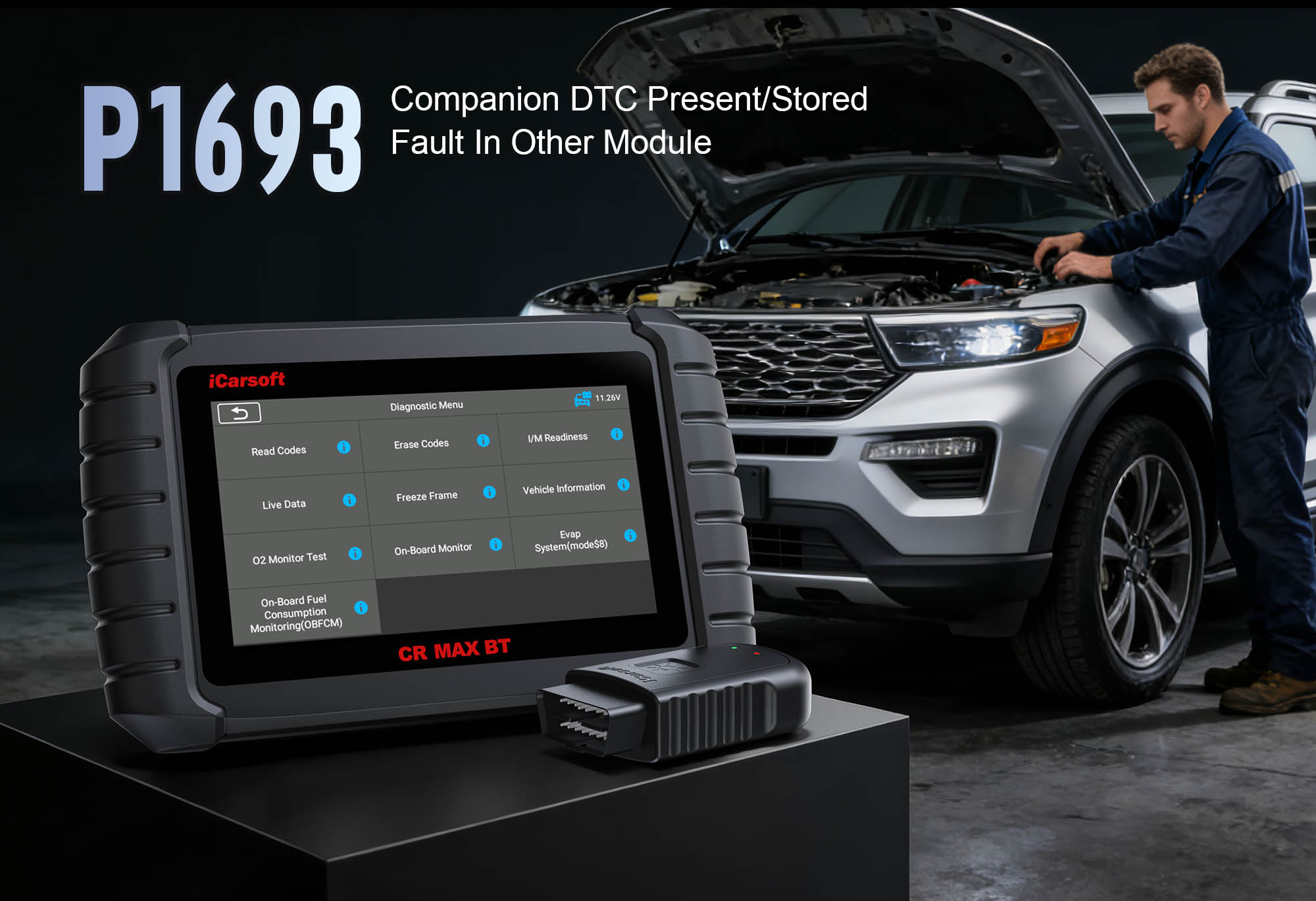 iCarsoft CR MAX BT monitoring CAN bus communication to diagnose P1693 fault code storage module issues
What Exactly Is the P1693 Code?
P1693 focuses on communication failures between the ECM and the fault code storage module, activating when the ECM detects a loss of signal for 2–5 consecutive seconds. This module is responsible for storing fault codes from subsystems that may not communicate directly with the ECM full-time (e.g., trailer brake controllers in trucks, or hybrid battery management modules). P1693 is most common in heavy-duty vehicles (e.g., Dodge Ram 2500, Ford Super Duty) and commercial fleets, but it also appears in passenger cars with advanced subsystem networks.
P1693 has make/model-specific trends tied to module design:
-
Dodge Ram 2500 6.7L Cummins P1693: Often linked to a faulty Body Control Module (BCM) or CAN bus wiring issues (common in 2013–2023 diesel models).
-
Ford F-350 6.7L Power Stroke P1693: Typically caused by a failed Instrument Cluster Control Module (ICCM) or loose CAN bus connectors (prevalent in 2011–2022 heavy-duty models).
-
Chevrolet Silverado 3500HD 6.6L Duramax P1693: Frequently stems from a malfunctioning Trailer Brake Control Module (TBCM) or ECM software glitch (common in 2015–2023 models).
-
Mercedes-Benz Sprinter 3.0L BlueTEC P1693: Often due to a faulty AdBlue Control Module or CAN bus short (prevalent in 2014–2022 commercial vans).
The iCarsoft CR MAX BT uses Auto VIN technology to pull your vehicle's exact module network specs—including CAN bus protocols, module addresses, and communication thresholds—eliminating guesswork and ensuring targeted diagnostics.
Key Symptoms of P1693 to Watch For
P1693 affects module communication, so symptoms often involve hidden fault data or subsystem malfunctions. Be alert for these critical warning signs:
-
Illuminated Check Engine Light: The most consistent indicator—may be paired with "Module Communication Error" or "Fault Data Unavailable" messages.
-
Missing Fault Codes: When scanning, some subsystems (e.g., ABS, transmission) show "No Data" instead of stored faults—hiding underlying issues.
-
Subsystem Malfunctions: Features controlled by the affected module (e.g., trailer brakes, AdBlue dosing) may stop working or operate erratically.
-
Erratic Gauge Readings: The instrument cluster may show incorrect values (e.g., false low fuel, speedometer freeze) if the storage module communicates with the ICCM.
-
Reduced Diagnostic Capability: Basic scanners can't access stored faults in the affected module—leading to misdiagnosis of other issues.
-
Vehicle Goes into Limp Mode (Rare): If the lost module controls critical systems (e.g., emissions), the ECM may activate limp mode to protect components.
-
CAN Bus Network Errors: Other communication codes (e.g., U0121, U0140) may appear alongside P1693, indicating a broader network issue.
Common Causes of P1693 (And How CR MAX BT Identifies Them)
P1693 has five primary causes, and the CR MAX BT's advanced module diagnostics help you pinpoint which one is affecting your vehicle—no need for expensive CAN bus analyzers:
|
Cause
|
Description
|
|
Failed Fault Code Storage Module
|
Internal module failure disrupts communication with the ECM. The CR MAX BT's module communication test sends CAN bus commands to verify if the module responds.
|
|
Damaged CAN Bus Wiring
|
Frayed wires, shorts, or corrosion break the communication path. The CR MAX BT's CAN bus integrity test measures voltage/resistance to detect wiring anomalies.
|
|
Loose/Corroded Connectors
|
Poor contact at module plugs disrupts signal flow. The CR MAX BT's connector resistance test identifies high-resistance connections causing intermittent communication.
|
|
ECM/Module Software Glitch
|
Outdated firmware or corrupted data blocks communication. The CR MAX BT's One-Key Upgrade installs free ECM/module patches to restore signal flow.
|
|
Power Supply Issues
|
Low battery voltage or faulty fuses deprive the storage module of power. The CR MAX BT's battery load test and fuse status check identify power-related problems.
|
Why iCarsoft CR MAX BT Is the Best Tool for P1693
Basic code readers only confirm P1693 is present—they can't diagnose CAN bus networks or access faulty modules. The CR MAX BT offers industry-leading module communication diagnostics with these exclusive features:
Multi-Module Communication Testing
Tests communication with 1,200+ control modules (BCM, TBCM, AdBlue module) to isolate the faulty fault code storage unit—critical for heavy-duty and commercial vehicles.
CAN Bus Integrity Diagnostics
Measures CAN High/CAN Low voltage (2.5V/2.5V at rest) and resistance (60Ω) to find shorts, opens, or corrosion—no separate CAN bus analyzer needed.
Direct Module Fault Code Retrieval
Bypasses the ECM to access hidden fault codes in the storage module via alternate CAN paths—uncovers issues masked by P1693.
Bi-Directional Module Activation
Sends commands to the fault code storage module to test responsiveness—confirms module functionality without removing panels or connectors.
Module Coding & Firmware Updates
Programs new modules to the vehicle's network and installs free firmware updates—saves $200–$500 in dealership programming fees.
Heavy-Duty & Fleet Vehicle Support
Works with commercial vehicles (Ford Super Duty, Dodge Ram HD, Mercedes Sprinter) and fleet-specific modules—supports CAN FD and J1939 protocols.
Step-by-Step: Diagnose & Fix P1693 with iCarsoft CR MAX BT
-
1. Confirm P1693 & Gather Vehicle-Specific Data
1. Plug the CR MAX BT's OBD-II adapter into your vehicle's port and pair via Bluetooth (connects in 10 seconds).
2. Select Auto VIN Identify to pull your vehicle's module network specs, then navigate to Vehicle Network > Fault Codes > Read Codes to confirm P1693.
3. Tap Code Details for insights—e.g., "Dodge Ram: P1693 BCM Communication Fault; CAN Bus Voltage: 3.2V/1.8V (Imbalanced); Check Wiring."
-
2. Visual Inspection & Basic Checks
1. Inspect CAN bus wiring (twisted-pair orange/black or green/white) for frays, shorts, or corrosion—repair obvious damage.
2. Check module connectors (ECM, BCM, TBCM) for loose pins or corrosion—clean with electrical contact cleaner.
3. Test battery voltage with the CR MAX BT: Go to System Tools > Battery Test—voltage should be 12.4V–12.7V (low = recharge/replace).
-
3. Monitor Live CAN Bus & Module Data
Start the engine and let it idle for 5 minutes. Go to Vehicle Network > Live Data > CAN Bus and monitor:
- CAN Bus Voltage: Should be 2.5V/2.5V at rest; 3.5V/1.5V during communication. Imbalanced voltage = wiring issue.
- Module Response Time: Fault code storage module should respond within 100ms. "No Response" = faulty module.
- Subsystem Communication: Check if other modules (TCM, ABS) are responding—multiple failures = network issue.
-
4. Run CAN Bus Integrity Test
1. Navigate to Vehicle Network > Special Functions > CAN Bus Integrity Test.
2. The CR MAX BT measures resistance between CAN High and CAN Low wires—"Above 120Ω" = open circuit; "Below 40Ω" = short circuit.
3. "Normal (60Ω)" = rule out wiring; focus on module or software issues.
-
5. Perform Module Communication Test
1. Go to Vehicle Network > Special Functions > Module Communication Test.
2. Select the fault code storage module (e.g., BCM, TBCM) from the menu.
3. The CR MAX BT sends commands—"No Response" = faulty module; "Intermittent Response" = connector/wiring issue.
-
6. Retrieve Hidden Fault Codes
1. Use the CR MAX BT's Direct Module Access feature to bypass the ECM:
2. Go to Vehicle Network > Special Functions > Direct Module Access.
3. Select the faulty module and pull stored codes—uncovers hidden issues masked by P1693.
-
7. Update ECM/Module Firmware (If Needed)
1. Navigate to System Tools > One-Key Upgrade.
2. Connect to Wi-Fi and install the latest ECM/module firmware (free of charge).
3. This fixes software glitches causing false P1693 codes, common in Chevrolet and Mercedes models.
-
8. Repair & Validate the Fix
1. Address the root cause based on test results:
- Failed Module: Replace with OEM unit (e.g., BCM, TBCM) and code with CR MAX BT.
- Damaged Wiring: Repair frays or replace shorted CAN bus sections.
- Loose Connectors: Clean/replace connectors and re-secure pins.
- Power Issues: Recharge/replace battery and check module fuses.
2. Clear P1693 via Vehicle Network > Fault Codes > Clear Codes.
3. Test drive 50–100 miles (activate subsystems like trailer brakes or AdBlue dosing).
4. Re-scan with CR MAX BT—stable CAN bus voltage and module communication confirm the fix.
FAQs: Your P1693 Questions Answered
Q: Is it safe to drive with P1693?
A: It depends—if no other warning lights are on, short daily drives are safe. But P1693 hides underlying faults (e.g., transmission issues, emissions leaks) that can lead to breakdowns. Fix it before long trips or heavy use, especially in commercial vehicles.
Q: How much does it cost to fix P1693?
A: Costs vary by cause—here's a breakdown:
- Module replacement (e.g., BCM): $200–$600 (parts + labor; $800–$1,200 at a dealership).
- CAN bus wiring repair: $100–$300 (depends on wire accessibility).
- Connector cleaning/replacement: $50–$150 (parts + labor).
- Software update: $150–$300 (dealership) or free (with CR MAX BT).
- Battery replacement: $150–$300 (parts + labor).
The CR MAX BT saves $200+ by letting you diagnose the issue and avoid unnecessary module replacements.
Q: Why does P1693 come back after I clear it?
A: You didn't fix the root cause. For example, if you cleared the code but didn't repair a shorted CAN bus wire, the communication failure will reoccur. Use the CR MAX BT's CAN bus integrity test to find hidden wiring issues.
Q: Can a dead battery cause P1693?
A: Yes—low battery voltage (below 12V) can disrupt module power, leading to temporary communication loss. Recharging the battery may clear P1693, but if it returns, there's a separate issue (e.g., faulty module).
Q: Does P1693 affect passenger cars or only trucks?
A: It affects both—while common in heavy-duty trucks and commercial vehicles, passenger cars with multiple subsystems (e.g., hybrid vehicles, luxury cars with advanced driver aids) also trigger P1693 when fault storage modules fail.
Q: Will P1693 cause a failed emissions test?
A: Indirectly—if P1693 hides emissions-related faults (e.g., AdBlue issues in diesel vehicles), the emissions test will fail. Even if P1693 itself isn't an emissions code, the hidden faults it masks will cause non-compliance.
Q: Can the CR MAX BT access hidden fault codes stored in the faulty module?
A: Yes—its direct module access feature bypasses the ECM and connects directly to the fault code storage module via alternate CAN paths. This lets you pull hidden faults even when the ECM can't communicate.
Q: How often should I update the CR MAX BT for P1693 fixes?
A: Update every 3 months via free Wi-Fi. New firmware includes support for 2024+ module protocols (e.g., CAN FD for modern commercial vehicles) and fixes for false P1693 codes caused by software glitches.
Conclusion
P1693 is a critical communication fault that hides underlying issues—putting your vehicle at risk of unexpected breakdowns. With the iCarsoft CR MAX BT, you have the power to identify whether the issue is a faulty module, damaged CAN bus wiring, or software glitch—then fix it quickly and affordably.
No more guessing, no more overpaying for dealership diagnostics. Invest in the CR MAX BT today, and take control of P1693—and your vehicle's reliability, safety, and long-term performance.