Fix P2011: Intake Manifold Runner Control Fault (Bank 1) – How iCarsoft CR MAX BT Simplifies Repairs
Imagine merging onto the highway, only to feel your engine lag—no warning at first, but minutes later, the Check Engine Light glows. A quick scan reveals P2011, a code that’s easy to misdiagnose without the right tools. Short for “Intake Manifold Runner Control (IMRC) Circuit/Actuator Fault (Bank 1),” P2011 signals a problem with the system that adjusts airflow into your engine. This isn’t just a minor annoyance: left unfixed, it leads to reduced power, worse fuel efficiency, and even engine damage over time. But with the iCarsoft CR MAX BT, you can skip the guesswork, pinpoint the issue fast, and fix it like a pro—whether you’re a home DIYer or a professional mechanic.
First, let’s break down the basics: “Bank 1” refers to the cylinder bank with the number 1 cylinder (check your owner’s manual for specifics). The IMRC system uses an actuator (motor or solenoid) to open or close intake manifold runners—narrow passages that optimize airflow. At low speeds, runners close to boost torque; at high speeds, they open to maximize power. When the Engine Control Module (ECM) detects the actuator isn’t responding correctly (e.g., electrical glitches, stuck parts), it triggers P2011. Unlike generic codes, P2011 narrows the issue to Bank 1’s IMRC system—but without the right diagnostic tool, finding the root cause (wiring? actuator? ECM?) feels like searching in the dark. That’s where the CR MAX BT shines.
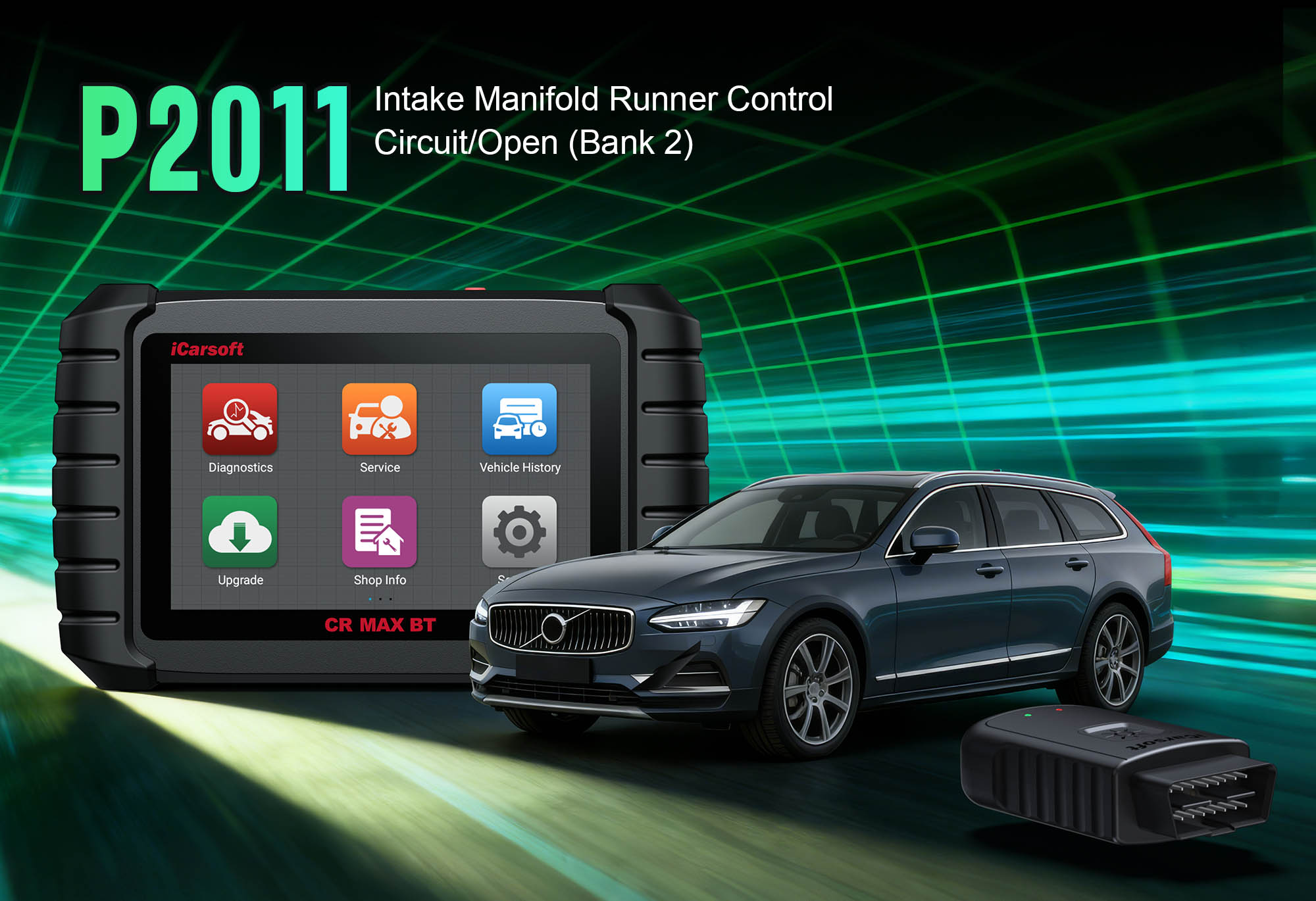 iCarsoft CR MAX BT monitoring IMRC actuator position to diagnose P2011 Bank 1 airflow issues
What Is P2011, and Which Vehicles Are Prone to It?
P2011 is an OBD-II code focused on electrical or mechanical failures in Bank 1’s IMRC system. It activates when the ECM runs self-tests and finds mismatches between its commands (e.g., “open runners”) and the actuator’s actual performance. Unlike P2004 (IMRC stuck open) or P2005 (stuck closed), P2011 covers both electrical issues (e.g., frayed wires) and mechanical problems (e.g., seized actuators)—making it a common code in vehicles with variable intake manifolds (most 2000+ gasoline engines).
Certain makes and models are more likely to trigger P2011 due to their IMRC design:
-
Ford F-150 5.0L Coyote (2011–2023): Often linked to faulty IMRC actuator motors or broken runner linkages—common in high-mileage trucks.
-
Chevrolet Silverado 5.3L EcoTec3 (2014–2022): Typically caused by shorted IMRC circuits or outdated ECM software.
-
Chrysler 300C 5.7L HEMI (2011–2023): Frequently stems from carbon-clogged runners or seized actuators.
-
BMW 3 Series 3.0L N55 (2011–2018): Often due to malfunctioning IMRC solenoids or corroded wiring in turbocharged models.
The iCarsoft CR MAX BT eliminates guesswork with Auto VIN Identify—it automatically pulls your vehicle’s exact IMRC specs (voltage ranges, actuator type, wiring diagrams) so you don’t waste time on generic fixes. No more scrolling through forums or buying parts that don’t fit.
Key Symptoms of P2011 to Watch For
P2011 disrupts airflow, so symptoms are hard to ignore—especially during acceleration. Here’s what to look for:
-
Check Engine Light: The most obvious sign—may pop up with “IMRC Malfunction” or “Reduced Power” messages on newer dashboards.
-
Engine Lag: Sluggish acceleration, especially at 30–60 mph, as the IMRC fails to open runners for extra airflow.
-
Worse Fuel Efficiency: A misfiring IMRC system can increase fuel use by 10–15%—you’ll notice more frequent trips to the gas station.
-
Rough Idling: If the actuator sticks open/closed, the engine may shake or stall at stoplights.
-
Strange Noises: A clicking or grinding sound from the intake manifold means the actuator is struggling to move (a sign it’s seized).
-
Failed Emissions Tests: Imbalanced airflow raises hydrocarbon (HC) levels, leading to fails in EPA Tier 3, CARB, or Euro 6 tests.
Common Causes of P2011 (And How CR MAX BT Finds Them)
P2011 has 5 main causes, and the CR MAX BT’s advanced diagnostics zero in on the issue without costly disassembly:
|
Cause
|
Description
|
|
Faulty IMRC Actuator
|
Internal motor/solenoid failure prevents runner movement. The CR MAX BT’s Bi-directional Activation Test sends commands to the actuator—“No Response” confirms a faulty unit.
|
|
Damaged Wiring/Connectors
|
Frayed wires or corroded plugs disrupt voltage flow. The CR MAX BT’s Circuit Continuity Test measures resistance to spot breaks, shorts, or corrosion.
|
|
Carbon-Clogged Runners
|
Deposits (common in direct-injection engines) trap runners in one position. The CR MAX BT’s Live Data shows mismatches between ECM commands and actual runner position.
|
|
ECM Software Glitch
|
Outdated firmware misinterprets IMRC data, triggering false P2011 codes. The CR MAX BT’s One-Key Upgrade installs free ECM patches to resolve glitches.
|
|
Broken Runner Linkage
|
Plastic rods connecting the actuator to runners snap or detach. The CR MAX BT’s Actuator Feedback Test reveals discrepancies between commands and physical movement.
|
Why iCarsoft CR MAX BT Is the Best Tool for P2011
Basic code readers only tell you “P2011 is present”—the CR MAX BT dives deep into your IMRC system to find the root cause. Here’s how it outperforms cheap scanners:
Bank-Specific IMRC Diagnostics
Pulls vehicle-specific specs for Bank 1 (e.g., Ford’s 12V actuator voltage, BMW’s 5V solenoid requirements) to ensure targeted testing—no generic data.
Bi-Directional Actuator Control
Activate the IMRC actuator remotely to test movement—listen for motor hum and verify runner position without removing the intake manifold.
Live IMRC Data Monitoring
Track actuator position (0–100%), circuit voltage (9V–14V), and runner feedback in real time—spot stuck components or electrical anomalies instantly.
Circuit Continuity & Resistance Testing
Identify frayed wires, corroded connectors, or short circuits with precision—eliminates the need for a separate multimeter.
ECM Coding & Firmware Updates
Calibrate new IMRC actuators to the ECM and install free firmware updates—fixes software glitches and ensures compatibility (saves $150–$300 in dealership fees).
58+ Vehicle Brand Compatibility
Works with Ford, Chevy, Chrysler, BMW, Mercedes, and luxury brands—supports turbocharged and direct-injection engines prone to P2011.
Step-by-Step: Diagnose & Fix P2011 with iCarsoft CR MAX BT
-
1. Confirm P2011 & Visual Inspection
1. Plug the CR MAX BT’s OBD-II adapter into your vehicle’s port and pair via Bluetooth (connects in 10 seconds).
2. Select Auto VIN Identify to pull your vehicle’s IMRC specs, then navigate to Engine > Fault Codes > Read Codes to confirm P2011.
3. Tap Code Details for insights—e.g., “Ford F-150: P2011 IMRC Actuator Fault; Current Position: 0% (Expected: 80% at 50 mph); Check Linkage.”
4. Visually inspect the IMRC actuator (on intake manifold) for loose wires, corrosion, or broken linkages.
-
2. Monitor Live IMRC Data
Start the engine, let it idle for 5 minutes, then drive 30–60 mph for 10 minutes. Go to Engine > Live Data > Intake System > IMRC Bank 1 and monitor:
- Actuator Position: Should adjust with speed (20% at idle, 80% at 50 mph). Stuck = seized actuator or broken linkage.
- Circuit Voltage: Should stay 9V–14V. Below 9V = wiring fault; 0V = open circuit.
- Runner Feedback: Should match ECM commands. Mismatch = carbon buildup or linkage issues.
-
3. Run Targeted IMRC Tests
Go to Special Functions > Engine Control > IMRC Diagnostics and run these tests:
1. Actuator Activation Test: Sends open/close commands—“No Movement” = faulty actuator; “Intermittent Movement” = linkage issue.
2. Circuit Continuity Test: Checks wiring between actuator and ECM—“High Resistance” = corroded connectors; “No Continuity” = frayed wire.
3. Runner Position Verification: Confirms runners move to ECM-requested positions—“Stuck” = carbon buildup.
-
4. Repair & Validate the Fix
1. Address the root cause based on test results:
- Faulty Actuator: Replace with OEM part (aftermarket parts fail calibration). Use the CR MAX BT’s activation test to confirm functionality.
- Damaged Wiring: Repair frays or clean connectors with electrical cleaner. Re-test continuity.
- Clogged Runners: Clean with carbon cleaner (minor) or replace intake manifold (severe). Recheck position data.
- ECM Glitch: Run One-Key Upgrade to install firmware (free via Wi-Fi).
2. Clear P2011 via Engine > Fault Codes > Clear Codes.
3. Test drive 100–150 miles (mix highway/city). Re-scan with CR MAX BT—stable actuator position and normal voltage confirm the fix.
FAQs: Your P2011 Questions Answered
Q: Is it safe to drive with P2011?
A: Short trips are okay, but long drives risk reduced power and engine damage (e.g., lean misfires). Avoid towing or high speeds until you fix it.
Q: How much does it cost to fix P2011?
A: Costs vary:
- Actuator replacement: $150–$350 (DIY-friendly for most cars).
- Wiring repair: $80–$200 (depends on accessibility).
- Intake manifold cleaning/replacement: $200–$600.
- Dealership fix: $500–$1,000 (includes diagnostic fees).
The CR MAX BT saves $200+ by letting you diagnose and do simple fixes yourself.
Q: Why does P2011 come back after I clear it?
A: You didn’t fix the root cause—e.g., clearing the code but not cleaning clogged runners. Use the CR MAX BT’s tests to find hidden issues.
Q: Can carbon buildup really cause P2011?
A: Yes—direct-injection engines are prone to carbon deposits that trap runners. The CR MAX BT’s runner position test will show “stuck” readings.
Q: Does P2011 affect turbocharged cars more?
A: Yes—turbo engines rely on precise IMRC airflow to balance boost. P2011 in turbos leads to worse lag and power loss.
Q: Will P2011 make me fail emissions tests?
A: Absolutely—high HC emissions from imbalanced airflow fail EPA/CARB standards. Fix it with the CR MAX BT first.
Q: Can the CR MAX BT calibrate a new IMRC actuator?
A: Yes—its Actuator Coding function syncs new parts with your ECM, so they work correctly from day one.
Q: How often should I update the CR MAX BT?
A: Every 3 months via Wi-Fi—new firmware adds 2024+ vehicle support and fixes false P2011 codes.
Conclusion
P2011 is a warning sign your engine isn’t getting the airflow it needs—but with the iCarsoft CR MAX BT, you don’t need to be a mechanic to fix it. This tool turns complex IMRC diagnostics into a simple process, saving you time and money on guesswork and dealership fees.
No more guessing, no more overpaying. Invest in the CR MAX BT today, and take control of P2011—and your car’s performance, fuel efficiency, and long-term reliability.