Fix P2201: NOx Sensor Circuit Issue – Trust iCarsoft CR MAX BT
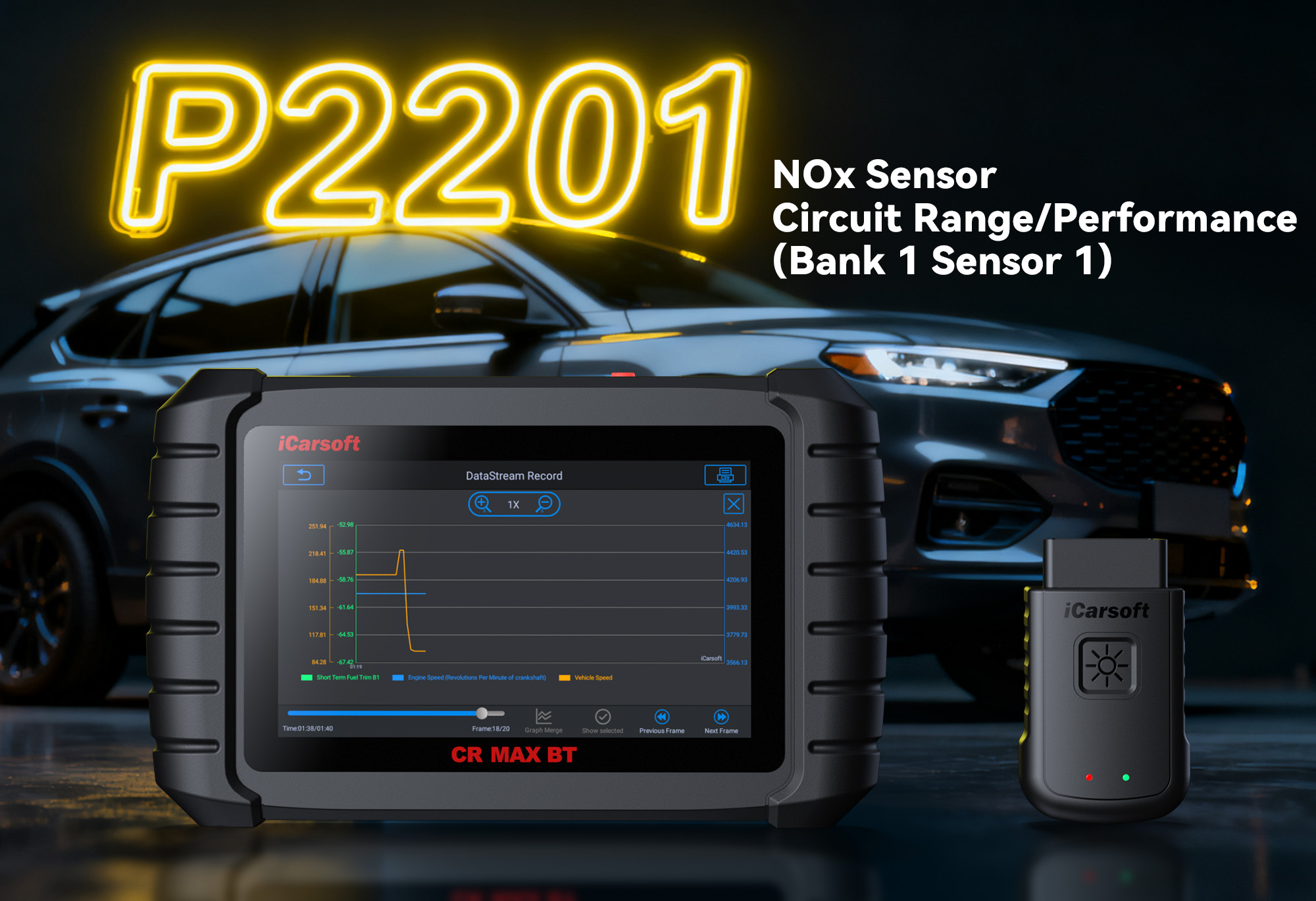
You’re driving your diesel vehicle, and suddenly the Check Engine Light illuminates—followed by a “Reduced Engine Power” warning on the dashboard. A diagnostic scan reveals P2201, a code that targets your vehicle’s Nitrogen Oxide (NOx) sensor. Defined as “NOx Sensor Circuit Range/Performance (Bank 1, Sensor 1),” this fault disrupts your vehicle’s emissions control system, risking failed inspections, increased AdBlue consumption, and even engine damage. But with the iCarsoft CR MAX BT, you can diagnose, troubleshoot, and fix P2201 like a pro—whether you’re a DIY enthusiast or a professional mechanic.
The NOx sensor is critical for diesel vehicles equipped with Selective Catalytic Reduction (SCR) systems. It measures nitrogen oxide levels in the exhaust, sending real-time data to the Engine Control Module (ECM) to adjust AdBlue injection and reduce emissions. When the sensor’s circuit malfunctions—sending erratic, too-high, or too-low signals—the ECM can’t optimize the SCR system, triggering P2201. Let’s break down everything you need to know about P2201 and how the CR MAX BT makes resolution simple.
What Exactly Is the P2201 Code?
P2201 focuses on the NOx sensor circuit (typically the upstream sensor near the exhaust manifold). It activates when the sensor’s voltage output or communication with the ECM falls outside the manufacturer’s acceptable range. Unlike other emissions codes, P2201 specifically points to electrical or circuit-related issues—not just sensor failure—such as wiring damage, poor connections, or ECM communication glitches.
P2201 is common in diesel vehicles across major makes, with model-specific trends:
-
Volkswagen Touareg TDI P2201: Often linked to sensor wiring damage from exhaust heat (common in 2015–2020 models).
-
Ford F-250 Power Stroke P2201: Typically caused by a faulty NOx sensor or corroded connector (prevalent in 2017–2023 6.7L models).
-
Mercedes-Benz E350 BlueTEC P2201: Frequently stems from ECM software glitches or sensor calibration errors (common in 2014–2021 variants).
The iCarsoft CR MAX BT uses Auto VIN technology to pull your vehicle’s exact NOx sensor specs—including circuit voltage ranges and SCR system details—eliminating guesswork and ensuring targeted diagnostics.
Key Symptoms of P2201 to Watch For
P2201 disrupts emissions control and engine performance, so symptoms are hard to miss. Be alert for these critical warning signs:
-
Illuminated Check Engine Light: The most obvious indicator—often paired with “AdBlue System Fault” or “Emissions Control Malfunction” messages.
-
Reduced Engine Power: Many vehicles enter “limp mode” to protect the SCR system, limiting speed to 40–50 mph.
-
Increased AdBlue Consumption: The ECM may over-inject AdBlue to compensate for faulty sensor data, doubling or tripling usage.
-
Failed Emissions Tests: High NOx levels will cause non-compliance with strict standards like Euro 6 or EPA Tier 3.
-
Engine Hesitation: Erratic sensor signals disrupt fuel-air balance, leading to sluggish acceleration or rough idling.
-
AdBlue Warning Light: Some vehicles trigger a separate AdBlue light, even if levels are full (due to sensor miscommunication).
-
Catalytic Converter Overheating: Unregulated NOx levels can damage the SCR catalyst, causing a burning smell or reduced efficiency.
Common Causes of P2201 (And How CR MAX BT Identifies Them)
Faulty NOx Sensor
Internal sensor failure from heat or contamination. The CR MAX BT’s NOx sensor performance test checks voltage output against exhaust NOx levels to confirm faults.
Damaged Wiring/Connectors
Frayed wires, corroded terminals, or water damage disrupt the circuit. The CR MAX BT’s continuity test detects breaks/shorts without a multimeter.
Poor Sensor Ground
Loose/corroded ground connection causes erratic signals. The CR MAX BT’s voltage test verifies ground integrity and power supply to the sensor.
ECM Communication Glitch
Software errors misinterpret sensor data. The CR MAX BT’s communication test identifies glitches and offers free firmware updates to fix them.
SCR System Contamination
Debris/AdBlue residue on the sensor tip skews readings. The CR MAX BT’s live data monitoring shows inconsistent NOx levels to flag contamination.
Why iCarsoft CR MAX BT Is the Best Tool for P2201
Basic code readers only tell you “P2201 is present”—the CR MAX BT goes further, helping you diagnose the root cause and fix it. Here’s how it outperforms cheap scanners:
NOx Sensor Specific Testing
Run targeted tests for voltage, response time, and ECM communication—matching your vehicle’s OEM specs (e.g., VW’s 5V signal range).
AdBlue System Diagnostics
Monitor AdBlue level, injection rate, and SCR catalyst efficiency to rule out related issues critical for diesel P2201 resolution.
Bi-Directional Control
Send commands to the NOx sensor to verify responsiveness—3x faster than manual testing—and confirm circuit functionality.
Auto VIN Identification
Automatically detects your diesel vehicle’s make/model/engine (e.g., Ford Power Stroke) to pull precise NOx system details.
ECM Coding & Firmware Updates
Calibrate new NOx sensors or update ECM software—saves $150–$300 in dealership programming fees.
Lifetime Free Wi-Fi Updates
Access new NOx sensor specs and SCR diagnostics for 2024+ diesel models—no recurring subscription fees.
Step-by-Step: Diagnose & Fix P2201 with CR MAX BT
Step 1: Visual Inspection & Tool Connection
Inspect NOx sensor wiring/connectors for damage; plug CR MAX BT’s OBD-II adapter into the port and pair via Bluetooth (10-second connection).
Step 2: AutoVIN Identify & Code Confirmation
Select AutoVIN to pull your vehicle’s NOx/SCR specs; navigate to Engine > Fault Codes > Read Codes to confirm P2201 and view model-specific insights.
Step 3: Live NOx Sensor Data Monitoring
Start the engine and reach operating temperature; monitor NOx sensor voltage (0.1V–5V), NOx concentration (0–500 ppm), and AdBlue injection rate for anomalies.
Step 4: Run Targeted Diagnostic Tests
Go to Special Functions > Emissions Control > NOx Sensor Diagnostics to run performance, continuity, voltage supply, and ECM communication tests.
Step 5: Repair the Root Cause
Replace faulty NOx sensors, repair damaged wiring, fix ground connections, update ECM firmware, or clean sensor contamination (follow test results).
Step 6: Code Clear & Validation Test Drive
Erase P2201 via Fault Codes > Clear Codes; test drive 50–100 miles (city + highway) and re-scan to confirm stable sensor data and no code recurrence.
FAQs: Your P2201 Questions Answered
Is it safe to drive with P2201?
Short trips (5–10 miles) are manageable if there’s no reduced power, but long-term driving risks SCR catalyst damage and failed emissions tests. Avoid heavy loads and highways until the code is fixed.
How much does it cost to fix P2201?
Costs vary by cause: NOx sensor replacement ($350–$600), wiring repair ($150–$300), dealership ECM update ($100–$200, free with CR MAX BT), dealership diagnostic + repair ($800–$1,500). The CR MAX BT saves $200+ on diagnostics and DIY fixes.
Why does P2201 come back after sensor replacement?
You missed a secondary issue—like damaged wiring, poor ground, or uncalibrated ECM. Use the CR MAX BT’s live data and circuit tests to find the hidden problem.
Can bad AdBlue cause P2201?
Indirectly—contaminated or diluted AdBlue can damage the SCR catalyst, leading to erratic NOx levels that confuse the sensor. The CR MAX BT’s AdBlue system test checks fluid quality and injection rate.
Does P2201 affect gasoline vehicles?
No—P2201 is exclusive to diesel vehicles with SCR systems. Gasoline vehicles don’t use NOx sensors in the same way and won’t trigger this code.
Will P2201 cause a failed emissions test?
Yes—faulty NOx sensors lead to high nitrogen oxide emissions, which fail strict standards like Euro 6 or EPA Tier 3. Fix P2201 with the CR MAX BT to ensure compliance.
Can the CR MAX BT test both upstream and downstream NOx sensors?
Yes—its NOx sensor diagnostics support both upstream (Bank 1, Sensor 1) and downstream (Bank 1, Sensor 2) sensors, letting you identify which one is faulty.
How often should I update the CR MAX BT for P2201 fixes?
Update every 3 months via free Wi-Fi. New firmware includes NOx sensor specs for 2024+ diesel models and fixes ECM communication glitches that trigger false P2201 codes.
Final Thoughts: Take Control of P2201 & Your Diesel’s Emissions
P2201 is a critical warning sign for your diesel vehicle’s NOx sensor and SCR system—ignoring it leads to costly repairs, failed inspections, and reduced performance. With the iCarsoft CR MAX BT, you can skip the dealership markup and diagnose the root cause yourself, whether it’s a faulty sensor, damaged wiring, or an ECM glitch.
No more guessing, no more overpaying. Invest in the CR MAX BT today to resolve P2201 quickly, ensure emissions compliance, and keep your diesel vehicle running at its best.