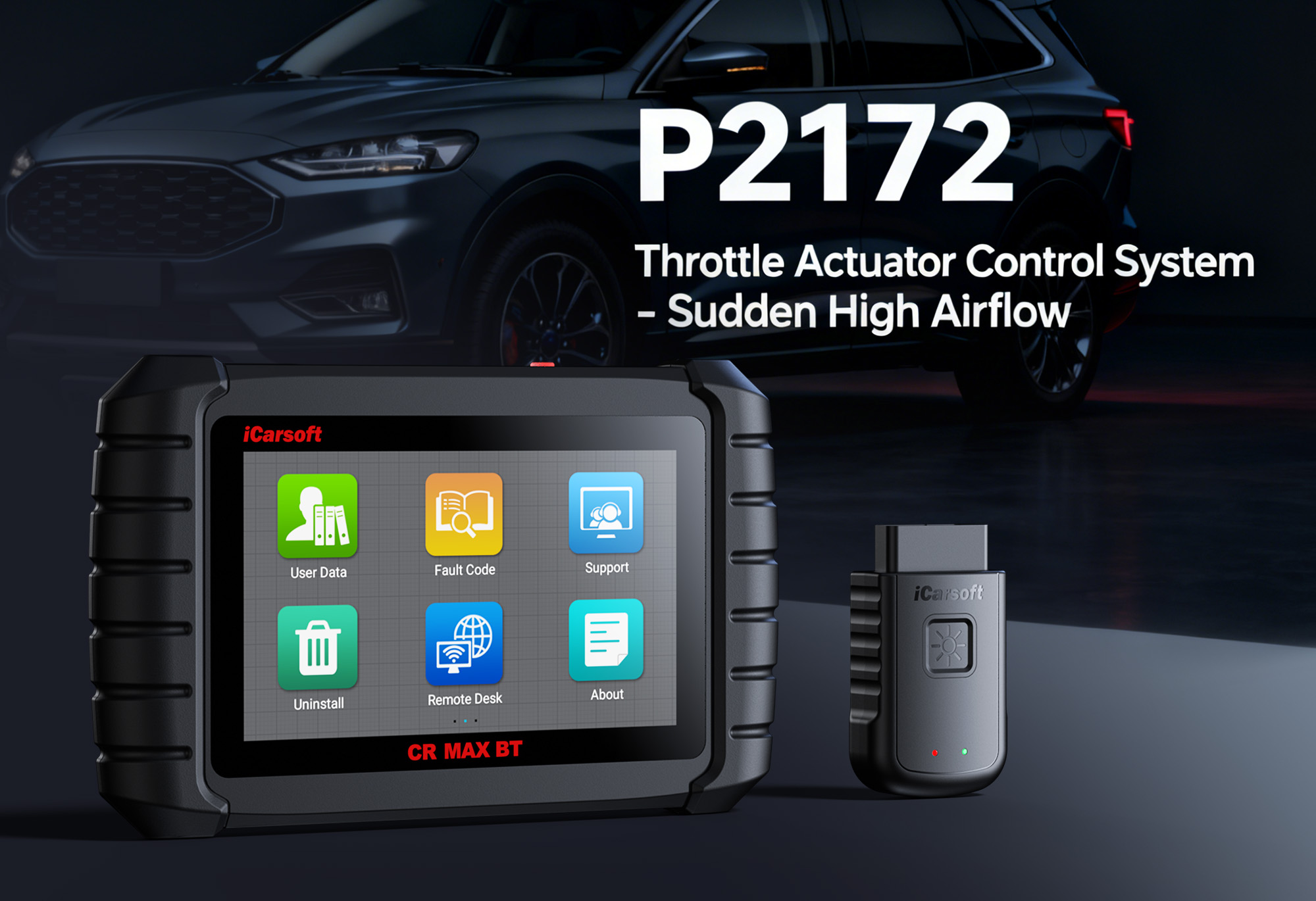
Fix P2172: Air-Fuel Ratio Imbalance – Trust iCarsoft CR MAX BT
You’re driving, and suddenly your engine sputters—followed by a glowing Check Engine Light. A quick diagnostic scan pulls up P2172, a code that spells trouble for your vehicle’s fuel efficiency and performance. Defined as “Air-Fuel Ratio (AFR) Imbalance at Idle or Cruise (Closed Loop Fuel Control),” P2172 signals that your engine is getting too much air or too little fuel (or vice versa), throwing off the critical 14.7:1 ideal AFR. Ignoring it can lead to misfires, catalytic converter damage, and skyrocketing fuel costs—but with the iCarsoft CR MAX BT, you can diagnose, troubleshoot, and fix this issue like a pro, whether you’re a DIY hobbyist or a professional mechanic.
The air-fuel ratio is the backbone of engine performance. The Engine Control Module (ECM) uses oxygen sensors, mass airflow (MAF) sensors, and throttle position sensors (TPS) to adjust fuel delivery in real time—this is “closed loop fuel control.” When these sensors send conflicting data, or when there’s a leak in the intake system, the ECM can’t maintain the perfect AFR, triggering P2172. Let’s break down everything you need to know about P2172 and how the CR MAX BT makes resolving it simple.
What Exactly Is the P2172 Code?
P2172 targets the closed-loop fuel control system, which relies on constant feedback from sensors to balance air and fuel. Specifically, it indicates that the ECM has detected a persistent imbalance between the air entering the engine and the fuel being injected—usually a “lean” condition (too much air) or occasionally a “rich” condition (too much fuel). This imbalance is most noticeable at idle or steady cruise speeds, where the ECM expects stable AFR readings.
P2172 is common across gasoline vehicles, with make and model-specific trends:
-
Toyota Camry P2172: Often linked to a dirty MAF sensor or vacuum leak in the intake manifold (common in 2012–2018 2.5L models).
-
Chevrolet Malibu P2172: Typically caused by a faulty oxygen sensor or a clogged fuel injector (prevalent in 2016–2020 1.5L Turbo engines).
-
Honda Civic P2172: Frequently stems from a damaged intake hose or a malfunctioning throttle body (common in 2017–2023 1.5L Turbo variants).
The iCarsoft CR MAX BT uses Auto VIN technology to pull your vehicle’s exact fuel system specs, including sensor types and AFR targets, eliminating guesswork and ensuring targeted diagnostics.
Key Symptoms of P2172 to Watch For
P2172 disrupts the engine’s core operation, so symptoms are hard to miss. Be alert for these critical warning signs:
-
Illuminated Check Engine Light: The most obvious sign—often paired with “Reduced Engine Power” messages in newer vehicles.
-
Engine Sputtering or Misfiring: Especially at idle or when accelerating gently, as the imbalanced AFR causes incomplete combustion.
-
Increased Fuel Consumption: A lean or rich condition forces the engine to burn more fuel—expect a 15–25% drop in MPG.
-
Rough Idle: The engine vibrates or shakes when stopped, and may even stall if the AFR imbalance is severe.
-
Slow Acceleration: The engine lacks responsiveness, feeling “sluggish” when you press the gas pedal.
-
Black or White Exhaust Smoke: Rich conditions (too much fuel) produce black smoke; extreme lean conditions can cause white smoke from overheating.
-
Catalytic Converter Overheating: Unburned fuel can ignite in the converter, leading to a burning smell or even damage.
Common Causes of P2172 (And How CR MAX BT Identifies Them)
P2172 has six primary causes, and the CR MAX BT’s advanced features help you pinpoint which one is plaguing your vehicle:
Dirty or Faulty MAF Sensor
The MAF sensor measures incoming air—debris or oil contamination skews readings. The CR MAX BT’s MAF sensor performance test compares airflow data to OEM specs to confirm faults.
Vacuum Leaks
Cracks in intake hoses or loose gaskets let extra air enter the engine. The CR MAX BT’s live AFR monitoring shows a persistent lean condition, and its intake pressure test detects leaks.
Faulty Oxygen Sensor
O2 sensors monitor exhaust AFR—slow response or dead sensors send incorrect data to the ECM. The CR MAX BT runs O2 sensor response tests to check signal consistency and identify failures.
Clogged/Dirty Fuel Injectors
Clogged injectors deliver uneven fuel spray, causing lean/rich spots. The CR MAX BT checks injector pulse width and balance to spot flow mismatches.
Dirty Throttle Body
Carbon buildup sticks the throttle plate, disrupting airflow. The CR MAX BT performs throttle adaptation to re-calibrate after cleaning.
ECM Software Glitch
Outdated firmware misinterprets sensor data. The CR MAX BT’s One-Key Upgrade installs the latest ECM firmware for free via Wi-Fi.
Diagnose & Fix P2172 with CR MAX BT (Step-by-Step)
Step 1: Connect CR MAX BT
Plug the VCI into your OBD-II port and pair with the tablet via Bluetooth; turn on the ignition.
Step 2: AutoVIN Identify
The tool automatically detects your vehicle’s VIN and fuel system specs—no manual entry needed.
Step 3: Scan for Codes
Select “Full System Scan” to retrieve P2172 and related codes (e.g., P0171/P0172 for lean/rich conditions).
Step 4: Live Data Analysis
Monitor AFR, MAF airflow, O2 sensor voltage, and fuel trim—erratic values confirm the root cause.
Step 5: Bi-Directional Tests
Activate injectors, test MAF response, and check intake pressure to isolate faulty components without disassembly.
Step 6: Fix the Root Cause
Clean MAF/O2 sensors, repair vacuum leaks, replace injectors, clean throttle body, or update ECM firmware (follow CR MAX BT’s repair suggestions).
Step 7: Clear Codes & Verify
Erase P2172, test drive 50–100 miles, and re-scan—stable AFR confirms the fix.
FAQs: Your P2172 Questions Answered
Is it safe to drive with P2172?
Short trips (5–10 miles) are manageable if there’s no severe misfiring, but long-term driving risks catalytic converter damage and engine wear. Avoid heavy loads and highway speeds until the code is fixed.
How much does P2172 repair cost?
Costs vary: MAF cleaning ($10–$20 DIY), O2 sensor replacement ($150–$300), intake repair ($80–$200), injectors ($100–$400), dealership service ($600–$1,200). The CR MAX BT saves $200+ on diagnostics and DIY fixes.
Why does P2172 keep returning?
You didn’t fix the root cause (e.g., unaddressed vacuum leak). Use CR MAX BT’s live data to find hidden issues.
Can a dirty air filter cause P2172?
Yes—severe clogging restricts airflow, causing rich conditions. Always check/replace the air filter first.
Does P2172 affect diesel vehicles?
No—P2172 is exclusive to gasoline vehicles with closed-loop fuel control. Diesels use codes like P0171 for lean conditions.
Will P2172 cause emissions test failure?
Absolutely—imbalanced AFR increases HC/CO emissions, failing EPA Tier 3 or EU6 tests.
Can CR MAX BT fix P2172 on its own?
It can resolve software glitches and guide repairs; new parts may be needed, but it ensures proper calibration.
How often to update CR MAX BT for P2172?
Update every 3 months via Wi-Fi to cover new fuel systems and code definitions.
Final Thoughts: Take Control of P2172
P2172 is a warning sign your engine’s air-fuel balance is off—and ignoring it leads to bigger, costlier problems. With the iCarsoft CR MAX BT, you can pinpoint whether the issue is a dirty sensor, vacuum leak, or fuel system fault—then fix it quickly and affordably without dealership markups.
No more guessing, no more overpaying. Invest in the CR MAX BT today to master P2172 and protect your engine’s efficiency and performance.