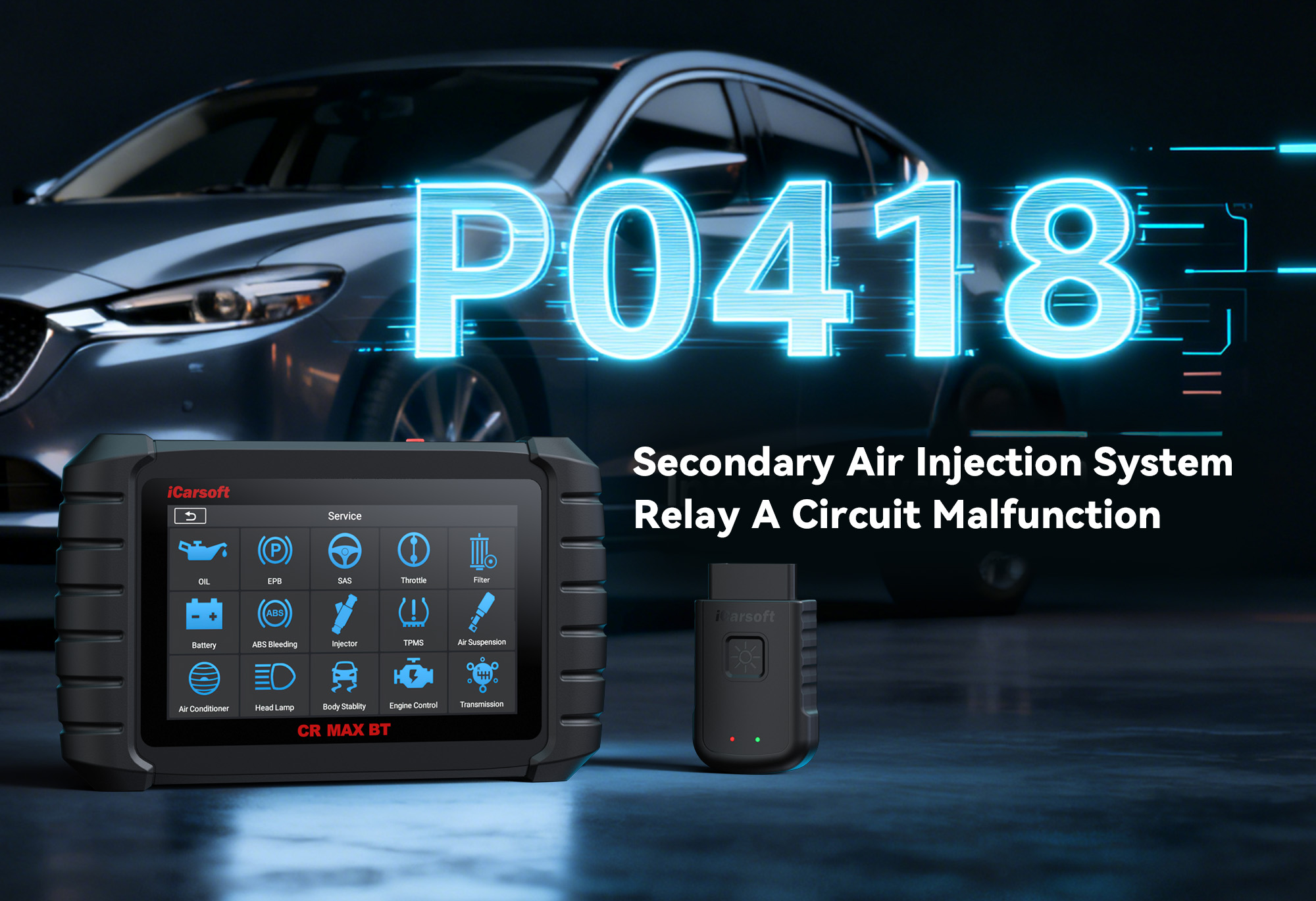
Fix P0418: Secondary Air Pump Relay Circuit Fault – Trust iCarsoft CR MAX BT
You turn on your vehicle, and the Check Engine Light flicks on—even before you hit the road. A diagnostic scan reveals P0418, a code tied to your vehicle’s emissions system. Defined as “Secondary Air Injection (SAI) Pump Relay Circuit High,” P0418 signals a malfunction in the relay that controls the secondary air pump—a key component for reducing cold-start emissions. Ignoring it can lead to failed emissions tests, increased hydrocarbon levels, and even damage to the catalytic converter. But with the iCarsoft CR MAX BT, you can diagnose, troubleshoot, and fix this issue like a pro—whether you’re a DIY hobbyist or a professional mechanic.
The secondary air pump (also called the smog pump) kicks in during cold starts, pumping fresh air into the exhaust manifold. This extra oxygen helps burn uncombusted fuel, lowering emissions and warming the catalytic converter faster. The relay acts as a switch, sending power to the pump when the Engine Control Module (ECM) calls for it. When the relay’s circuit malfunctions—sending too much voltage or failing to communicate with the ECM—P0418 is triggered. Let’s break down everything you need to know about P0418 and how the CR MAX BT simplifies resolution.
What Exactly Is the P0418 Code?
P0418 targets the secondary air pump relay circuit, which includes the relay itself, its wiring, connectors, and communication with the ECM. It activates when the ECM detects that the relay’s control circuit voltage exceeds the manufacturer’s acceptable range (typically 4.5V–14.5V) for a sustained period. Unlike codes that point to pump failure (e.g., P0410), P0418 focuses on the electrical path that powers the relay—though a faulty relay can also be the root cause.
P0418 is common in vehicles with SAI systems (required in most models since the 1990s), with make and model-specific trends:
-
Mercedes-Benz C-Class (W205) P0418: Often linked to a faulty relay in the engine bay fuse box (common in 2010–2018 models).
-
Volkswagen Golf/Jetta TSI P0418: Typically caused by wiring damage near the secondary air pump or a corroded relay connector (prevalent in 2012–2020 variants).
-
Chevrolet Silverado 5.3L V8 P0418: Frequently stems from ECM software glitches or a relay stuck in the “on” position (common in 2014–2023 models).
-
BMW 3 Series (F30) P0418: Often due to a faulty relay control module or broken wiring between the ECM and relay (prevalent in 2013–2019 models).
The iCarsoft CR MAX BT uses Auto VIN technology to pull your vehicle’s exact SAI system specs—including relay voltage ranges and ECM communication protocols—eliminating guesswork and ensuring targeted diagnostics.
Key Symptoms of P0418 to Watch For
P0418 primarily affects emissions, so some symptoms may be subtle—but others are hard to miss. Be alert for these critical warning signs:
-
Illuminated Check Engine Light: The most consistent indicator—often the only symptom in mild cases.
-
Failed Emissions Tests: Increased hydrocarbon (HC) and carbon monoxide (CO) levels will cause non-compliance with standards like Euro 6 or EPA Tier 3.
-
Secondary Air Pump Not Activating: No faint humming from the pump (located near the front of the engine bay) during cold starts.
-
Catalytic Converter Overheating: A stuck-on relay can keep the pump running continuously, flooding the exhaust with air and overheating the converter (signaled by a burning smell).
-
Reduced Fuel Efficiency: The ECM may adjust fueling to compensate for poor emissions control, increasing fuel consumption by 5–10%.
-
Engine Misfire (Rare): In severe cases, excess air in the exhaust can cause backpressure issues, leading to rough idling or misfires during cold starts.
-
Relay Clicking Noise: A faulty relay may make repeated clicking sounds when the vehicle is turned on (indicating it’s trying to engage but failing).
Common Causes of P0418 (And How CR MAX BT Identifies Them)
Faulty SAI Pump Relay
Worn contacts or burned coils cause voltage spikes. The CR MAX BT’s relay activation test sends commands to the relay to check if it engages/disengages properly.
Damaged Wiring/Connectors
Frayed wires or corroded terminals disrupt the circuit. The CR MAX BT’s continuity test detects breaks or shorts in seconds—no separate multimeter needed.
ECM Malfunction
Software glitches send incorrect voltage to the relay. The CR MAX BT’s ECM communication test identifies glitches and offers free firmware updates to fix them.
Relay Control Module Failure
Separate control modules (on some vehicles) fail to regulate relay power. The CR MAX BT’s module scan checks for communication errors with the control unit.
Blown Fuse
A blown fuse causes voltage fluctuations (often paired with P0419). The CR MAX BT’s fuse status test verifies power supply to the relay circuit.
Why iCarsoft CR MAX BT Is the Best Tool for P0418
Basic code readers only tell you “P0418 is present”—the CR MAX BT goes further, diving into the SAI system’s electrical components to diagnose the root cause. Here’s how it outperforms cheap scanners:
SAI System-Specific Diagnostics
Supports 800+ SAI configurations and pulls relay specs tailored to your vehicle (e.g., Mercedes’ 12V relay requirements).
Bi-Directional Relay Activation
Send commands to engage/disengage the SAI relay—eliminates guesswork about whether the relay is faulty or the issue is wiring.
Live Circuit Voltage Monitoring
Track relay control circuit voltage in real time to spot spikes or drops that trigger P0418—view data as a graph or numeric readout.
ECM Coding & Firmware Updates
Calibrate new relays or update ECM software to resolve voltage miscommunication—saves $100–$250 in dealership programming fees.
Emissions Pre-Test Function
Run a simulated emissions test to confirm P0418 is fixed before visiting a testing center—avoids costly retests and wasted time.
Lifetime Free Wi-Fi Updates
Access new SAI system specs and ECM firmware for 2024+ vehicles—no recurring subscription fees.
Step-by-Step: Diagnose & Fix P0418 with CR MAX BT
Step 1: Visual Inspection & Tool Connection
Locate the SAI relay (engine bay fuse box), inspect wiring/connectors for damage; check the SAI pump fuse. Plug CR MAX BT’s OBD-II adapter into the port and pair via Bluetooth (10-second connection).
Step 2: AutoVIN Identify & Code Confirmation
Select AutoVIN to pull your vehicle’s SAI/relay specs; navigate to Engine > Fault Codes > Read Codes to confirm P0418 and view model-specific insights.
Step 3: Live SAI Relay Circuit Data Monitoring
Turn ignition to “On” (don’t start engine); monitor relay control voltage (4.5V–14.5V normal), relay status (engaged/disengaged), and ECM signal to the relay for anomalies.
Step 4: Run Targeted Diagnostic Tests
Go to Special Functions > Emissions Control > SAI System Diagnostics to run relay activation, circuit continuity, voltage supply, and ECM communication tests.
Step 5: Repair the Root Cause
Replace faulty relays, repair damaged wiring, update ECM firmware, replace control modules, or install new fuses (follow test results for precise fixes).
Step 6: Code Clear & Validation Test Drive
Erase P0418 via Engine > Fault Codes > Clear Codes; test drive 50–100 miles (include cold starts). Run CR MAX BT’s Emissions Pre-Test to confirm compliance before official inspection.
FAQs: Your P0418 Questions Answered
Is it safe to drive with P0418?
Yes—for short to medium trips—since P0418 doesn’t directly affect engine performance. However, long-term driving risks catalytic converter damage (if the relay is stuck on) and failed emissions tests. Fix it promptly to avoid costly repairs.
How much does it cost to fix P0418?
Costs vary by cause: SAI relay replacement ($30–$100 DIY, $150–$250 shop), wiring repair ($80–$200), dealership diagnostic + repair ($400–$800). The CR MAX BT saves $150+ by letting you diagnose and handle simple fixes yourself.
Why does P0418 come back after I clear it?
You didn’t fix the root cause—e.g., unaddressed frayed wiring or a faulty control module. Use the CR MAX BT’s continuity and voltage tests to find hidden electrical issues that basic scanners miss.
Can a dead battery cause P0418?
Indirectly—low battery voltage can disrupt the ECM’s ability to send consistent power to the SAI relay, causing temporary voltage spikes. However, P0418 usually persists after the battery is recharged, indicating a separate electrical issue.
Does P0418 affect diesel vehicles?
Rarely—most diesel vehicles use Selective Catalytic Reduction (SCR) systems with AdBlue instead of secondary air pumps. P0418 is almost exclusive to gasoline vehicles with SAI systems.
Will P0418 cause a failed emissions test?
Yes—100%. The secondary air pump reduces cold-start emissions by burning uncombusted fuel, and P0418 disables this function. High HC and CO levels will fail even the most lenient emissions standards.
Can the CR MAX BT test the secondary air pump itself?
Yes—after fixing the relay circuit, use the CR MAX BT’s SAI pump activation test to send power to the pump and confirm it runs. This ensures the pump isn’t faulty (which would trigger P0410 instead of P0418).
How often should I update the CR MAX BT for P0418 fixes?
Update every 3 months via free Wi-Fi. New firmware includes SAI system specs for 2024+ vehicles and ECM patches that fix glitches triggering false P0418 codes (common in newer turbocharged gasoline engines).
Final Thoughts: Resolve P0418 & Protect Your Emissions Compliance
P0418 is a small electrical issue with big consequences—failed emissions tests, potential catalytic converter damage, and unnecessary dealership costs. With the iCarsoft CR MAX BT, you can skip the guesswork and pinpoint the root cause in minutes, whether it’s a faulty relay, damaged wiring, or an ECM glitch.
No more overpaying for basic diagnostics. Invest in the CR MAX BT today to resolve P0418 quickly, pass your emissions test with confidence, and keep your vehicle running cleanly.