Fix P0703: Transmission Range Sensor Circuit Fault – Trust iCarsoft CR MAX BT
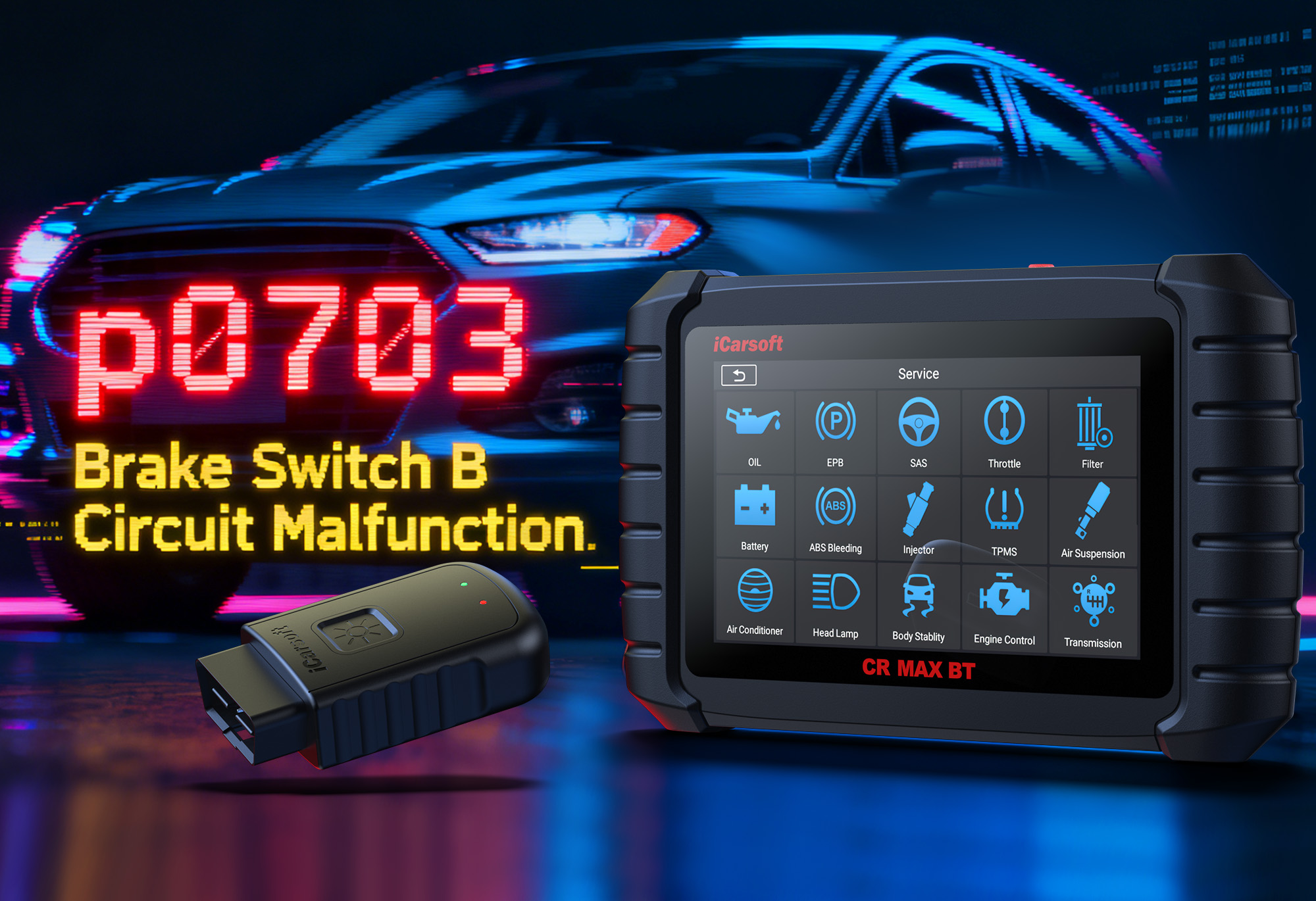
You shift your vehicle into Drive, but nothing happens—or it lurches forward unexpectedly. Seconds later, the Check Engine Light and a “Transmission Range Fault” warning appear. A diagnostic scan reveals P0703, a code targeting your vehicle’s Transmission Range Sensor (TRS)—also known as the neutral safety switch. Defined as “Transmission Range Sensor Circuit High Input (A),” P0703 signals that the sensor sending gear position data to the Transmission Control Module (TCM) is delivering voltage outside the acceptable range. Ignoring it can lead to no-start issues, unintended gear shifts, and transmission damage—but with the iCarsoft CR MAX BT, you can diagnose, troubleshoot, and fix this issue like a pro, whether you’re a DIY enthusiast or a professional mechanic.
The Transmission Range Sensor is the “translator” between your gear shifter and the TCM. It’s mounted on the transmission case, near the shift linkage, and detects whether the shifter is in Park (P), Reverse (R), Neutral (N), or Drive (D). It sends this data to the TCM to adjust shift points, and to the Engine Control Module (ECM) to prevent the engine from starting in Drive/Reverse (via the neutral safety function). When the sensor’s circuit delivers voltage that’s too high (typically above 4.5V), the TCM/ECM can’t trust the gear position data—triggering P0703.
What Exactly Is the P0703 Code?
P0703 focuses on the Transmission Range Sensor’s A circuit—one of the sensor’s internal electrical paths that sends gear position signals. It activates when the TCM detects that the A circuit’s voltage exceeds the manufacturer’s threshold for a sustained period (usually 2–3 seconds). Unlike P0705 (which indicates a total sensor circuit failure), P0703 specifically points to a high-voltage issue in the A circuit, often caused by wiring shorts, sensor contamination, or TCM miscommunication.
P0703 is common across automatic and semi-automatic transmissions, with make and model-specific trends:
-
Chrysler 300 P0703: Often linked to a faulty TRS in the 8-speed ZF transmission (common in 2015–2022 models).
-
Ford Explorer P0703: Typically caused by wiring damage near the shift linkage or a corroded sensor connector (prevalent in 2016–2023 10-speed automatic variants).
-
Toyota Corolla P0703: Frequently stems from TRS contamination (from transmission fluid leaks) or a TCM software glitch (common in 2014–2020 CVT models).
-
Hyundai Sonata P0703: Often due to a loose shift linkage or a failing TRS in the 6-speed automatic transmission (prevalent in 2013–2021 models).
The iCarsoft CR MAX BT uses Auto VIN technology to pull your vehicle’s exact TRS specs—including A circuit voltage ranges and TCM communication protocols—eliminating guesswork and ensuring targeted diagnostics.
Key Symptoms of P0703 to Watch For
P0703 disrupts the critical link between your shifter and the transmission, so symptoms are often immediate and noticeable. Be alert for these critical warning signs:
-
Illuminated Check Engine Light: The most consistent indicator—often paired with “Gear Position Unknown” or “Transmission Safe Mode” messages.
-
No-Start Condition: The neutral safety function may engage incorrectly, preventing the engine from starting even in Park/Neutral.
-
Erratic Gear Shifting: The transmission may shift into the wrong gear (e.g., selecting Drive but getting Reverse) or refuse to shift at all.
-
Shifter Indicator Mismatch: The dashboard gear indicator shows “P” but the shifter is in “D”—or the indicator flashes unpredictably.
-
Vehicle Stalls When Shifting: Shifting from Park to Drive/Reverse may cause the engine to stall, as the TCM misinterprets gear position.
-
Transmission Limp Mode: The TCM may limit the vehicle to 2nd or 3rd gear to prevent damage, reducing speed to 40–50 mph.
-
Reverse Lights Not Working: The TRS controls reverse lights—faulty data may prevent them from activating when in Reverse.
Common Causes of P0703 (And How CR MAX BT Identifies Them)
Faulty Transmission Range Sensor
Worn contacts or damaged internal circuits cause voltage spikes. The CR MAX BT’s TRS performance test checks A circuit voltage against gear position to confirm sensor failure.
Wiring Short or Damage
Wires touching the vehicle frame or 12V components push voltage too high. The CR MAX BT’s circuit continuity test detects shorts and pinpoints the damaged section.
Corroded or Loose Connectors
Rust or dirt disrupts signal flow, causing voltage irregularities. The CR MAX BT’s connector resistance test measures contact quality to spot corrosion issues.
TCM Malfunction
Software glitches or hardware failures misinterpret sensor data. The CR MAX BT’s TCM communication test identifies glitches and offers free firmware updates to resolve them.
Shift Linkage Misalignment
Loose or bent linkage moves the TRS out of position. The CR MAX BT’s gear position verification test compares shifter position to sensor data to detect misalignment.
Why iCarsoft CR MAX BT Is the Best Tool for P0703
Basic code readers only tell you “P0703 is present”—the CR MAX BT goes further, diving into the TRS’s electrical signals and gear position data to diagnose the root cause. Here’s how it outperforms cheap scanners:
TRS-Specific Diagnostics
Supports 1200+ transmission models (Chrysler ZF, Ford 10-speed, Toyota CVT) and pulls A circuit voltage specs tailored to your vehicle.
Live Gear Position & Voltage Monitoring
Track TRS A circuit voltage and gear position in real time (graph/text) to spot anomalies—e.g., 5V in Park (should be 0.5V).
Bi-Directional TRS Activation Testing
Send commands to the TRS to verify correct voltage output for each gear—eliminates guesswork about sensor functionality.
TCM Coding & Firmware Updates
Calibrate new TRS sensors or update TCM software to resolve miscommunication—saves $150–$300 in dealership programming fees.
Shift Linkage Alignment Check
Compare TRS gear position data to TCM expectations to detect misalignment—critical for fixing P0703 in older vehicles with worn linkage.
Lifetime Free Wi-Fi Updates
Access new TRS specs and TCM firmware for 2024+ vehicles—no recurring subscription fees.
Step-by-Step: Diagnose & Fix P0703 with CR MAX BT
Step 1: Visual Inspection & Tool Connection
Locate the TRS (transmission case, near shift linkage), inspect wiring for frays/shorts, check connector tightness; wiggle shifter to test linkage looseness. Plug CR MAX BT’s OBD-II adapter into the port and pair via Bluetooth (10-second connection).
Step 2: AutoVIN Identify & Code Confirmation
Select AutoVIN to pull your vehicle’s TRS/transmission specs; navigate to Transmission > Fault Codes > Read Codes to confirm P0703 and view model-specific insights.
Step 3: Live TRS A Circuit Data Monitoring
Turn ignition to “On” (don’t start engine); move shifter through P-R-N-D-L. Go to Transmission > Live Data > Range Sensor to monitor A circuit voltage (0.5V–4.5V normal), gear position signal accuracy, and TCM response to gear changes.
Step 4: Run Targeted Diagnostic Tests
Go to Special Functions > Transmission Control > TRS Diagnostics to run A circuit voltage test, circuit continuity test, connector resistance test, and linkage alignment test—narrow down the root cause of high voltage input.
Step 5: Repair the Root Cause
Replace faulty TRS, repair shorted wiring, clean corroded connectors, update TCM firmware, or adjust shift linkage—follow CR MAX BT test results for precise fixes.
Step 6: Code Clear & Validation Test Drive
Erase P0703 via Transmission > Fault Codes > Clear Codes; test drive 50–100 miles (shift through all gears). Verify neutral safety function by attempting to start the engine in Drive/Reverse—ensure it’s disabled.
FAQs: Your P0703 Questions Answered
Is it safe to drive with P0703?
No—P0703 risks unintended gear shifts or no-start conditions, which are major safety hazards. If you must move the vehicle (e.g., to a repair shop), use extreme caution: engage the parking brake, shift slowly, and avoid busy roads. Fix the code immediately.
How much does it cost to fix P0703?
Costs vary by cause, but P0703 is often affordable to fix: TRS replacement ($150–$350), wiring repair ($80–$200), connector cleaning (DIY for $10, shop $50–$150), dealership diagnostic + repair ($600–$1,200). The CR MAX BT saves $200+ by letting you diagnose and handle simple fixes yourself.
Why does P0703 come back after I clear it?
You didn’t address the root cause—e.g., unrepired shorted wiring, loose shift linkage, or a TCM glitch. Use the CR MAX BT’s continuity, voltage, and linkage tests to find hidden issues that basic scanners miss.
Can a dead battery cause P0703?
Indirectly—low battery voltage can disrupt the TCM’s ability to process TRS signals, causing temporary voltage irregularities. However, P0703 usually persists after the battery is recharged, indicating a separate issue with the TRS or its circuit.
Does P0703 affect manual transmissions?
No—manual transmissions don’t use Transmission Range Sensors (they rely on driver input for gear selection). P0703 is exclusive to automatic, semi-automatic, and CVT transmissions.
Will P0703 cause a failed emissions test?
It depends on your location. Most states fail vehicles with active transmission codes, as erratic shifting from P0703 can lead to incomplete combustion and higher emissions. Even if it doesn’t fail you directly, the safety risks make fixing P0703 a priority.
Can the CR MAX BT test the neutral safety function?
Yes—after fixing P0703, use the CR MAX BT’s neutral safety test to verify the engine won’t start in Drive/Reverse. This ensures the TRS is communicating correctly with the ECM, a critical safety check.
How often should I update the CR MAX BT for P0703 fixes?
Update every 3 months via free Wi-Fi. New firmware includes TRS specs for 2024+ transmissions (e.g., Ford’s 10R140, Toyota’s Direct Shift-CVT) and TCM patches that fix glitches triggering false P0703 codes.
Final Thoughts: Fix P0703 & Restore Transmission Safety
P0703 isn’t just a check engine light code—it’s a safety hazard that can lead to unintended gear shifts or no-start conditions. With the iCarsoft CR MAX BT, you can skip the dealership’s expensive diagnostics and pinpoint the root cause in minutes, whether it’s a faulty TRS, shorted wiring, or a TCM glitch.
No more guessing, no more overpaying. Invest in the CR MAX BT today to resolve P0703 quickly, restore smooth and safe gear shifting, and protect your transmission from costly damage.