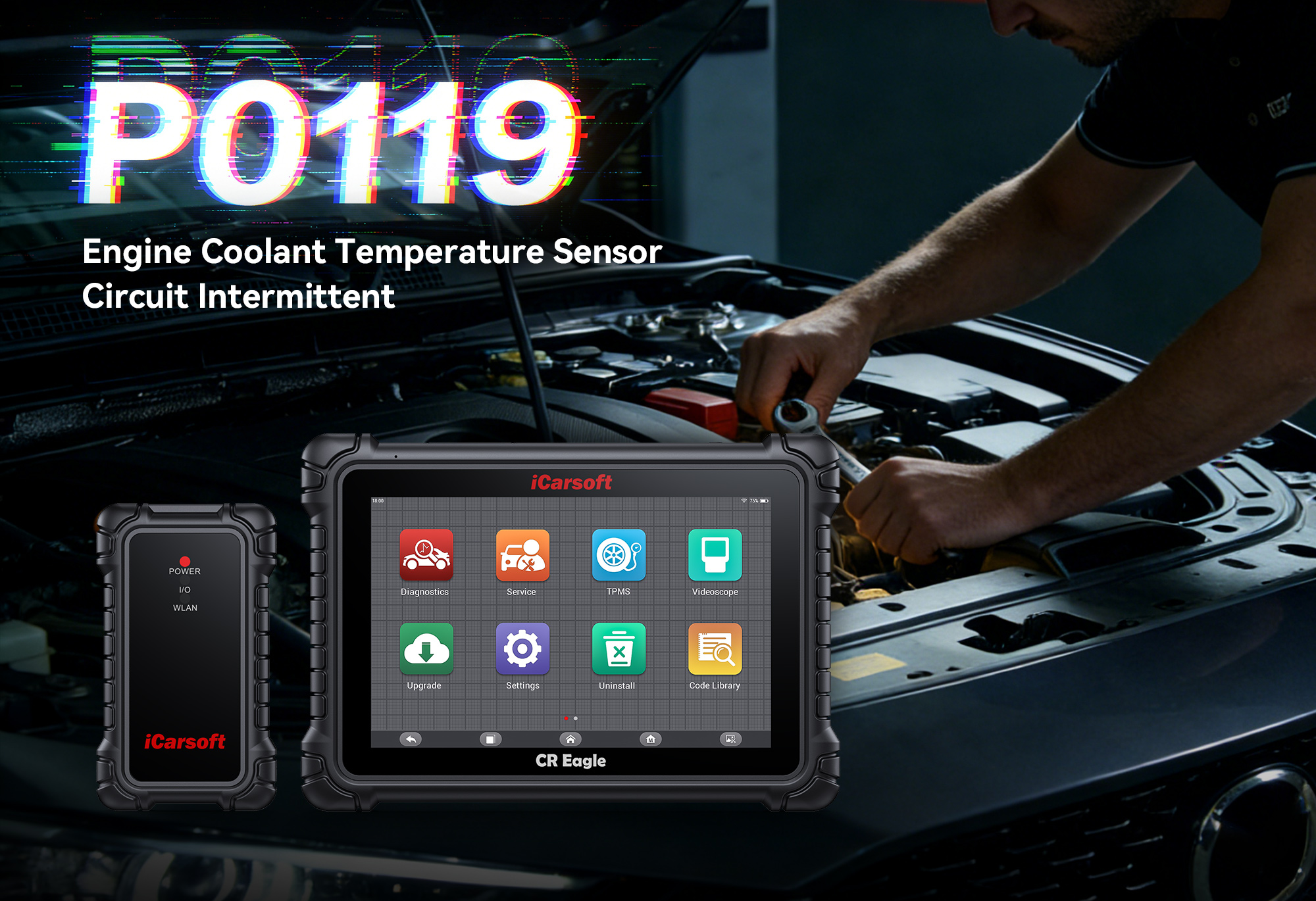
Fix P0119: Engine Coolant Temperature Sensor Circuit Intermittent/Erratic – Trust iCarsoft CR Eagle
If your check engine light turns on and you notice rough idling, poor acceleration, or inconsistent engine performance, your diagnostic tool may retrieve P0119. This trouble code points to a critical issue with your vehicle’s Engine Coolant Temperature (ECT) Sensor—specifically an “ECT Sensor Circuit Intermittent/Erratic” malfunction. The ECT sensor provides real-time coolant temperature data to the Engine Control Unit (ECU), which adjusts fuel injection, ignition timing, and idle speed accordingly. Ignoring P0119 can lead to engine overheating, reduced fuel efficiency, and long-term component damage. In this guide, we’ll break down P0119, its causes, and how the iCarsoft CR Eagle—an OE-level diagnostic tool—helps you resolve it efficiently.
What Exactly Is Fault Code P0119?
P0119 is a generic OBD-II trouble code defined as “Engine Coolant Temperature (ECT) Sensor Circuit Intermittent/Erratic”. Key details to understand:
-
The ECT sensor is typically mounted in the engine block or cylinder head, immersed in coolant. It sends voltage signals to the ECU that vary with temperature (lower voltage = higher temperature, or vice versa, depending on the sensor type).
-
An “intermittent/erratic” circuit means the ECU detects inconsistent voltage from the sensor—signals that randomly spike, drop, or cut out instead of following a smooth temperature-related curve.
-
This inconsistency prevents the ECU from receiving reliable coolant temperature data, disrupting optimal engine tuning for different operating conditions.
-
P0119 applies to 1996+ OBD-II compliant vehicles with electronic fuel injection systems, including popular makes like Ford, Toyota, Honda, BMW, Mercedes-Benz, and VW.
Why Does P0119 Happen? Common Causes
Faulty ECT Sensor
Internal electrical wear, corrosion, or thermal degradation leads to erratic signal transmission.
Wiring or Connector Issues
Frayed, shorted, or corroded wires, or loose/dirty connectors between the sensor and ECU, create intermittent contact.
Coolant Contamination
Rust, debris, or oil in the coolant coats the sensor’s sensing element, interfering with temperature detection.
Low Coolant Level
Insufficient coolant prevents the sensor from being fully immersed, leading to inconsistent readings.
ECU Malfunction
Rarely, a faulty ECU misinterprets the sensor’s signal, triggering a false P0119 code.
Battery Voltage Fluctuations & Damaged Sensor Mount
Low/unstable battery voltage disrupts circuit performance; loose mounts cause sensor shifting and inconsistent coolant exposure.
Symptoms of P0119
P0119 often presents inconsistent but noticeable symptoms, including:
-
Illuminated check engine light (primary indicator).
-
Rough idling or engine stalling (especially during warm-up or cold starts).
-
Poor acceleration and reduced engine power.
-
Decreased fuel efficiency due to incorrect fuel-air mixture.
-
Engine overheating or erratic temperature gauge readings.
-
Engine misfires under load or at high speeds.
-
Intermittent hesitation when pressing the accelerator.
Why the iCarsoft CR Eagle Is Perfect for P0119
Basic scanners only read P0119, but the iCarsoft CR Eagle offers advanced features that simplify diagnosing intermittent sensor issues. Here’s why it stands out:
Full ECT Sensor System Scans
Dives deep into the sensor, wiring, connectors, and ECU communication to pinpoint the source of erratic signals.
Live Data Monitoring
Captures real-time ECT sensor voltage and coolant temperature data—catches intermittent spikes or drops that basic scanners miss, even during engine warm-up.
Powerful Bi-directional Control
Sends commands to test the ECT sensor circuit—verifies if the sensor responds consistently to temperature changes without disassembly.
Global Vehicle Coverage
Works with 58 major vehicle makes, including gasoline/diesel models and OBDI vehicles (with included adaptors like Benz38Pin and BMW20Pin).
Advanced Hardware
Features a 10.1-inch touchscreen, 4GB RAM + 128GB ROM, and dual-band Wi-Fi/Bluetooth for smooth wireless diagnostics.
ECU Coding & Adaptation
Reconfigures the ECU after sensor replacement to ensure seamless compatibility and optimal calibration.
Bonus Features
Built-in TPMS programming (with 4 sensors) and a videoscope to inspect the ECT sensor for contamination and coolant condition.
Lifetime Free Updates & Support
Stays compatible with new vehicle models and provides expert technical support.
How to Diagnose & Fix P0119 with the iCarsoft CR Eagle (Step-by-Step)
Step 1: Connect the Tool
Plug the CR Eagle’s OBD-II cable into your vehicle’s port (under the dashboard). Use included OBDI adaptors for older models.
Step 2: AutoVIN Identification
The tool automatically retrieves your vehicle’s make, model, and VIN—no manual entry needed.
Step 3: Scan for Codes
Select “Full System Scan” or “Engine System Scan” to pull up P0119 and related codes (e.g., P0117 for low sensor voltage).
Step 4: Check Live Data
Navigate to “Live Data” to monitor ECT sensor voltage and coolant temperature. Start the engine and let it warm up—erratic fluctuations confirm a P0119 issue.
Step 5: Run Bi-directional Tests
Use the “Active Test” function to test the ECT sensor circuit. Inconsistent responses indicate wiring issues or a faulty sensor.
Step 6: Inspect Components
Use the CR Eagle’s videoscope to check the ECT sensor for contamination and wiring for damage. Verify coolant level and condition, and inspect connectors for corrosion.
Step 7: Repair or Replace Parts
Replace the faulty ECT sensor, repair/replace damaged wiring, clean connectors, or top up/flush contaminated coolant.
Step 8: Clear the Code & Verify
Use the CR Eagle to erase P0119, take a test drive (including warm-up and cold start cycles), and re-scan to ensure the code doesn’t return.
FAQs: Your P0119 Questions Answered
Can I drive with P0119?
You can drive short distances, but erratic engine performance and overheating risks make prompt diagnosis with the CR Eagle critical. Avoid long trips or heavy loads.
Will the CR Eagle work with my car?
Yes! It supports 58 major vehicle makes and all 1996+ OBD-II compliant vehicles with ECT sensors. It also works with OBDI models using included adaptors.
Do I need mechanical experience to use the CR Eagle?
No! Its 10.1-inch touchscreen, AutoVIN function, and clear prompts make it user-friendly for DIYers. Lifetime technical support is available if you need help.
Can the CR Eagle distinguish between a faulty sensor and coolant issues?
Absolutely. Live data shows if signals stabilize after topping up/cleaning coolant (coolant issue) or remain erratic (faulty sensor). Bi-directional tests confirm sensor functionality.
Do I need to replace the sensor, or can I clean it?
The CR Eagle’s live data and videoscope help you decide—cleaning works for surface contamination; replacement is needed for internal electrical failure.
Is the CR Eagle better than a basic scanner for P0119?
Yes. Basic scanners only read the code, but the CR Eagle captures intermittent signals and tests circuits—saving you from guesswork and unnecessary sensor replacements.
How often should I update the CR Eagle?
Update every 3–6 months via free Wi-Fi updates to ensure compatibility with new ECT sensor designs and diagnostic algorithms.
Does the CR Eagle come with everything I need?
Yes! It includes an OBD-II cable, 4 OBDI adaptors, 4 TPMS sensors, a videoscope, and a carrying case—no extra tools required for P0119 diagnosis.
Final Thoughts: Don’t Let Erratic P0119 Disrupt Your Engine’s Temperature Control
P0119 is a warning that your ECT sensor is sending inconsistent signals, compromising engine performance and temperature regulation. The iCarsoft CR Eagle isn’t just a tool for fixing P0119—it’s a comprehensive diagnostic solution that handles over 40 high-level service functions, making it a long-term investment for all your vehicle maintenance needs. Whether you’re a DIY enthusiast or a professional, the CR Eagle gives you the power to diagnose and fix P0119 right from your garage.
Invest in the iCarsoft CR Eagle today to tackle P0119 and hundreds of other codes—keep your vehicle running smoothly and efficiently.