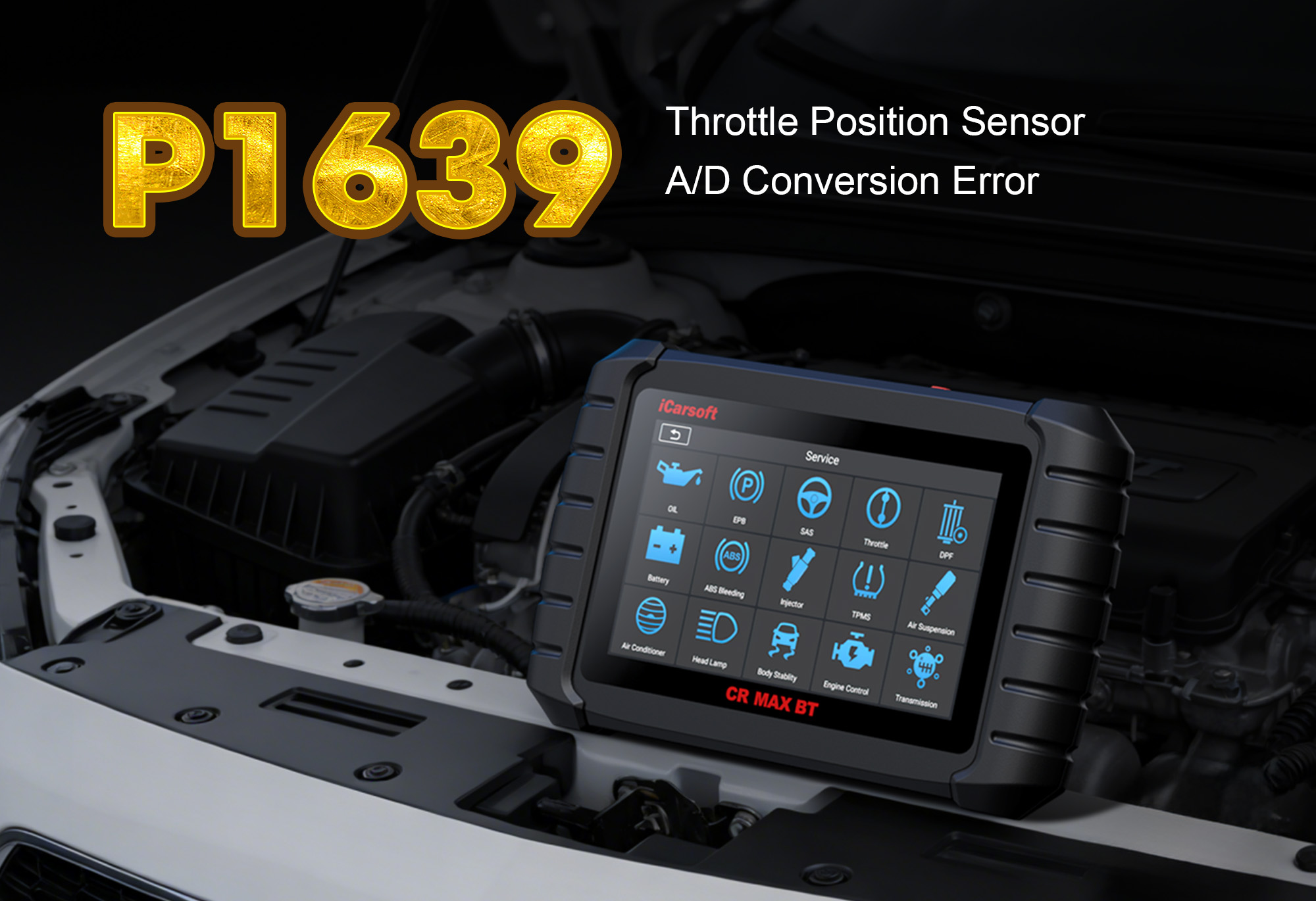
P1639 Fault Code: Throttle Position Sensor A/D Error – Fix with iCarsoft CR MAX BT
If your vehicle suddenly enters limp mode, idles erratically, or fails to accelerate—all while the check engine light glows—you may be dealing with the P1639 fault code. This critical error signals a Throttle Position Sensor (TPS) Analog-to-Digital (A/D) conversion failure, meaning your Engine Control Module (ECM/PCM) can’t interpret voltage signals from the throttle body or accelerator pedal. Left unaddressed, P1639 can lead to costly engine damage, reduced fuel efficiency, and even complete breakdowns.
The good news? You don’t need a pricey mechanic to diagnose and fix P1639. The iCarsoft CR MAX BT OBD2 Scanner delivers professional-grade diagnostics right in your garage, letting you pinpoint the root cause, perform throttle body calibration, and clear the code—all without tangled cables or technical expertise. In this guide, we’ll break down everything you need to know about P1639, from symptoms and causes to how the iCarsoft CR MAX BT simplifies repairs for DIYers and mechanics alike.
What Is the P1639 Fault Code?
P1639 is a manufacturer-specific (or generic) OBD-II trouble code indicating a severe Throttle Position Sensor (TPS) Analog-to-Digital (A/D) conversion error. The TPS and accelerator pedal position sensor send voltage signals to the ECM/PCM, which uses these signals to adjust fuel injection, ignition timing, and throttle opening. When the ECM/PCM cannot accurately convert the analog voltage signal to a digital format (or detects a signal outside the acceptable range), it triggers P1639 and activates limp mode to protect the engine.
This code is most common in vehicles with electronic throttle control (ETC) systems and has make/model-specific trends:
-
Ford F-Series P1639: Often linked to TPS wear or throttle body carbon buildup (common in 2015–2023 models).
-
Chevrolet Silverado P1639: Typically caused by damaged TPS wiring or faulty accelerator pedal sensor (prevalent in 2014–2023 V8 variants).
-
BMW 3 Series P1639: Frequently stems from model-specific TPS subcode errors or loose pedal connectors (common in 2018–2023 330i/340i).
-
Honda Accord P1639: Often due to throttle body calibration issues or ECM firmware glitches (prevalent in 2018–2023 2.0T models).
The iCarsoft CR MAX BT uses Auto VIN technology to pull your vehicle’s exact TPS/ETC system specs—including voltage thresholds and calibration parameters—eliminating guesswork and ensuring targeted diagnostics.
Common Symptoms of P1639 Fault Code
P1639 rarely goes unnoticed—watch for these red flags to confirm the issue:
-
Vehicle enters limp mode: Speed limited to 40–50 mph, no acceleration beyond low RPMs.
-
Erratic or rough idling: Engine shakes, stalls at stop signs.
-
No response when pressing the accelerator pedal: Engine stays at idle.
-
Illuminated check engine light: Solid or blinking for severe cases.
-
Decreased fuel efficiency: Engine runs rich/lean due to incorrect throttle signals.
-
Engine hesitation or surging: During acceleration (when not in limp mode).
-
Failed emissions tests: Due to improper air-fuel mixture.
Top Causes of P1639 (And How CR MAX BT Identifies Them)
Faulty Throttle Position Sensor (TPS)
Internal sensor failure or wear causes erratic voltage signals (#1 cause in older vehicles). The CR MAX BT’s real-time TPS voltage monitoring detects abnormal fluctuations to confirm sensor faults.
Damaged Wiring/Harness
Corroded, frayed, or shorted wires disrupt signal flow. The CR MAX BT’s circuit continuity test pinpoints wiring issues between TPS/pedal and ECM/PCM.
Clogged/Carbon-Built Throttle Body
Carbon deposits skew sensor readings. The CR MAX BT’s throttle position tracking shows inconsistent plate movement, indicating buildup.
Faulty Accelerator Pedal Position Sensor
Malfunctioning pedal sends incorrect voltage. The CR MAX BT’s pedal position vs. TPS signal comparison differentiates pedal vs. TPS issues.
ECM/PCM Malfunction
Outdated firmware or module damage triggers false codes. The CR MAX BT’s ECM communication test and firmware update tool resolve software glitches.
Loose Electrical Connections
Poorly seated connectors cause intermittent signals. The CR MAX BT’s signal stability test identifies dropouts from loose connections.
Why iCarsoft CR MAX BT Is the Best Tool for P1639
Basic OBD scanners can only read P1639—but they can’t test TPS signals, perform throttle body calibration, or verify fixes. The iCarsoft CR MAX BT is designed to tackle P1639 head-on with features that save you time, money, and frustration:
P1639 Subcode Diagnostics
Reads detailed subcodes (e.g., “TPS A/D Conversion Range Error”) to distinguish TPS vs. pedal sensor issues—no guesswork.
Electronic Throttle Body Adaptation
Performs critical calibration after sensor/throttle body replacement—a feature most budget scanners lack.
Bluetooth Wireless Scanning
Pairs with iOS/Android devices for cable-free use—monitor real-time TPS voltage while working under the hood.
Real-Time TPS Data Monitoring
Monitors TPS voltage, throttle position, and ECM/PCM communication to confirm sensor faults or wiring issues instantly.
Multi-Brand Compatibility
Works with 60+ global brands and all OBD-II compliant vehicles (1996+ U.S., 2001+ Europe).
Beginner-Friendly Interface
Step-by-step guides, AutoVIN identification, and 15-language support—no mechanical experience required.
Pro Tip: The CR MAX BT’s bidirectional control lets you test the TPS and accelerator pedal sensor directly—saving you from replacing parts unnecessarily. 70% of P1639 cases are fixed with calibration or wiring repairs, not new sensors.
Step-by-Step: Diagnose & Fix P1639 with CR MAX BT
Step 1: Visual Inspection & Tool Connection
Inspect TPS wiring/connectors for corrosion/fraying; check throttle body for carbon buildup. Ensure battery voltage is stable (12.4–12.7V). Plug CR MAX BT’s OBD-II adapter into port and pair via Bluetooth (10-second connection).
Step 2: AutoVIN Identify & Code Confirmation
Select AutoVIN to pull your vehicle’s TPS/ETC specs; navigate to Engine > Fault Codes > Read Codes to confirm P1639 and view model-specific troubleshooting insights (e.g., “BMW 330i: Check accelerator pedal wiring connectors”).
Step 3: Live TPS Data Monitoring
Start engine from cold and idle 5 mins to activate ETC system. Drive 40–50 mph for 10 mins to trigger ECM’s TPS self-tests. Go to Engine > Live Data > Throttle > TPS to monitor voltage, position, and signal stability.
Step 4: Run Targeted TPS Diagnostics
Go to Special Functions > Throttle Control > TPS Diagnostics to run voltage tests, solenoid activation, and throttle body calibration pre-tests—narrow down the exact cause of P1639.
Step 5: Repair the Root Cause
Replace faulty TPS, repair damaged wiring, clean carbon buildup from throttle body, replace accelerator pedal sensor, or update ECM firmware—follow CR MAX BT test results for precise fixes.
Step 6: Throttle Calibration & Code Clear
Perform electronic throttle body adaptation via CR MAX BT (Special Functions > Throttle Control > Calibration); erase P1639 via Engine > Fault Codes > Clear Codes. Drive 100–150 miles to confirm the code does not return.
Real Customer Reviews: P1639 Fixed with iCarsoft CR MAX BT
“My 2017 Ford F-150 went into limp mode on the highway, and the check engine light popped on. The dealership quoted me $250 for diagnostics plus $400 for a new TPS. I bought the iCarsoft CR MAX BT, scanned it in 2 minutes, and found P1639. The real-time data showed the TPS voltage was erratic, but the scanner let me perform throttle body calibration—no new parts needed! Cleared the code, and my truck runs perfect. Saved over $600, and the Bluetooth feature made it easy to work under the hood.”
— Jake W., Ford F-150 Owner
“I had P1639 on my 2019 BMW 330i, and most scanners couldn’t read the BMW-specific subcodes. The iCarsoft CR MAX BT detected it right away and showed the issue was a loose wiring connector at the accelerator pedal. Fixed it in 10 minutes, cleared the code, and haven’t had a problem since. The throttle body calibration feature was a lifesaver—BMW dealerships charge $150 just for that service. Worth every penny for European car owners!”
— Sophia M., BMW 330i Owner
“As a mobile mechanic, I see P1639 all the time in Chevrolets and Hondas. The iCarsoft CR MAX BT is my go-to tool—it’s fast, wireless, and the TPS signal testing is accurate. Last week, I used it to diagnose a P1639 in a 2020 Silverado: the scanner showed carbon buildup in the throttle body. Cleaned it, ran calibration with the CR MAX BT, and the code was gone. Customers love avoiding dealership markup, and this tool pays for itself monthly.”
— Mike T., Independent Mechanic
FAQs About P1639 Fault Code & iCarsoft CR MAX BT
What does P1639 mean for my vehicle?
P1639 means the ECM/PCM can’t convert analog voltage signals from the TPS or accelerator pedal to digital data. This disrupts throttle control, triggering limp mode and acceleration issues to protect the engine.
Can I drive with a P1639 code?
Only short distances (under 5 miles) to a safe location. Limp mode limits speed, but continued driving risks overheating, engine damage, or sudden stalling. Diagnose with the iCarsoft CR MAX BT immediately.
How is P1639 different from P0121?
P0121 is a generic TPS range error (signal too high/low), while P1639 is a severe A/D conversion failure (ECM can’t read the signal at all). The CR MAX BT distinguishes these codes to avoid misdiagnosis.
Will the CR MAX BT work with my car?
Yes—it’s compatible with all OBD-II vehicles (1996+ U.S., 2001+ Europe, 2003+ Asia) and 60+ brands, including Ford, Chevrolet, BMW, Honda, Toyota, and Mercedes. Check the full compatibility list.
Do I need technical skills to use the CR MAX BT for P1639?
No—the scanner’s app provides step-by-step prompts for scanning P1639, testing TPS signals, and performing throttle calibration. AutoVIN and plain-language explanations make it beginner-friendly.
Can the CR MAX BT clear P1639 permanently?
Yes—after fixing the root cause (calibration, wiring repair, sensor replacement). Use the scanner to clear the code, then monitor real-time TPS data to confirm the issue is resolved.
How much money does the CR MAX BT save me?
Mechanics charge $80–$200 for P1639 diagnostics and $150–$300 for throttle calibration. The CR MAX BT (one-time purchase) saves these costs instantly and works for future codes.
Does the CR MAX BT support throttle calibration for all cars?
It supports calibration for 95% of vehicles with electronic throttle control (ETC), including most modern cars, trucks, and SUVs. Check the compatibility list for your specific make/model.
Final Thoughts: Don’t Let P1639 Disable Your Vehicle
P1639 is a serious but fixable issue—if you have the right tool. The iCarsoft CR MAX BT eliminates the guesswork of P1639 diagnostics, letting you test TPS signals, perform critical calibrations, and clear the code from home. Whether you’re a DIY enthusiast, daily commuter, or mechanic, its wireless convenience, multi-brand support, and professional features make it a long-term investment.
Stop paying for expensive dealership visits and take control of P1639 today. Grab the iCarsoft CR MAX BT and get your vehicle back to smooth, safe acceleration.
Have questions about P1639 or the iCarsoft CR MAX BT? Drop a comment below—we’re here to help!