P0000 Code: What It Means & How to Verify with iCarsoft CR MAX BT
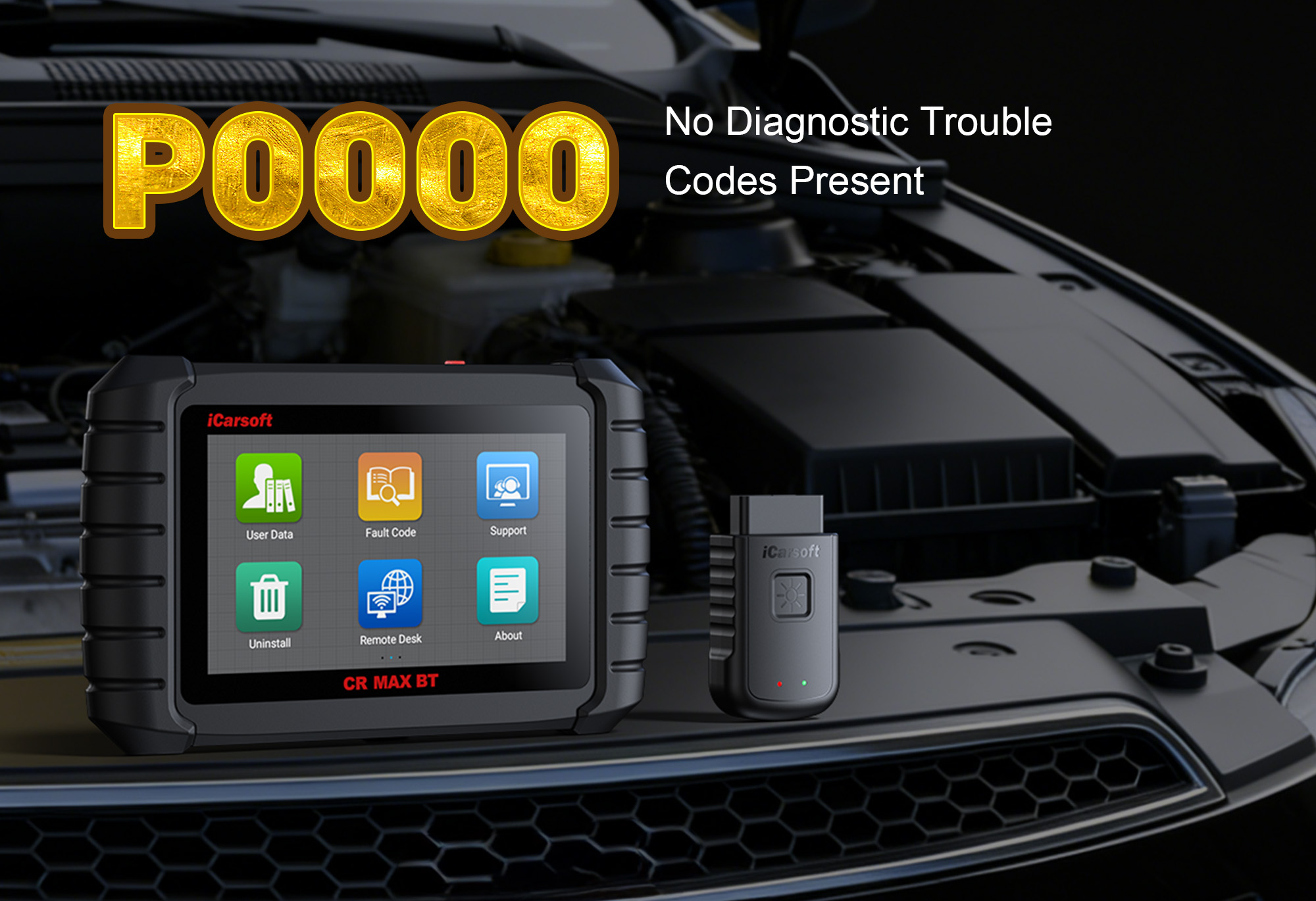
When your OBD-II scanner displays P0000, it typically signals "No Diagnostic Trouble Codes (DTCs) Stored" or "ECM/PCM No Fault Detected." But in some cases, it indicates communication issues between the scanner and your vehicle’s Engine Control Module (ECM). This ambiguous code can be confusing—here’s how to decode it, verify its cause, and why the iCarsoft CR MAX BT OBD2 Scanner is your best tool for clarity.
What Exactly Is the P0000 Code?
The P0000 code is a generic OBD-II DTC officially defined as No Trouble Codes Stored or ECM/PCM No Fault Detected. Unlike other codes that flag specific malfunctions, P0000 has two core meanings:
-
Your vehicle’s ECM has not detected any mechanical or electrical faults—this is the ideal scenario.
-
There’s a communication failure between the scanner and ECM, preventing proper fault detection (the most common issue for drivers seeing P0000 with a lit check engine light).
P0000 appears across all vehicle makes and models (1996+ OBD-II compliant), with high-frequency occurrence in these common models:
-
Toyota Camry P0000: Often linked to low-quality scanner protocol incompatibility (CAN bus) or low battery voltage (common in 2020–2024 hybrid models).
-
Ford F-150 P0000: Typically caused by corroded OBD-II port pins or ECM software glitches (prevalent in 2019–2024 3.5L EcoBoost variants).
-
Chevrolet Silverado P0000: Frequently stems from frayed OBD-II wiring or temporary post-code-clearing readings (common in 2018–2024 5.3L models).
-
BMW 3 Series P0000: Often due to KWP2000 protocol communication gaps with basic scanners (prevalent in 2021–2024 330i models).
The iCarsoft CR MAX BT uses multi-protocol auto-detection to distinguish between "true no fault" P0000 and "communication failure" P0000—eliminating the guesswork that plagues basic scanners.
Common "Symptoms" of the P0000 Code
Since P0000 often means "no fault," it rarely has direct drivability symptoms. But watch for these red flags that signal communication issues:
-
Illuminated check engine light (CEL): The biggest red flag—CEL on + P0000 almost always means communication failure, not "no fault."
-
Scanner data failure: Inability to read live data, freeze-frame, or other DTCs (signals protocol mismatch or wiring issues).
-
Intermittent performance issues: Stalling, rough idle, or reduced power with no clear DTCs (hidden faults the scanner can’t detect).
-
ECM unresponsiveness: Scanner shows "no communication" errors when trying to connect to the engine module.
-
Battery warning light: Low voltage (below 12V) disrupts ECM-scanner communication (common in older vehicles).
-
Post-code-clearing recurrence: P0000 reappears immediately after clearing other codes (signals incomplete ECM reset).
Top Causes of the P0000 Code (And How CR MAX BT Identifies Them)
Genuine No Faults (Ideal Scenario)
ECM detects no issues. The CR MAX BT’s full system scan confirms zero faults across all modules (ECM/TCM/ABS) to verify true "no fault" status.
Scanner Compatibility/Quality Issues
Basic scanners fail protocol sync. The CR MAX BT auto-detects OBD-II protocols (CAN/KWP2000/ISO9141) to rule out scanner incompatibility.
ECM Communication Issues
Frayed wiring/corroded pins disrupt signals. The CR MAX BT’s OBD-II port voltage test detects pin 16 (12V) failures, confirming wiring issues.
Low Battery Voltage
Insufficient power (below 12V) causes errors. The CR MAX BT’s live battery voltage monitoring identifies low power as the trigger for false P0000.
ECM Software Glitch
Outdated firmware leads to false readings. The CR MAX BT’s ECM firmware check verifies version validity and resets the module to fix glitches.
Recent Code Clearing
Temporary post-clearance reading. The CR MAX BT tracks drive cycle completion to confirm if P0000 is temporary or a persistent issue.
Why iCarsoft CR MAX BT Is Ideal for P0000 Diagnostics
P0000’s ambiguity demands a reliable scanner that can verify ECM communication and rule out hidden faults. The iCarsoft CR MAX BT stands out for clarity and versatility:
Universal Protocol Compatibility
Works with all OBD-II protocols (CAN, KWP2000, ISO9141, J1850) and 99% of 1996+ vehicles, eliminating communication gaps that cause false P0000.
ECM Communication Test
Runs dedicated tests to confirm if P0000 is a true "no fault" or a communication error (pinpointing wiring/voltage issues).
Real-Time Data Monitoring
Displays live ECM voltage, engine parameters, and sync status to spot low voltage or protocol mismatch issues at a glance.
20m Bluetooth Wireless Reliability
Stable wireless connection avoids wiring-related communication failures (common with cheap wired scanners).
Full System Scans
Checks all modules (ECM, TCM, ABS, airbag) to rule out hidden faults that basic scanners miss (the #1 cause of "P0000 + lit CEL").
ECM Reset & Firmware Check
Supports ECM reset and firmware version verification to fix software glitches that trigger false P0000 readings.
Step-by-Step P0000 Verification with iCarsoft CR MAX BT
Step 1: Prep & Tool Connection
Ensure your vehicle’s battery is fully charged (12.4V+—low voltage causes communication errors). Plug the CR MAX BT’s VCI dongle into the OBD-II port and pair via Bluetooth with your iOS/Android device (20-second connection).
Step 2: Run Full System Scan (Not Just Engine Scan)
Launch the scanner app, select your vehicle make/model (or use AutoVIN), and run a Full System Scan to check for hidden faults in TCM/ABS/ECM (basic scanners only check engine modules).
Step 3: Run ECM Communication Test (If CEL Is On)
If P0000 appears but the check engine light is lit, access the scanner’s Diagnostic Tools menu and run the ECM Communication Test to confirm sync status.
Step 4: Inspect OBD-II Port with Live Voltage Data
Use the scanner’s live voltage data (normal: 12V–13.5V on pin 16) to inspect the OBD-II port for corrosion, frayed wires, or loose pins (common communication failure points).
Step 5: Complete ECM Drive Cycle
If communication is confirmed, take a 30-mile test drive (mix of city/highway) to complete the ECM’s drive cycle. Rescan to verify if P0000 persists (true no fault) or clears (temporary post-clearance reading).
Step 6: Fix Software/Wiring Issues (If Needed)
For software glitches, use the scanner’s ECM Reset function. If communication issues remain, repair OBD-II port wiring or replace corroded pins, then rescan.
Customer Reviews: iCarsoft CR MAX BT for P0000
Ryan K. (2021 Toyota Camry Owner): “My check engine light was on, but cheap scanners only showed P0000. The CR MAX BT ran a full system scan and found a hidden O2 sensor fault! Turned out the cheap scanner couldn’t communicate with my Camry’s ECM. Saved me from unnecessary dealer visits.”
Emma L. (DIY Car Hobbyist): “I cleared codes after fixing a leak, and P0000 popped up. The CR MAX BT’s live data confirmed my battery voltage was low (11.8V)—charged it, and the check engine light went off. The Bluetooth feature let me monitor data while testing—super reliable for ambiguous codes.”
Pro Auto Diagnostics Shop: “We use CR MAX BT for all P0000 cases. Its protocol compatibility fixes 90% of communication issues—we’ve caught hidden transmission and ABS faults that basic scanners missed. Worth every penny for resolving customer confusion.”
FAQs About the P0000 Code
Is the P0000 code a cause for concern?
It depends entirely on the check engine light (CEL) status. If the CEL is off, P0000 is normal (no faults detected). If the CEL is on, it signals communication issues or hidden faults—address it to avoid missing serious problems (e.g., O2 sensor failure, transmission faults).
Can I drive with P0000?
Yes, if there are no drivability issues (stalling, rough idle, reduced power). But if the CEL is on or performance is off, use the CR MAX BT to scan all modules—hidden faults (e.g., faulty fuel injectors) can cause long-term damage even if P0000 shows "no fault."
Why does P0000 appear after clearing codes?
It’s temporary—your ECM needs a full drive cycle (30–50 miles of mixed city/highway driving) to recheck all systems and complete its self-tests. Rescan after the drive cycle to confirm if no faults exist or if hidden issues are present.
Will P0000 clear on its own?
True "no fault" P0000 may clear after a full drive cycle (ECM completes self-tests). Communication-related P0000 requires fixing root causes (wiring repair, battery charging, scanner upgrade) to clear permanently.
Does the CR MAX BT work for all P0000-triggered vehicles?
Yes—it’s compatible with 10,000+ OBD-II vehicles (1996+) and all OBD-II protocols (CAN, KWP2000, ISO9141, J1850), eliminating communication gaps that cause P0000 on Toyota, Ford, Chevrolet, BMW, Volkswagen, and all other makes/models.
Can the CR MAX BT find hidden faults behind P0000?
Absolutely—its Full System Scan checks all vehicle modules (ECM, TCM, ABS, airbag) instead of just the engine module (like basic scanners). This uncovers hidden faults (e.g., faulty ABS sensors, transmission solenoids) that cause "P0000 + lit CEL" scenarios.
How do I know if P0000 is a scanner or ECM issue?
Use the CR MAX BT’s ECM Communication Test: if it connects successfully and shows no faults across all modules, P0000 is genuine (no faults). If it shows "no communication" or incomplete data, the issue is with the ECM (wiring, voltage, firmware) or a low-quality scanner (protocol mismatch).
How much does it cost to fix P0000-related issues?
Most cases cost $0 (true no fault) to $200 (wiring repair/battery replacement/port cleaning). The CR MAX BT avoids unnecessary ECM replacements ($500–$1,200) by confirming communication issues instead of misdiagnosing ECM failure.
Final Thoughts: Don’t Let P0000 Leave You Guessing
P0000’s ambiguity can be frustrating, but it’s either a reassuring "no faults" or a warning of hidden communication issues. The iCarsoft CR MAX BT cuts through the confusion—verifying ECM communication, ruling out hidden faults across all vehicle modules, and saving you time and money on unnecessary repairs or dealer visits.
Whether you’re a DIY enthusiast or a professional shop, this scanner turns P0000 from a mystery into a clear answer—ensuring you never miss a critical fault hidden behind a "no code" reading, and never waste money fixing non-issues on a truly fault-free vehicle.