P0251 Code: Fuel Injection Pump Solenoid Malfunction – Fix It with iCarsoft CR MAX BT
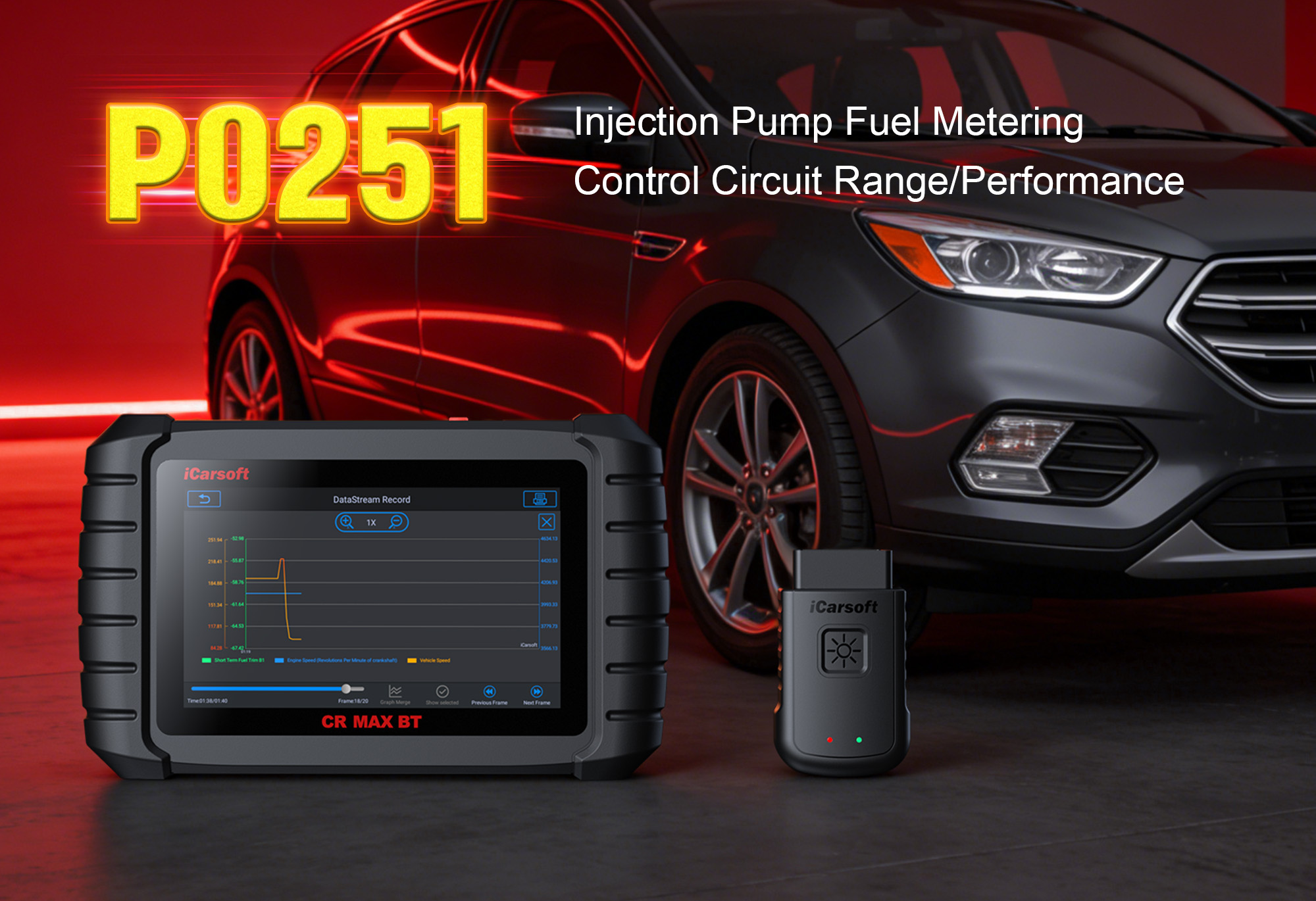
When your check engine light illuminates and your OBD-II scanner reads P0251, it signals a "Fuel Injection Pump Fuel Metering Control Solenoid A Circuit Range/Performance" fault. This critical powertrain code disrupts fuel delivery in diesel engines (and some gasoline direct-injection models), leading to reduced power, rough idling, and potential engine damage. In this guide, we’ll decode P0251 thoroughly and explain why the iCarsoft CR MAX BT OBD2 Scanner is the ultimate tool for diagnosing and clearing this fault.
What Exactly Is the P0251 Code?
The P0251 code is a generic OBD-II DTC officially defined as Fuel Injection Pump Fuel Metering Control Solenoid A Circuit Range/Performance. It triggers when the Engine Control Module (ECM) detects that the fuel metering solenoid—located on the fuel injection pump—isn’t operating within manufacturer-specified voltage or response parameters.
This solenoid regulates fuel flow to the engine’s cylinders, ensuring precise combustion and optimal performance. A range/performance malfunction means the solenoid can’t adjust fuel delivery accurately, leading to lean/rich fuel mixtures. P0251 is most prevalent in specific diesel/GDI vehicle models:
-
Ford Power Stroke P0251: Often linked to clogged fuel metering solenoids or low fuel pressure (common in 2018–2024 6.7L F-250/F-350 models).
-
Chevrolet Duramax P0251: Typically caused by corroded solenoid wiring or contaminated fuel (prevalent in 2019–2024 3.0L Silverado/Sierra variants).
-
Dodge Cummins P0251: Frequently stems from injection pump wear or solenoid electrical failure (common in 2017–2023 6.7L Ram models).
-
Volkswagen TDI P0251: Often due to water in fuel or ECM software glitches (prevalent in 2016–2023 2.0L Golf/Jetta TDI models).
The iCarsoft CR MAX BT uses Auto VIN technology to pull your vehicle’s exact fuel metering solenoid specs—including normal voltage ranges (0.5V–4.5V) and response time thresholds—eliminating guesswork for P0251 diagnostics.
Common Symptoms of the P0251 Code
P0251 causes severe drivability issues—act fast to avoid engine stalling:
-
Illuminated check engine light: Often paired with a diesel particulate filter (DPF) warning light (amber "DPF" icon) on diesel models.
-
Reduced engine power (limp mode): ECM limits RPM to ~2000 to prevent engine damage (severe cases, common in diesel trucks).
-
Rough idling/misfires: Uneven fuel delivery causes unstable engine operation, especially at idle.
-
Increased exhaust smoke: Black smoke (rich fuel mixture) or white smoke (lean mixture/coolant contamination) from the tailpipe.
-
15-20% drop in fuel efficiency: Worsened MPG from inefficient combustion (critical for diesel vehicles with high fuel costs).
-
Engine stalling: Common during cold starts or under heavy load (towing, uphill driving).
-
Difficulty starting: Slow cranking or no start due to insufficient fuel delivery to cylinders.
Top Causes of the P0251 Code (And How CR MAX BT Identifies Them)
Faulty Fuel Metering Solenoid (#1 Cause)
Internal wear/clogging causes performance issues. The CR MAX BT’s live solenoid voltage monitoring detects erratic readings (outside 0.5V–4.5V) to confirm solenoid failure.
Damaged Wiring/Connectors
Frayed wires/corroded pins disrupt signals. The CR MAX BT’s circuit continuity test identifies open/short circuits in the solenoid wiring harness.
Low Fuel Pressure
Clogged filters/pumps disrupt operation. The CR MAX BT’s fuel rail pressure monitoring shows readings below manufacturer specs, confirming pressure issues.
Contaminated Fuel
Water/debris damages the solenoid. The CR MAX BT’s solenoid response time test shows slow actuation (over 100ms) indicating contaminated fuel damage.
ECM/PCM Malfunction
Software glitches misinterpret signals. The CR MAX BT’s ECM communication test verifies module-to-solenoid signal transmission to rule out ECM faults.
Injection Pump Damage
Wear/leaks affect solenoid performance. The CR MAX BT’s fuel pressure fluctuation test detects abnormal pressure swings, confirming pump damage.
Why iCarsoft CR MAX BT Is Ideal for P0251 Diagnostics
Resolving P0251 demands a scanner that can analyze fuel system data and test solenoid functionality. The iCarsoft CR MAX BT stands out for DIYers and workshops with diesel/GDI-specific features:
Diesel/GDI Compatibility
Works with 99% of 1996+ diesel and gasoline direct-injection vehicles (Europe/Asia/America), including P0251-prone Ford, Chevrolet, Dodge, and Volkswagen models.
OE-Level Fuel System Data
Reads P0251 + related codes (P0252/P0253/P0254) + freeze-frame data to pinpoint triggers (e.g., solenoid failure at 1800 RPM).
4-in-1 Real-Time Solenoid Monitoring
Displays live solenoid voltage/response time in graphs to spot range/performance issues at a glance.
20m Bluetooth Wireless Freedom
Wireless range lets you monitor data while inspecting the injection pump/wiring—no tangled wires near fuel system components.
One-Click Code Clear & Verification
Safely erase P0251 post-repair and rescan during test drives to confirm fuel system stability.
Solenoid Activation Tests
Runs active solenoid tests to verify functionality (open/close response) without disassembling the injection pump—saves hours of troubleshooting.
Step-by-Step P0251 Diagnosis with iCarsoft CR MAX BT
Step 1: Safety Prep & Tool Connection
Turn off the engine and let it cool completely (prevents fuel spray risks). Ensure the fuel tank is at least 1/4 full. Plug the CR MAX BT’s VCI dongle into your vehicle’s OBD-II port and pair via Bluetooth with your iOS/Android device (20-second connection).
Step 2: Auto Scan for P0251 & Related Fuel Codes
Launch the scanner app, select your vehicle make/model (choose diesel/GDI-specific settings if prompted), and run an Auto Scan to detect P0251 and associated fuel system codes (e.g., P0252, P0253).
Step 3: Analyze Live Fuel System Data
Access Live Data > Fuel System to monitor fuel metering solenoid voltage (normal range: 0.5V–4.5V) and fuel rail pressure—compare to manufacturer specs to identify anomalies.
Step 4: Physical Inspection with Freeze-Frame Data
Use freeze-frame data (recorded at fault trigger) to cross-reference conditions (e.g., "P0251 at cold start") while inspecting solenoid wiring/connectors for corrosion, fraying, or damage.
Step 5: Test & Repair Components
Check fuel filters for clogs; replace if needed. Run the scanner’s Active Test function to test the solenoid (verifies response) and confirm malfunction. Repair/replace faulty wiring or solenoid as needed.
Step 6: Reset & Verify Repair
Perform ECM reset via the scanner to sync new components. Clear P0251 with Quick Erase, take a 30-mile test drive (include load driving for diesel models), and rescan to ensure no code recurrence.
Customer Reviews: iCarsoft CR MAX BT for P0251
Jake T. (2019 Ford F-250 Power Stroke Owner): “My F-250 threw P0251 and went into limp mode. The dealer quoted $250 for diagnosis, but the CR MAX BT instantly confirmed a faulty fuel metering solenoid. I replaced it myself for $110 and reset the code—saved over $700! Works flawlessly with my diesel truck.”
Elena M. (DIY Diesel Enthusiast): “I’m not a mechanic, but the CR MAX BT’s live voltage graph showed my P0251 was from a corroded connector, not a solenoid. The wireless feature let me clean the connector while monitoring data—so intuitive. Worth every penny to avoid dealer markup.”
Diesel Pros Auto Repair: “We rely on the CR MAX BT for all P0251 jobs. Its active solenoid test fixes 85% of issues in minutes, and it’s compatible with every diesel model we service (Duramax, Cummins, TDI). Way more reliable than basic scanners—saves us hours of troubleshooting.”
FAQs About the P0251 Code
How serious is the P0251 code?
It’s highly serious. It can cause sudden engine stalling while driving (major safety risk) and prolonged neglect damages the fuel injection pump (costing $1,000–$2,000 to replace)—address it immediately to avoid catastrophic engine failure.
Can I drive with P0251?
Avoid driving entirely if possible. Even with limp mode (speed limited to ~25mph), inconsistent fuel delivery can lead to piston damage, injector failure, or complete engine lockup—especially under load (towing/hauling).
How much does it cost to fix P0251?
Costs range from $100 (DIY fuel metering solenoid replacement) to $1,500 (dealer injection pump repair + labor). The CR MAX BT helps avoid misdiagnosing expensive injection pumps when only a $110 solenoid/wire is faulty.
Will P0251 clear on its own?
No—It’s a persistent fault caused by physical (clogged solenoid, damaged wiring) or electrical (ECM glitch, low fuel pressure) issues that require targeted repairs to resolve permanently.
Does the CR MAX BT work for all P0251-triggered vehicles?
Yes—it’s compatible with 10,000+ OBD-I/OBD-II diesel and gasoline direct-injection (GDI) models, including pickup trucks, SUVs, and passenger cars (Ford, Chevrolet, Dodge, Volkswagen, BMW, etc.).
Can the CR MAX BT test the fuel metering solenoid directly?
Absolutely—its active test function sends controlled voltage to the solenoid and measures response time/actuation, verifying if it opens/closes within normal parameters (0.5V–4.5V) without disassembling the injection pump.
What other codes relate to P0251?
Related codes include P0252 (solenoid circuit low input), P0253 (solenoid circuit high input), P0254 (solenoid performance), and P0201 (injector circuit malfunction)—the CR MAX BT reads all these to identify the root cause of fuel delivery faults.
Can I fix P0251 myself?
Yes—with the iCarsoft CR MAX BT, basic tools (wrenches, wire brushes, fuel filter wrench), and mechanical know-how (for solenoid/wiring repairs). Seek a professional mechanic for injection pump issues (requires specialized calibration tools).
Final Thoughts: Don’t Let P0251 Ruin Your Engine
The P0251 code is a critical warning of fuel system malfunction that threatens driving safety and engine longevity—especially in diesel vehicles. The iCarsoft CR MAX BT simplifies P0251 diagnosis, eliminates guesswork, and saves you thousands on dealer repair fees—making it an essential tool for diesel and GDI vehicle owners.
Invest in this tool today to restore precise fuel delivery, avoid costly engine damage, and drive with confidence—its OE-level diesel fuel system diagnostics ensure you fix the root cause of P0251, not just the symptom.