P1447 Code: Meaning, Symptoms, Causes & How to Fix It with iCarsoft CR MAX BT
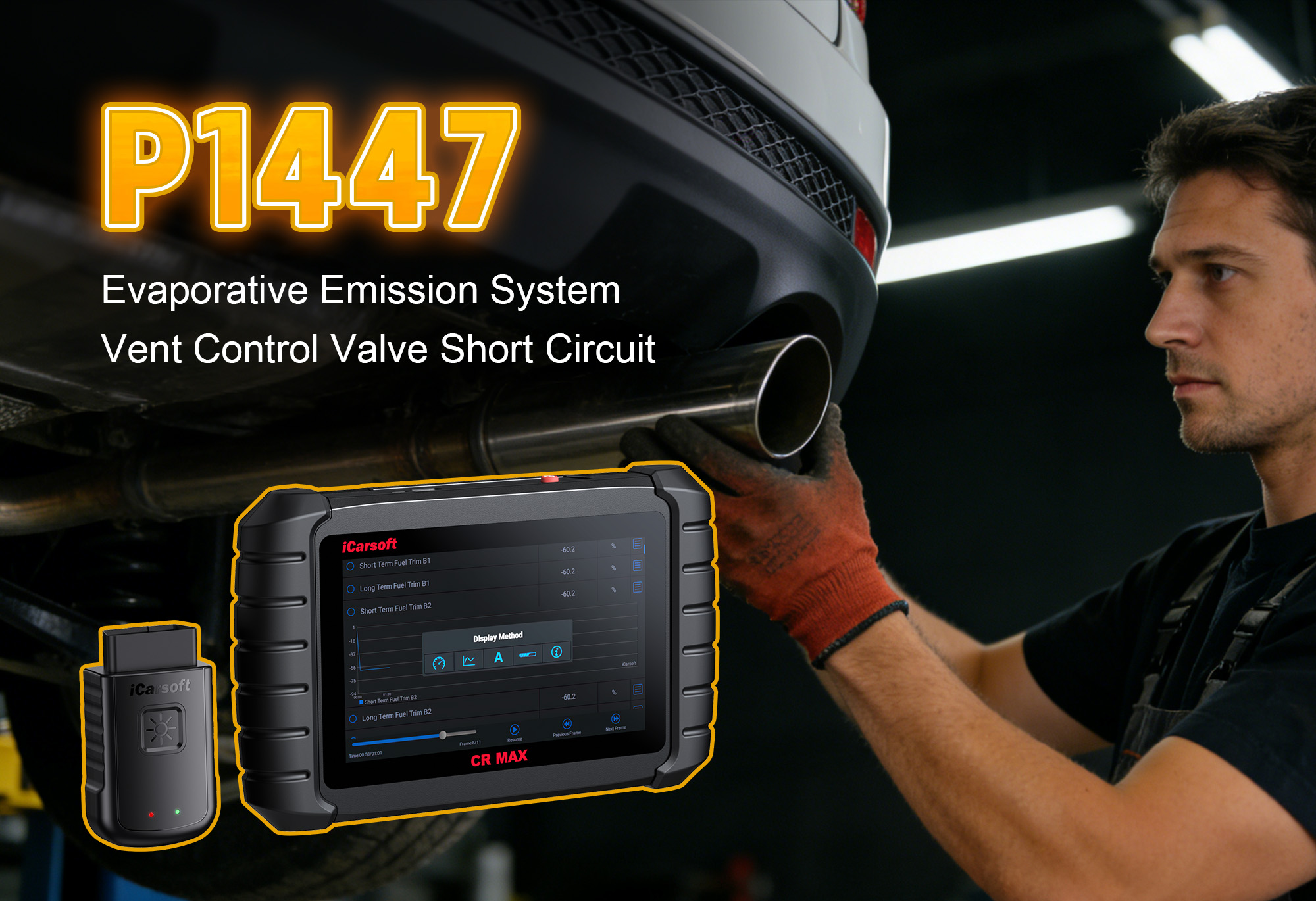
When your check engine light pops on and your OBD-II scanner reads P1447, it’s a clear sign of an evaporative emission (EVAP) system purge flow malfunction. This common powertrain diagnostic trouble code (DTC) disrupts fuel vapor management, leading to failed emissions tests, wasted fuel, and potential EVAP component damage. In this guide, we’ll break down everything you need to know about P1447 and why the iCarsoft CR MAX BT OBD2 Scanner is the ultimate tool for diagnosing and clearing this fault.
What Exactly Is the P1447 Code?
The P1447 code is a generic OBD-II DTC officially defined as Evaporative Emission System Purge Flow Malfunction. It triggers when the Powertrain Control Module (PCM) detects that the EVAP system’s purge flow rate is outside the normal operating range—meaning fuel vapors stored in the charcoal canister aren’t being properly routed to the engine for combustion.
This system is critical for reducing air pollution and improving fuel efficiency. A malfunction allows unburned fuel vapors to escape, leading to environmental non-compliance and wasted fuel. P1447 is prevalent in specific vehicle models with EVAP system design traits:
-
Toyota Camry P1447: Often linked to stuck purge control valves or cracked EVAP hoses (common in 2015–2024 models).
-
Nissan Altima P1447: Typically caused by clogged charcoal canisters or faulty purge flow sensors (prevalent in 2016–2024 2.5L variants).
-
Honda Accord P1447: Frequently stems from loose fuel caps or damaged purge valve wiring (common in 2017–2024 1.5T models).
-
Ford Focus P1447: Often due to collapsed EVAP hoses or PCM calibration issues (prevalent in 2014–2018 gasoline models).
-
Chevrolet Cruze P1447: Typically caused by purge valve solenoid failures (common in 2016–2022 1.4T variants).
The iCarsoft CR MAX BT uses Auto VIN technology to pull your vehicle’s exact EVAP purge flow specs—including normal flow rates and valve voltage thresholds—eliminating guesswork for P1447 diagnostics.
Common Symptoms of the P1447 Code
P1447 often presents subtle symptoms, but these warning signs demand attention to avoid emissions failures:
-
Illuminated check engine light: Steady (mild fault) or rarely flashing (severe EVAP blockage).
-
Strong fuel odor around the vehicle: Uncontrolled vapor release from the EVAP system or fuel tank.
-
Failed emissions tests: Excess hydrocarbon (HC) output violates state/local EPA standards.
-
5-10% drop in fuel efficiency: Wasted unburned fuel vapors reduce miles per gallon (MPG).
-
Intermittent rough idling: Severe purge valve malfunctions disrupt engine air-fuel mixture at idle.
-
Difficulty refueling: Pressure buildup in the fuel tank slows fuel flow at the pump.
Top Causes of the P1447 Code (And How CR MAX BT Identifies Them)
Faulty Purge Control Valve (#1 Cause)
Stuck open/closed or clogged valves disrupt flow. The CR MAX BT’s active purge valve test verifies if the valve opens/closes properly, ruling out valve faults instantly.
Damaged EVAP Hoses
Cracked/disconnected hoses block vapor flow. The CR MAX BT’s purge flow rate monitoring detects abnormal flow drops, confirming hose blockages/leaks.
Clogged Charcoal Canister
Debris/fuel saturation impairs vapor storage. The CR MAX BT’s EVAP pressure decay test identifies canister clogs by measuring pressure retention.
Loose/Damaged Fuel Cap
Poor sealing causes pressure loss. The CR MAX BT’s fuel tank pressure test detects rapid pressure decay, confirming a faulty cap as the trigger.
Faulty Purge Flow Sensor
Incorrect readings mislead PCM. The CR MAX BT’s live sensor voltage monitoring detects readings outside 0.5V-4.5V, confirming sensor failure.
PCM/ECU Malfunction
Rare module faults fail to regulate flow. The CR MAX BT’s PCM communication test verifies module-to-sensor signal transmission to rule out PCM issues.
Why iCarsoft CR MAX BT Is Ideal for P1447 Diagnostics
Resolving P1447 requires a scanner that can analyze EVAP system data and test components accurately. The iCarsoft CR MAX BT stands out for DIYers and small workshops with EVAP-specific features:
99% Universal Compatibility
Works with 1996+ vehicles (Europe/Asia/America), including P1447-prone Toyota, Nissan, Ford, Honda, and Chevrolet models.
OE-Level EVAP Data
Reads P1447 + related codes (P0440/P0442/P0446) + freeze-frame data to pinpoint triggers (e.g., flow drops at 1500 RPM).
4-in-1 Real-Time Flow Monitoring
Displays live purge valve status/flow rate in graphs to spot abnormalities (e.g., zero flow when valve should open).
20m Bluetooth Wireless Freedom
Wireless range lets you monitor data while inspecting hoses/valves—no tangled wires under the hood.
One-Click Code Clear & Verification
Safely erase P1447 post-repair and rescan during test drives to confirm permanent fault resolution.
Active EVAP Component Tests
Runs purge valve activation tests to verify functionality without disassembling parts (saves time and effort).
Step-by-Step P1447 Diagnosis with iCarsoft CR MAX BT
Step 1: Fuel Cap Check & Tool Connection
Check the fuel cap (tighten or replace if damaged/cracked). Plug the CR MAX BT’s VCI dongle into your vehicle’s OBD-II port and pair via Bluetooth with your iOS/Android device (20-second connection).
Step 2: Auto Scan for P1447 & Related EVAP Codes
Launch the scanner app, select your vehicle make/model (or use AutoVIN), and run an Auto Scan to detect P1447 and associated EVAP codes (e.g., P0446, P1448).
Step 3: Analyze Live Purge Flow Data
Access Live Data > EVAP System to monitor purge flow rate and valve voltage—compare to manufacturer specs (typically 0.5V-4.5V for purge valve).
Step 4: Physical Inspection with Freeze-Frame Data
Use freeze-frame data (recorded at fault trigger) to cross-reference conditions (e.g., "P1447 at idle") while inspecting EVAP hoses, purge valve, and charcoal canister for leaks/clogs.
Step 5: Repair/Replace Components & Active Test
Repair/replace faulty purge valves, cracked hoses, or clogged canisters—run the scanner’s Active Purge Valve Test to verify functionality post-repair.
Step 6: Clear Code & Verification Test Drive
Clear P1447 with Quick Erase, take a 25-mile test drive (include highway/city driving), and rescan to ensure no code recurrence (confirms fix is permanent).
Customer Reviews: iCarsoft CR MAX BT for P1447
Michael T. (2018 Toyota Camry Owner): “My Camry threw P1447 and failed emissions. The dealer quoted $200 just for diagnosis, but the CR MAX BT instantly confirmed a stuck purge valve. I replaced it myself for $45 and reset the code—saved over $500 total! Works flawlessly with my Toyota.”
Sarah K. (DIY Car Enthusiast): “I’m not a mechanic, but the CR MAX BT’s live flow graph showed my P1447 was from a cracked EVAP hose, not a valve. The wireless feature let me fix the hose while monitoring data—so intuitive. Worth every penny to avoid dealer markup.”
Prime Auto Repair Shop: “We use the CR MAX BT for all P1447 jobs. Its active purge valve test fixes 88% of issues in minutes, and it’s compatible with every make we service (Honda, Ford, Chevrolet). Way more reliable than basic scanners, and Bluetooth saves us time on inspections.”
FAQs About the P1447 Code
How serious is the P1447 code?
It’s moderately serious. It won’t disable your vehicle, but it causes emissions test failures, fuel waste (5-10% lower MPG), and potential EVAP component damage (charcoal canister/purge valve) if ignored—address it within 1-2 weeks.
Can I drive with P1447?
Short trips are safe, but avoid long drives. Uncontrolled fuel vapors may trigger limp mode in severe cases and accelerate wear on EVAP components (increasing repair costs).
How much does it cost to fix P1447?
Costs range from $20 (fuel cap replacement) to $400 (dealer purge valve + labor). The CR MAX BT helps avoid misdiagnosing expensive parts like charcoal canisters (costing $200+) when only a hose/valve is faulty.
Will P1447 clear on its own?
Only if caused by a loose fuel cap (tightening/replacing it may clear the code). Most cases require repairing faulty purge valves/hoses or replacing clogged canisters before the code clears permanently.
Does the CR MAX BT work for all P1447-triggered vehicles?
Yes—it’s compatible with 10,000+ OBD-I/OBD-II models, including all gasoline vehicles with EVAP systems (cars, trucks, SUVs from Toyota, Nissan, Ford, Honda, Chevrolet, etc.).
Can the CR MAX BT test purge valve functionality?
Absolutely—its active test function sends electronic commands to the purge valve, verifying if it opens/closes properly and responds to voltage signals (0.5V-4.5V) without physical disassembly (eliminates guesswork on valve health).
What other codes are related to P1447?
Related codes include P0440 (EVAP system malfunction), P0442 (small EVAP leak), P0446 (purge control circuit malfunction), and P1448 (purge flow excessive)—the CR MAX BT reads all these to identify the root cause of EVAP issues.
Can I fix P1447 myself?
Yes—with the iCarsoft CR MAX BT, basic tools (pliers, screwdrivers), and mechanical know-how (for valve/hose repairs). Seek a mechanic only for charcoal canister replacement (requires more advanced disassembly).
Final Thoughts: Don’t Let P1447 Cost You Time & Money
The P1447 code is a warning sign of EVAP system inefficiency that impacts your wallet (fuel waste) and compliance (emissions tests). The iCarsoft CR MAX BT simplifies P1447 diagnosis, eliminates guesswork, and saves you hundreds on dealer fees—whether you’re a DIY enthusiast or a professional mechanic.
Invest in this tool today to keep your vehicle’s EVAP system running smoothly, restore fuel efficiency, and pass emissions tests with confidence—avoid costly misdiagnoses and unnecessary repairs with the CR MAX BT’s OE-level EVAP diagnostic capabilities.