OBD-II Code P219F: Cylinder 4 Air-Fuel Ratio Imbalance – Fix It Fast with iCarsoft CR Ultra P
If your check engine light illuminates, your engine idles roughly, you feel hesitation on acceleration, or your fuel economy takes a sudden nosedive, OBD-II Code P219F—Cylinder 4 Air-Fuel Ratio Imbalance—could be the culprit. This targeted fault means your vehicle’s Engine Control Module (ECM) has detected a persistent, abnormal fuel and air mixture in cylinder 4, drastically different from the balance in your other engine cylinders. It’s not a random misfire, but a specific imbalance that erodes performance, wastes fuel, and risks costly catalytic converter damage if left unaddressed. The good news? P219F is almost always caused by simple, fixable issues—faulty ignition parts, clogged injectors, or minor vacuum leaks—and you don’t need to pay steep dealer diagnostic fees to resolve it. This complete guide breaks down everything you need to know about P219F, from its core causes and symptoms to why the iCarsoft CR Ultra P is the ultimate professional diagnostic tool for DIYers to accurately detect, troubleshoot, and permanently clear this code at home—no advanced mechanical skills required.
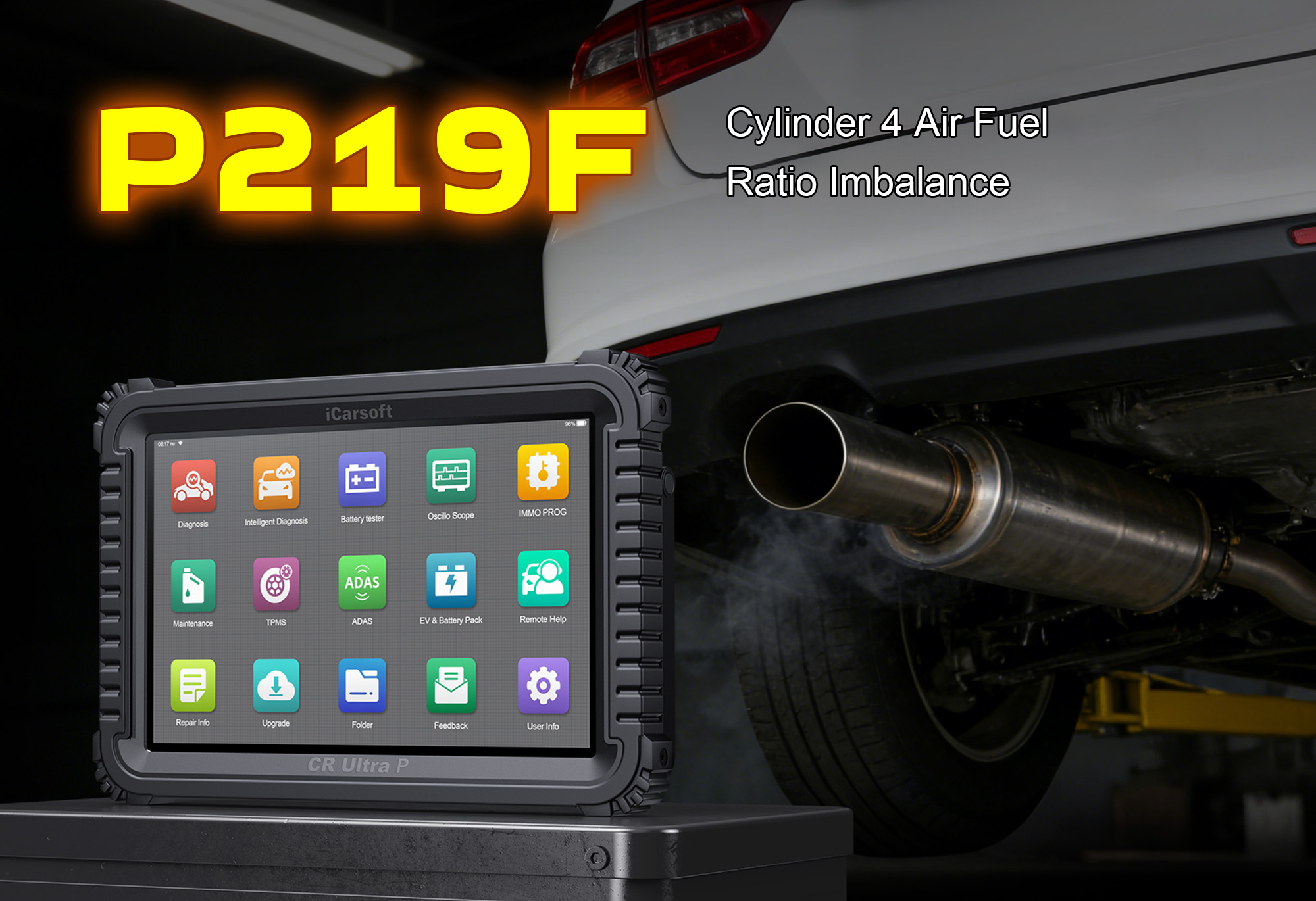
What Is OBD-II Code P219F?
OBD-II Code P219F is a cylinder-specific air-fuel ratio fault that exclusively targets cylinder 4 in gasoline and diesel engines (4-cylinder, V6, V8, inline 6). Your vehicle’s ECM is engineered to monitor combustion efficiency and the air-fuel mixture (ideal ratio: 14.7:1 for gasoline) across every cylinder in real time. When the ECM detects that cylinder 4 is consistently running too lean (too much air, not enough fuel) or too rich (too much fuel, not enough air) compared to the rest of the engine, it triggers P219F and illuminates the check engine light.
Unlike general misfire codes (e.g., P0304, Cylinder 4 Misfire), P219F is not a complete combustion failure—it’s a mixture imbalance that means cylinder 4 is burning fuel inefficiently, not failing to burn it at all. However, the two codes often appear together, as an uncorrected imbalance will quickly lead to a full misfire. Critically, P219F is a targeted fault, which eliminates the guesswork of diagnosing random engine issues: the problem is isolated to cylinder 4’s ignition, fuel delivery, or air intake system—making it one of the easiest engine codes to fix with the right diagnostic tool.
Common Symptoms of P219F
P219F’s symptoms are directly tied to inefficient combustion in cylinder 4, and they’re most noticeable at idle, light acceleration, or steady highway speeds—when the engine relies on a precise air-fuel balance. The check engine light is the permanent primary alert, and symptoms will worsen over time if the imbalance is not fixed. Watch for these core red flags:
-
Illuminated solid Check Engine Light (MIL) on the dashboard (may be accompanied by P0304 in advanced cases)
-
Rough, shaky idle and engine vibration from the engine bay (the most noticeable symptom)
-
Hesitation or sluggish acceleration—delayed power when pressing the gas pedal
-
Reduced fuel economy (10-30% MPG drop)—wasted fuel from inefficient combustion
-
Minor engine surging or sputtering at steady speeds (e.g., 55-65 MPH on the highway)
-
Weak engine power and poor performance, especially under light load
-
Unusual exhaust smells (rotten egg or gasoline) from unburned fuel in the exhaust system
-
Potential catalytic converter overheating (a burning smell from the exhaust)—a critical risk of unaddressed P219F
Top Causes of P219F (Ranked by Likelihood)
Pinpointing P219F’s root cause is straightforward because the fault is isolated to cylinder 4—99% of cases stem from fuel, ignition, or air intake issues for this single cylinder, not major internal engine failure. Generic OBD scanners only read the code, but the iCarsoft CR Ultra P lets you test each component to avoid trial-and-error part replacement. The causes, ordered from most to least common, are:
-
Worn/fouled spark plug (Cylinder 4): The #1 cause—carbon buildup, worn electrodes, or an oil-fouled plug disrupts spark and combustion, creating an imbalance.
-
Faulty ignition coil (Cylinder 4): A failing coil delivers a weak or inconsistent spark, leading to incomplete fuel burn and a rich/lean condition in cylinder 4.
-
Clogged/leaking fuel injector (Cylinder 4): A clogged injector restricts fuel flow (lean condition), while a leaking injector dumps excess fuel (rich condition)—both trigger P219F.
-
Small vacuum leak near Cylinder 4’s intake port: A cracked hose, loose gasket, or damaged intake runner lets excess air into cylinder 4, creating a lean air-fuel mixture.
-
Dirty/failing upstream oxygen (O2) sensor: A faulty O2 sensor sends inaccurate air-fuel data to the ECM, which miscalculates fuel delivery for cylinder 4.
-
Low fuel pressure: A weak fuel pump or clogged fuel filter reduces fuel flow to cylinder 4’s injector, causing a lean imbalance.
-
Intake manifold gasket leak (near Cylinder 4): A small leak in the gasket surrounding cylinder 4’s intake port introduces excess air into the combustion chamber.
-
ECM calibration glitch: Rarely, outdated ECM firmware misreads combustion data for cylinder 4—easily fixed with a reset via the iCarsoft CR Ultra P.
Why the iCarsoft CR Ultra P Is the Ultimate Tool for P219F
Generic OBD scanners only do one thing: read the P219F code. They cannot test cylinder 4’s components, display live combustion data, or confirm the root cause—leaving DIYers guessing and replacing expensive parts unnecessarily (e.g., a full fuel injector set for a single clogged cylinder 4 injector). The iCarsoft CR Ultra P is a professional-grade, full-system diagnostic tool designed for both DIYers and small repair shops, with exclusive cylinder-specific and air-fuel ratio testing features that make it the perfect solution for P219F. Unlike basic scanners, it gives you dealership-level diagnostic power to pinpoint the exact cause of the cylinder 4 imbalance in minutes—and clear the code permanently once the issue is fixed. Here’s why it stands out for P219F troubleshooting:
Cylinder-Specific Live Data Monitoring
Tracks real-time air-fuel ratio, fuel trim, and combustion data exclusively for cylinder 4—instantly showing if it’s running lean or rich, and how severe the imbalance is.
Ignition System Testing
Tests cylinder 4 ignition coil’s spark strength and spark plug’s combustion performance—no disassembly or multimeter required.
Fuel Injector Functional Testing
Activates cylinder 4 fuel injector manually to check for clogs, leaks, or weak fuel flow—confirming if the injector is the root cause.
Vacuum & Air Intake Diagnostics
Monitors intake manifold pressure and air flow to detect small vacuum leaks near cylinder 4’s intake port—an often-missed cause of P219F.
O2 Sensor & Fuel Trim Analysis
Tests upstream/downstream O2 sensors and displays live fuel trim data to confirm if inaccurate sensor readings are causing the imbalance.
One-Click Code Clearing & ECM Reset
Clear P219F (and accompanying codes like P0304) and reset ECM’s air-fuel ratio calibration in seconds—verify repairs instantly with a test drive.
Full-System Compatibility
Works with 1996+ US/2000+ EU/Asian OBD-II vehicles (cars, trucks, SUVs) – Ford, Toyota, BMW, Chevrolet, Honda, Volkswagen, Hyundai, etc.
User-Friendly DIY Design
Intuitive interface, step-by-step testing guides, and cylinder location diagrams—no advanced mechanical/electrical knowledge needed.
Wireless Connectivity & Portable Design
Compact handheld build fits in glove box; wireless Bluetooth sync with smartphone/tablet lets you monitor live data while inspecting the engine bay.
Real Customer Reviews: iCarsoft CR Ultra P for P219F Repairs
“My 2023 Toyota Camry 4-cylinder threw P219F, had a rough idle, and my MPG dropped from 38 to 25. The Toyota dealer quoted $150 for diagnostics plus $400 for a ‘full ignition service and injector cleaning’. I bought the CR Ultra P, paired it with my phone, and it instantly showed cylinder 4 was running lean from a fouled spark plug. I replaced the plug for $12, cleared the code, and my Camry runs like new—MPG is back to 38! Saved $538, and the tool paid for itself in one use.”
— Sarah M., California
“I have a 2022 Ford F-150 3.5L V6 with P219F and hesitation on acceleration. Cheap scanners only said ‘P219F’—so I almost bought a new set of ignition coils for $200. The CR Ultra P tested cylinder 4’s coil and showed it was weak, and the fuel injector was slightly clogged. I replaced the coil for $60 and cleaned the injector for $5, cleared the code, and the truck has full power again. The live fuel trim data let me confirm the fix immediately—so easy for a beginner!”
— Mark T., Texas
“My 2021 BMW 330i 2.0L 4-cylinder threw P219F and the check engine light was on, plus it had a weird exhaust smell. The BMW dealer wanted $200 for diagnostics plus $800 for an ‘air-fuel system service and catalytic converter check’. The CR Ultra P found a small vacuum leak near cylinder 4’s intake port and a faulty upstream O2 sensor. I fixed the leak with a $10 hose and replaced the sensor for $75, cleared the code, and the exhaust smell is gone—no more P219F. Saved $895—this tool is a game-changer for European cars!”
— Lucas K., Florida
“I run a small auto repair shop, and P219F is one of the most common codes we see. The iCarsoft CR Ultra P is our go-to tool for this fault—it pinpoints the exact issue with cylinder 4 in 2 minutes flat, every time. We’ve used it for Honda Civics, Chevrolet Silverados, and Volkswagen Golfs, and it works perfectly for all makes. It’s affordable, durable, and far better than expensive dealer scanners for DIYers and small shops alike.”
— Jen S., Shop Owner, Ohio
FAQ: Everything You Need to Know About P219F & iCarsoft CR Ultra P
What exactly does OBD-II Code P219F mean?
P219F is a Cylinder 4 Air-Fuel Ratio Imbalance fault. Your vehicle’s ECM detects that cylinder 4 is consistently running too lean (too much air) or too rich (too much fuel) compared to the other engine cylinders, causing inefficient combustion.
Is P219F the same as P0304 (Cylinder 4 Misfire)?
No—they’re related but distinct codes. P219F is an air-fuel mixture imbalance (cylinder 4 burns fuel inefficiently), while P0304 is a complete misfire (cylinder 4 fails to burn fuel at all). An uncorrected P219F will almost always lead to P0304.
Can I drive my car with P219F?
You can drive short distances at low speed to get home or to a parts store, but prolonged driving is not recommended. Unaddressed P219F causes poor fuel economy, engine wear, and catalytic converter overheating/damage—a $1,000+ repair.
What’s the cheapest and most common fix for P219F?
Replacing the cylinder 4 spark plug (cost: $10-$20) is the #1 fix for P219F. The second most common is replacing the cylinder 4 ignition coil (cost: $50-$70)—both are simple DIY repairs.
Can a generic OBD scanner diagnose the root cause of P219F?
No—generic scanners only read the P219F code and cannot display cylinder-specific live data, test ignition/fuel components, or detect vacuum leaks. The iCarsoft CR Ultra P is required to find the exact cause.
Will cleaning the fuel injector fix P219F?
It can—if P219F is caused by a clogged cylinder 4 fuel injector (a common lean condition cause). The iCarsoft CR Ultra P will test the injector’s flow to confirm if cleaning or replacement is needed.
Can a vacuum leak cause P219F?
Yes—a small vacuum leak near cylinder 4’s intake port or intake manifold gasket introduces excess air into the cylinder, creating a lean air-fuel mixture and triggering P219F. The CR Ultra P detects these leaks via live intake pressure data.
Do I need a mechanic to clear P219F after fixing the issue?
No—once you’ve repaired the root cause (e.g., replaced the spark plug/coil), the iCarsoft CR Ultra P lets you clear P219F with one click and reset the ECM’s air-fuel calibration—no mechanic required.
Final Thoughts: Don’t Let P219F Wreck Your Engine’s Performance
OBD-II Code P219F—Cylinder 4 Air-Fuel Ratio Imbalance—is one of the most common and easiest engine codes to fix for DIYers, but it’s also one of the most overlooked. Generic scanners leave you stuck in trial-and-error, and dealers often charge exorbitant fees for simple diagnostics and repairs that you can do at home for a fraction of the cost. The iCarsoft CR Ultra P changes this by giving you professional, dealership-level diagnostic power to pinpoint the exact cause of the cylinder 4 imbalance in minutes—whether it’s a fouled spark plug, faulty coil, clogged injector, or small vacuum leak.
A precise air-fuel balance is the lifeblood of your engine’s performance and fuel efficiency, and cylinder 4 is a critical part of that equation. Ignoring P219F doesn’t just lead to a check engine light and poor MPG—it risks permanent damage to your catalytic converter and engine components, costing you thousands in future repairs. The iCarsoft CR Ultra P isn’t just a tool for fixing P219F: it’s a full-system diagnostic scanner that works for every OBD-II code, every engine system, and every make/model of vehicle. It’s compact, durable, easy to use, and pays for itself after just one repair—saving you hundreds (or thousands) in dealer fees for years to come.
Ready to fix P219F, restore your engine’s smooth performance, get your fuel economy back to normal, and avoid costly catalytic converter damage? Grab the iCarsoft CR Ultra P today and take complete control of your vehicle’s engine health—no mechanic required!
Buy iCarsoft CR Ultra P Now →
Disclaimer: This guide is for informational purposes only. Always consult your vehicle’s owner’s manual or a certified mechanic before engine/ignition system repairs. iCarsoft is not responsible for damage from improper tool use or engine maintenance.