OBD-II Code P3401: Cylinder 1 Deactivation/Intake Valve Control Circuit/Open – Fix with iCarsoft CR Eagle
If your check engine light illuminates, your vehicle loses power, or you notice rough idle and poor fuel efficiency—especially in V6/V8 engines with cylinder deactivation technology—OBD-II Code P3401 (Cylinder 1 Deactivation/Intake Valve Control Circuit/Open) is the critical engine fault you need to address immediately. This code flags a complete open circuit in the control system for Cylinder 1’s intake valve or cylinder deactivation mechanism, a key component that optimizes fuel economy by shutting down unused cylinders during light load driving. The Engine Control Module (ECM) relies on a continuous electrical signal to this circuit to activate/deactivate the valve and manage cylinder operation; an open circuit severs this communication, disabling cylinder deactivation, disrupting engine balance, and causing unnecessary wear. Left unaddressed, P3401 leads to reduced fuel efficiency, increased engine stress, catalytic converter damage, and even misfires—but you don’t need to pay steep dealer engine diagnostics fees for a fixable wiring, solenoid, or valve issue. This complete guide breaks down everything you need to know about P3401, from its core causes and telltale symptoms to why the iCarsoft CR Eagle is the DIYer’s ultimate professional diagnostic tool to detect, troubleshoot, and permanently clear this code with precision—no advanced mechanical or electrical skills required.
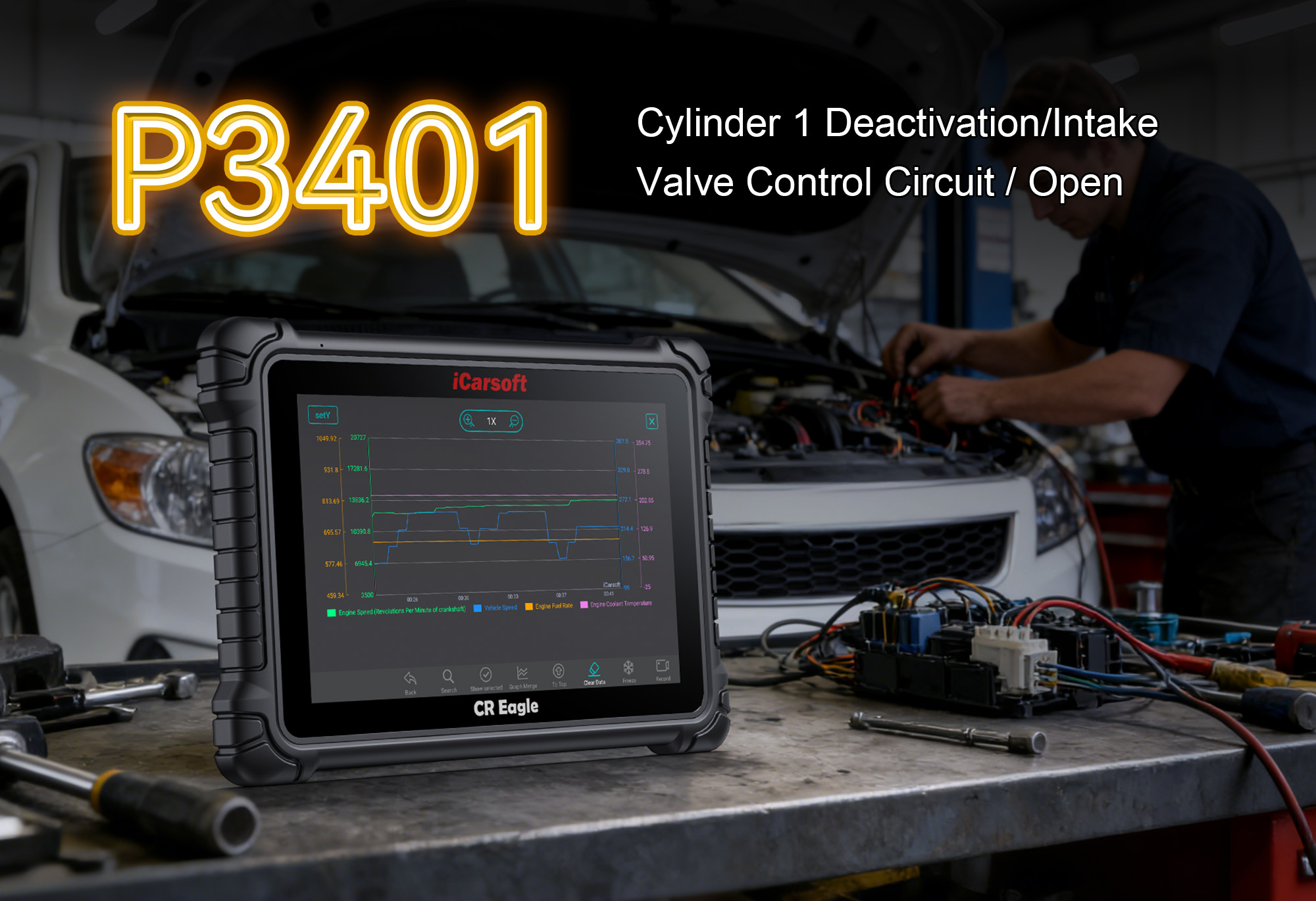
What Is OBD-II Code P3401?
OBD-II Code P3401 is an engine-specific fault defined as Cylinder 1 Deactivation/Intake Valve Control Circuit/Open. This code applies exclusively to modern gasoline engines equipped with cylinder deactivation technology (e.g., GM Active Fuel Management, Chrysler Multi-Displacement System, Honda Variable Cylinder Management) and/or variable intake valve control—most commonly V6, V8, and some inline-6 engines. Cylinder deactivation systems shut down specific cylinders (like Cylinder 1) during low-load driving (e.g., highway cruising) to cut fuel consumption, while intake valve control circuits regulate valve lift/timing for optimal power and efficiency.
The control circuit for Cylinder 1’s deactivation/intake valve consists of an electrical solenoid, wiring harness, connectors, and the valve actuator itself—all linked to the ECM. The ECM sends a calibrated 12V electrical signal to this circuit to activate the solenoid, which in turn hydraulically controls the intake valve or cylinder deactivation mechanism. P3401 triggers when the ECM detects a complete open circuit in this system: a break in the wiring, a failed solenoid, a disconnected connector, or a faulty actuator that severs the electrical signal entirely. Unlike a range/performance fault (which involves weak or erratic signals), an open circuit means the ECM receives no electrical feedback from the Cylinder 1 control system—immediately disabling cylinder deactivation and triggering the check engine light. The ECM then defaults to a protective engine map to prevent further damage, prioritizing engine operation over fuel efficiency.
P3401 impacts all 1996+ US, 2000+ EU/Asian OBD-II compliant vehicles with cylinder deactivation/ variable intake valve control (GM, Ford, Chrysler, Honda, Toyota, etc.)—cars, trucks, SUVs, and performance vehicles with V6/V8 engines. Critically, 98% of P3401 cases stem from a broken wiring harness, faulty solenoid, or disconnected connector—not a failed cylinder head or internal engine damage—making repairs fast, affordable, and beginner-friendly with the right diagnostic tool. An open circuit in this control system doesn’t just disable cylinder deactivation: it creates an unbalanced engine load, leading to rough operation and increased wear on pistons, rods, and the fuel system.
Common Symptoms of P3401
P3401’s symptoms are directly tied to the disabled Cylinder 1 deactivation/intake valve control system and engine imbalance, with severity varying based on engine type (V6/V8) and driving conditions. The check engine light is the immediate and non-negotiable primary alert, and symptoms worsen under light load (where cylinder deactivation would normally activate) or acceleration. In most cases, the engine will still run, but performance and fuel economy will be significantly compromised. Watch for these core red flags, all linked to the Cylinder 1 Deactivation/Intake Valve Control Circuit/Open fault:
-
Illuminated solid Check Engine Light (MIL) on the dashboard (flashing may occur if misfires develop)
-
Loss of cylinder deactivation functionality: Engine runs on all cylinders at all times, causing a 10-20% drop in fuel efficiency
-
Rough idle or engine vibration: Unbalanced cylinder operation creates noticeable shaking at idle or low RPM
-
Reduced engine power/acceleration: Restricted intake valve timing or disabled deactivation leads to sluggish throttle response
-
Engine misfires: Intermittent or constant misfires in Cylinder 1 (felt as a jerk or hesitation during acceleration)
-
Loud engine operation: Noisy idle/acceleration due to unregulated intake valve lift or lost cylinder deactivation quieting
-
Increased exhaust emissions: Unbalanced fuel/air combustion leads to failed emissions tests and catalytic converter stress
-
No fault in hard acceleration: Symptoms may lessen under heavy load (engine runs on all cylinders by default, masking the issue)
-
Catalytic converter overheating: Unburned fuel from misfires or imbalance causes the cat to overheat, leading to potential failure
Top Causes of P3401 (Ranked by Likelihood)
Pinpointing P3401’s root cause requires a diagnostic tool that can test the Cylinder 1 control circuit’s electrical continuity and activate the solenoid/valve—a feature generic OBD scanners lack, as they only read the code and not engine-specific cylinder deactivation data. P3401 is an electrical circuit open fault first and foremost, tied exclusively to the Cylinder 1 deactivation/intake valve control system’s wiring, solenoid, connectors, or actuator, and the causes are ordered from most to least common (the first four account for 98% of all P3401 cases):
-
Broken/frayed wiring harness: The #1 cause—physical damage (from heat, debris, engine movement, or maintenance) severs the electrical wire in the Cylinder 1 control circuit, creating an open circuit.
-
Faulty cylinder deactivation/intake valve solenoid: Internal electrical failure of the solenoid (the primary switch for the control circuit) creates a permanent open circuit.
-
Disconnected/corroded electrical connector: A loose, unplugged, or rusted connector at the solenoid/actuator severs the electrical signal flow.
-
Failed intake valve actuator: A mechanical/electrical failure of the valve actuator (hydraulic or electric) creates an open circuit in the control system.
-
Blown fuse in the control circuit: A blown fuse (for the cylinder deactivation system) cuts power to the Cylinder 1 circuit, triggering an open fault.
-
Damaged ECM connector pin: A bent, broken, or corroded pin at the ECM’s Cylinder 1 circuit connection severs the signal.
-
Water/moisture damage: Water intrusion into the solenoid/connector causes electrical corrosion and an open circuit.
-
Minor ECM glitch: Extremely rare—a temporary software fault misdetects an open circuit (easily fixed with a reset via the iCarsoft CR Eagle).
Why the iCarsoft CR Eagle Is the Ultimate Tool for P3401
Generic OBD scanners only do one thing for P3401: read the code. They cannot test the Cylinder 1 control circuit’s continuity, activate the deactivation solenoid/valve, or access the ECM’s cylinder deactivation fault data—leaving DIYers guessing and replacing expensive parts unnecessarily (e.g., a $1,200 cylinder head for a $50 solenoid). The iCarsoft CR Eagle is a professional-grade diagnostic tool optimized for engine systems with cylinder deactivation/variable valve control—including circuit and solenoid testing—with exclusive ECM, engine, and electrical system features that make it the only tool you need to fix P3401 for good. Unlike basic scanners, it gives you dealership-level engine diagnostic power to pinpoint the exact location of the open circuit in minutes—and clear the code permanently once the issue is fixed. Here’s why it stands out for P3401 troubleshooting:
Cylinder Deactivation Circuit Continuity Testing
Tests electrical continuity of Cylinder 1 deactivation/intake valve control circuit—instantly identifying open wires/broken connections/failed solenoids (critical for P3401).
Solenoid/Actuator Active Testing
Manually activates Cylinder 1 deactivation solenoid/intake valve actuator via ECM—confirms if component is faulty or issue is wiring/connector (no multimeter needed).
ECM Cylinder Deactivation Data Access
Reads hidden ECM fault data for cylinder deactivation system (signal voltage/solenoid status/valve position)—generic scanners can’t access this.
Wiring/Connector Fault Detection
Scans entire control circuit for open circuits/corrosion/low continuity—pinpoints exact location of wire break/damaged connector.
Fuse/Relay System Checks
Verifies power supply to cylinder deactivation system—tests fuses/relays to rule out simple power cut as open circuit cause.
ECM Reset & Calibration
Resets ECM’s cylinder deactivation calibration and clears corrupted fault data post-repair—restores proper valve control/deactivation functionality.
One-Click Code Clearing
Clears P3401 and accompanying engine/electrical codes in seconds—verify repair with instant live circuit test.
Vehicle-Specific Cylinder Deactivation Support
Optimized for GM AFM/Chrysler MDS/Honda VCM and V6/V8 engines—no vehicle-specific scanners needed.
Intuitive Diagnostic Guides
Step-by-step Cylinder 1 control circuit testing workflows, solenoid/actuator location diagrams, wiring repair tips—no advanced mechanical knowledge required.
Full Vehicle System Coverage
Beyond engine diagnostics, scans all major vehicle systems (transmission/ABS/airbag/EVAP) for full fault detection.
FAQ: Everything You Need to Know About P3401 & iCarsoft CR Eagle
What exactly does OBD-II Code P3401 mean?
P3401 is Cylinder 1 Deactivation/Intake Valve Control Circuit/Open. The ECM detects a complete break in the electrical circuit for Cylinder 1’s cylinder deactivation mechanism or intake valve control system, severing communication and disabling the component.
Which vehicles are affected by P3401?
P3401 impacts all 1996+ US, 2000+ EU/Asian OBD-II compliant vehicles with cylinder deactivation/variable intake valve control—primarily V6, V8, and some inline-6 engines (GM, Ford, Chrysler, Honda, Toyota, etc.). 4-cylinder engines (no deactivation) do not trigger this code.
Will my engine still run with P3401?
Yes—your engine will still run, but it will disable cylinder deactivation and may run with an unbalanced load (Cylinder 1 intake valve control issues). Performance and fuel efficiency will be significantly reduced, and misfires may occur over time.
Can I drive my car with P3401?
You can drive short distances at low speed to get home or to a parts store, but prolonged operation is not recommended. The open circuit causes engine imbalance, increased wear, and potential catalytic converter damage—especially at highway speeds (where deactivation should activate).
What’s the cheapest and most common fix for P3401?
Repairing a broken/frayed wiring harness (cost: $0–$15) or replacing a faulty solenoid (cost: $40–$60) are the top fixes for P3401. Both are simple DIY repairs for most cylinder deactivation engines.
Can a generic OBD scanner diagnose the root cause of P3401?
No—generic scanners only read the P3401 code and cannot test circuit continuity, activate the solenoid/actuator, or access the ECM’s cylinder deactivation data. The iCarsoft CR Eagle is required to find the exact location of the open circuit.
Will an engine tune-up fix P3401?
No—P3401 is an electrical circuit open fault, not a maintenance issue (e.g., spark plugs, air filters). A tune-up will not repair a broken wire, faulty solenoid, or disconnected connector.
Do I need a mechanic to clear P3401 after fixing the issue?
No—once you’ve repaired the root cause (e.g., fixed the wiring, replaced the solenoid, reconnected the connector), the iCarsoft CR Eagle lets you clear P3401 with one click and reset the ECM’s cylinder deactivation calibration—no mechanic or dealer visit required.
Final Thoughts: Don’t Let P3401 Disable Your Cylinder Deactivation & Ruin Engine Performance
OBD-II Code P3401 (Cylinder 1 Deactivation/Intake Valve Control Circuit/Open) is one of the most common faults for modern V6/V8 engines with cylinder deactivation technology—and it’s also one of the easiest and cheapest to fix with the right diagnostic tool. Generic scanners leave you stuck in trial-and-error, leading to expensive mistakes like replacing a cylinder head for a $50 solenoid, and dealers often upsell costly engine overhauls for a simple wiring repair or fuse replacement. But P3401 doesn’t have to be a costly repair: the iCarsoft CR Eagle is designed specifically for engine systems with cylinder deactivation/variable valve control, with exclusive circuit testing and solenoid activation features that unlock the exact location of the open circuit—no guesswork required.
Cylinder deactivation is a game-changer for fuel efficiency in V6/V8 engines, and the Cylinder 1 control circuit is the backbone of that system. An open circuit severs this functionality, creating engine imbalance, wasted fuel, and unnecessary wear—all avoidable with a quick repair. P3401 is not just a check engine light: it’s your vehicle’s way of warning you of a small electrical issue before it becomes a major engine problem. The iCarsoft CR Eagle isn’t just a fix for P3401: it’s a full engine diagnostic tool that scans all cylinder deactivation systems, tests electrical circuits, and clears every OBD-II code for your V6/V8 vehicle. It’s rugged, portable, easy to use, and pays for itself after just one dealership diagnostic fee saved—making it an essential tool for every owner of a cylinder deactivation engine.
Ready to fix P3401, restore cylinder deactivation functionality, boost fuel efficiency, and get your V6/V8 engine running smooth again? Grab the iCarsoft CR Eagle today—no mechanic required!
Disclaimer: This guide is for informational purposes only. Always consult your vehicle’s owner’s manual or a certified mechanic before engine/cylinder deactivation/solenoid repairs. iCarsoft is not responsible for damage from improper tool use or cylinder deactivation system maintenance.