OBD-II Code P2073: MAP/MAF - Throttle Position Correlation at Idle – Fix with iCarsoft CR Eagle
If your check engine light turns on, your vehicle has a rough or unstable idle, or you notice stalling at stoplights, OBD-II Code P2073—Manifold Absolute Pressure/Mass Air Flow – Throttle Position Correlation at Idle—is the critical engine air-fuel system fault you need to address right away. This code signals a major mismatch between data from your vehicle’s MAP (Manifold Absolute Pressure) sensor, MAF (Mass Air Flow) sensor, and throttle position sensor (TPS) only at idle—three core sensors that work in perfect harmony to let the Engine Control Module (ECM) calibrate precise air-fuel ratios for smooth idle operation. When their data doesn’t align, the ECM can’t properly regulate air intake or fuel delivery, leading to erratic idle, poor fuel efficiency, and potential engine damage. Left unaddressed, P2073 causes stalling, increased emissions, catalytic converter failure, and even loss of power—but you don’t need to pay steep dealer diagnostics fees for a fixable sensor, vacuum leak, or throttle body issue. This complete guide breaks down everything you need to know about P2073, from its core causes and telltale symptoms to why the iCarsoft CR Eagle is the DIYer’s ultimate professional diagnostic tool to detect, troubleshoot, and permanently clear this code with precision—no advanced mechanical or electrical skills required.
What Is OBD-II Code P2073?
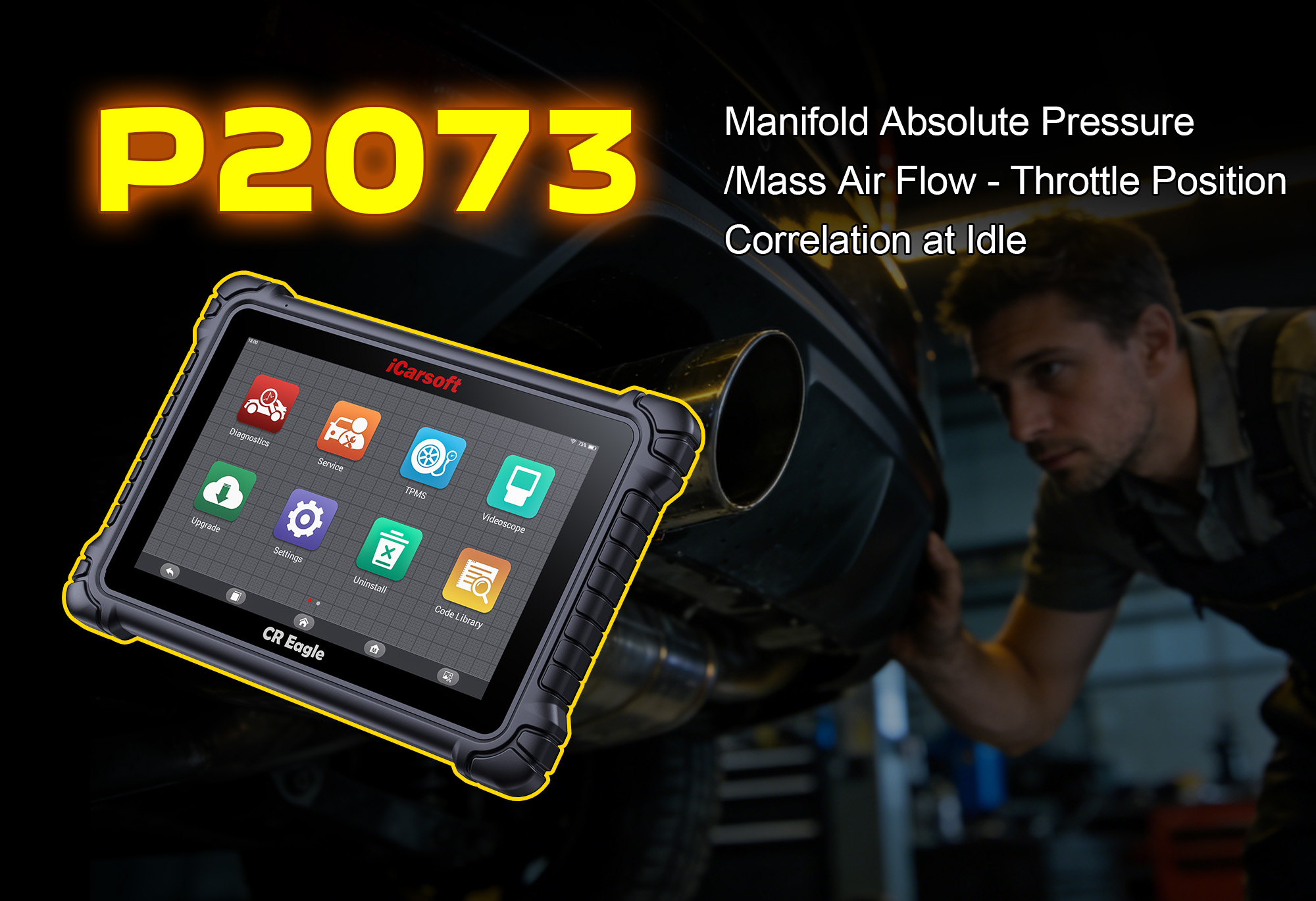
OBD-II Code P2073 is an engine air intake system fault defined as Manifold Absolute Pressure/Mass Air Flow – Throttle Position Correlation at Idle. This code is unique because it only triggers when the engine is at idle (0 RPM load, closed throttle) and indicates a fundamental data mismatch between three key sensors that the ECM relies on to manage air intake:
-
MAP Sensor: Measures intake manifold pressure (vacuum) to calculate engine load.
-
MAF Sensor: Counts the exact volume of air entering the engine.
-
TPS (Throttle Position Sensor): Tells the ECM the exact position of the throttle plate (closed at idle).
At idle, the throttle plate is nearly closed, the MAF sensor reads a low, steady volume of air, and the MAP sensor registers a high vacuum (low pressure)—all three data points must match the ECM’s factory-calibrated parameters. P2073 triggers when the ECM detects that one or more of these sensors is sending data that conflicts with the others (e.g., TPS says the throttle is closed, but MAF reads a high air volume; or MAP shows low vacuum when idle should create high vacuum). This mismatch means the ECM can’t accurately calculate the air-fuel ratio, forcing it into a protective idle map that causes rough operation, stalling, or elevated idle RPM. Unlike other correlation codes that trigger at all engine speeds, P2073 is isolated to idle, making its root causes specific to closed-throttle air intake issues (e.g., vacuum leaks, dirty throttle bodies, or faulty idle air control components).
P2073 impacts all 1996+ US, 2000+ EU/Asian OBD-II compliant gasoline engines (naturally aspirated and turbocharged) in cars, trucks, SUVs, and minivans from every major manufacturer (GM, Ford, Toyota, Honda, Volkswagen, Chrysler, Hyundai, etc.). Critically, 99% of P2073 cases stem from vacuum leaks, a dirty throttle body/MAF sensor, or a faulty idle air control (IAC) valve—not a failed ECM or internal engine damage—making repairs fast, affordable, and beginner-friendly with the right diagnostic tool. A data mismatch at idle doesn’t just trigger a check engine light: it disrupts the engine’s most stable operating state, leading to unnecessary wear on ignition and fuel system components.
Common Symptoms of P2073
P2073’s symptoms are exclusively tied to unstable idle operation (the only condition where this code triggers) and range from mild rough idle to complete stalling, depending on the severity of the sensor data mismatch or air intake issue. The check engine light is the immediate primary alert, and symptoms will be most noticeable at stoplights, in park, or in neutral—they will often disappear or lessen at higher RPM/under acceleration (when the throttle is open and the sensor correlation parameters change). Watch for these core red flags, all linked to the MAP/MAF-TPS correlation mismatch at idle:
-
Illuminated solid Check Engine Light (MIL) on the dashboard (no flashing MIL, as this is not a misfire fault)
-
Rough or shaky idle: The engine vibrates noticeably when at stoplights/park (the most common symptom)
-
Engine stalling: The engine shuts off unexpectedly at idle (severe cases, especially when the AC is on)
-
Erratic idle RPM: Idle speed jumps up and down (surges) instead of holding a steady factory setting
-
High idle RPM: The engine idles at a higher speed than normal (ECM compensating for air leaks)
-
Hard starting: Difficulty starting the engine, or the engine stumbles after starting
-
Poor fuel efficiency: Increased fuel consumption (ECM over-fuels to compensate for unmeasured air intake)
-
Hesitation on initial acceleration: Sluggish throttle response when pressing the gas from a stop
-
No symptoms at acceleration/high RPM: All performance issues disappear when the throttle is open (key P2073 telltale)
Top Causes of P2073 (Ranked by Likelihood)
Pinpointing P2073’s root cause requires a diagnostic tool that can read real-time data from the MAP, MAF, and TPS sensors simultaneously at idle—a feature generic OBD scanners lack (they only read the code, not side-by-side sensor data). P2073 is caused by air intake system issues or faulty sensor performance that disrupts idle sensor correlation, and the root causes are ordered from most to least common (the first four account for 99% of all P2073 cases):
-
Vacuum leaks in the intake system: The #1 cause—cracks/leaks in vacuum hoses, a faulty PCV valve, a loose intake manifold gasket, or a cracked air intake tube allows unmeasured air into the engine at idle, skewing MAF/MAP data while the TPS reads a closed throttle.
-
Dirty/clogged MAF sensor or throttle body: Carbon buildup on the MAF sensor’s sensing wire or the throttle body’s plates/IDLE air control (IAC) port causes inaccurate air volume/throttle position readings at idle.
-
Faulty Idle Air Control (IAC) valve: A stuck or failed IAC valve (controls air flow at idle when the throttle is closed) disrupts air intake, creating a mismatch between TPS position and actual air flow (MAF/MAP).
-
Dirty or faulty MAP sensor: A contaminated MAP sensor (carbon/vacuum debris) sends incorrect manifold pressure data at idle, conflicting with MAF/TPS readings.
-
Loose or damaged air intake tube: A cracked or disconnected air intake tube between the MAF sensor and throttle body lets unmeasured cold air into the engine, skewing MAF data.
-
Faulty TPS (Throttle Position Sensor): A worn TPS sends incorrect closed-throttle position data to the ECM, creating a mismatch with MAF/MAP idle readings (rare for P2073 alone).
-
Low engine coolant temperature (ECT) sensor: A faulty ECT sensor tells the ECM the engine is cold (even when warm), causing it to maintain a high idle that disrupts sensor correlation.
-
Minor ECM calibration glitch: Extremely rare—a temporary software fault misinterprets valid sensor data at idle (easily fixed with a reset and sensor recalibration via the iCarsoft CR Eagle).
Why the iCarsoft CR Eagle Is the Ultimate Tool for P2073
Generic OBD scanners are nearly useless for P2073—they only display the code and a generic “sensor correlation fault” message, with no ability to view real-time MAP/MAF/TPS data side-by-side at idle. This leaves DIYers guessing and replacing expensive sensors unnecessarily (e.g., a $200 MAF sensor for a $5 vacuum hose repair). The iCarsoft CR Eagle is a professional-grade diagnostic tool optimized for engine air intake system diagnostics, with exclusive real-time sensor data streaming and idle system calibration features that make it the only tool you need to fix P2073 for good. Unlike basic scanners, it gives you dealership-level access to the ECM’s sensor data at idle, letting you instantly identify which sensor is mismatched or which air intake issue is causing the fault—no guesswork required. Here’s why it stands out for P2073 troubleshooting:
Real-Time Tri-Sensor Data Streaming
Displays live, side-by-side MAP/MAF/TPS readings at idle—instantly spot data mismatches (e.g., closed TPS + high MAF air volume = vacuum leak) (critical for P2073).
Idle Air Control (IAC) Valve Testing
Manually activates/calibrates IAC valve to test operation—confirms if stuck/failed (top P2073 cause) without removing from engine.
Sensor Calibration & Relearn
Performs ECM-guided MAF/TPS/throttle body relearn/calibration—restores sensor correlation after air intake repairs (missed by generic scanners).
Vacuum Leak Detection Aids
Compares MAP vacuum readings to factory idle specs—instantly flags low vacuum (primary sign of unmeasured air leak).
Air Intake System Health Reports
Generates custom idle air intake sensor performance report—highlights faulty/out-of-spec components for targeted repairs.
One-Click Code Clearing
Clears P2073 and accompanying air intake/sensor codes in seconds—verify repair with post-repair idle test.
Throttle Body Adaptation
Performs throttle body idle adaptation (electronic throttles)—resets closed-throttle idle parameters post-cleaning.
Universal Vehicle Compatibility
Works with 1996+ US/2000+ EU/Asian OBD-II gasoline engines (naturally aspirated/turbocharged)—all major manufacturers, no vehicle-specific scanners needed.
Intuitive Idle System Diagnostic Guides
Step-by-step workflows for MAP/MAF/TPS testing, vacuum leak detection, throttle body/MAF cleaning—no advanced mechanical knowledge required.
Full Vehicle System Coverage
Beyond air intake diagnostics, scans all major vehicle systems (transmission/ABS/airbag/EVAP) for full fault detection.
FAQ: Everything You Need to Know About P2073 & iCarsoft CR Eagle
What exactly does OBD-II Code P2073 mean?
P2073 means there is a data mismatch between the MAP, MAF, and TPS sensors only at engine idle. The ECM detects that one or more of these sensors is sending readings that conflict with the factory-calibrated correlation parameters for closed-throttle, idle operation.
Which vehicles are affected by P2073?
P2073 impacts all 1996+ US, 2000+ EU/Asian OBD-II compliant gasoline engines (naturally aspirated and turbocharged) in cars, trucks, SUVs, and minivans from every major manufacturer. Diesel engines do not trigger this code (no MAF/TPS idle correlation parameters).
Why do P2073 symptoms only happen at idle?
P2073 is calibrated to only trigger at idle—the ECM uses different correlation parameters for open-throttle/acceleration (higher RPM/engine load). The sensor data mismatch is only significant enough to trigger the code when the throttle is closed and the engine is at a steady idle.
Can I drive my car with P2073?
Yes—you can drive the vehicle normally at acceleration/high RPM (symptoms will likely disappear), but prolonged driving with P2073 is not recommended at idle. Stalling at stoplights is a safety hazard, and the air-fuel mismatch can damage the catalytic converter over time.
What’s the cheapest and most common fix for P2073?
Repairing a vacuum leak (cost: $5–$20 for a new hose/PCV valve) or cleaning the MAF/throttle body (cost: $10–$15 for a cleaning kit) are the #1 fixes for P2073. Both are simple DIY repairs for all gasoline engines.
Can a generic OBD scanner diagnose the root cause of P2073?
No—generic scanners only read the P2073 code and cannot display real-time, side-by-side MAP/MAF/TPS data at idle (the key to identifying the mismatch). The iCarsoft CR Eagle is required to pinpoint the exact root cause.
Will a fuel system cleaning fix P2073?
No—P2073 is an air intake/sensor correlation fault, not a fuel system issue. Fuel system cleaning will not fix vacuum leaks, dirty MAF/throttle body components, or a stuck IAC valve.
Do I need a mechanic to clear P2073 or calibrate the sensors?
No—once you’ve repaired the root cause (e.g., fixed a vacuum leak, cleaned the MAF/throttle body), the iCarsoft CR Eagle lets you clear P2073 with one click and perform all necessary sensor/ throttle body relearn/calibration procedures—no mechanic or dealer visit required.
Final Thoughts: Don’t Let P2073 Ruin Your Smooth Idle
OBD-II Code P2073—MAP/MAF-TPS Correlation at Idle—is one of the most frustrating and misdiagnosed idle fault codes for gasoline engine owners. It triggers the check engine light and causes rough idle/stalling at stoplights, while generic scanners offer zero insight into which sensor or air intake issue is causing the mismatch—leaving most drivers stuck paying dealers for expensive, unnecessary sensor replacements. But P2073 doesn’t have to be a costly repair: the iCarsoft CR Eagle is designed specifically for engine air intake and idle system diagnostics, with exclusive real-time tri-sensor data streaming that unlocks the exact root cause (a vacuum leak, dirty MAF, stuck IAC valve) in minutes.
The MAP, MAF, and TPS sensors are the backbone of your engine’s idle operation—their perfect correlation is what makes your vehicle idle smoothly at stoplights. A mismatch between them disrupts the ECM’s ability to manage air-fuel ratios, leading to avoidable wear on ignition and emissions components. P2073 is not just a check engine light: it’s your vehicle’s way of warning you of a small air intake or sensor issue that’s easy to fix—before it becomes a major problem. The iCarsoft CR Eagle isn’t just a fix for P2073: it’s a full engine diagnostic tool that streamlines all air intake sensor testing, calibration, and code clearing for your gasoline vehicle. It’s rugged, portable, easy to use, and pays for itself after just one dealership diagnostic fee saved—making it an essential tool for every car owner who wants to fix idle issues on their own.
Ready to fix P2073, restore a smooth, stable idle, eliminate stalling at stoplights, and get your vehicle running like new? Grab the iCarsoft CR Eagle today—no mechanic required!
Disclaimer: This guide is for informational purposes only. Always consult your vehicle’s owner’s manual or a certified mechanic before air intake/sensor/IAC valve repairs. iCarsoft is not responsible for damage from improper tool use or idle system maintenance.