OBD-II Code P2510: ECM/PCM Power Relay Sense Circuit Range/Performance – Fix with iCarsoft CR Eagle
If your check engine light illuminates, your vehicle experiences intermittent electrical issues, or you notice rough engine startup and random power glitches, OBD-II Code P2510—ECM/PCM Power Relay Sense Circuit Range/Performance—is the critical electrical system fault demanding your immediate attention. This code flags abnormal, out-of-spec signals in the sense circuit for your vehicle’s Engine/Powertrain Control Module (ECM/PCM) power relay, the component that regulates the primary electrical power supply to the brain of your car’s engine and drivetrain. The ECM/PCM relies on a steady, calibrated signal from this sense circuit to confirm the relay is engaging/disengaging correctly; a range/performance fault disrupts this communication, leading to inconsistent power to the ECM/PCM, erratic engine operation, and potential electrical system failure. Left unaddressed, P2510 causes hard starting, stalling, reduced engine power, and even complete electrical shutdown—but you don’t need to pay steep dealer electrical diagnostics fees for a fixable wiring, relay, or connector issue. This complete guide breaks down everything you need to know about P2510, from its core causes and telltale symptoms to why the iCarsoft CR Eagle is the DIYer’s ultimate professional diagnostic tool to detect, troubleshoot, and permanently clear this code with precision—no advanced electrical or mechanical skills required.
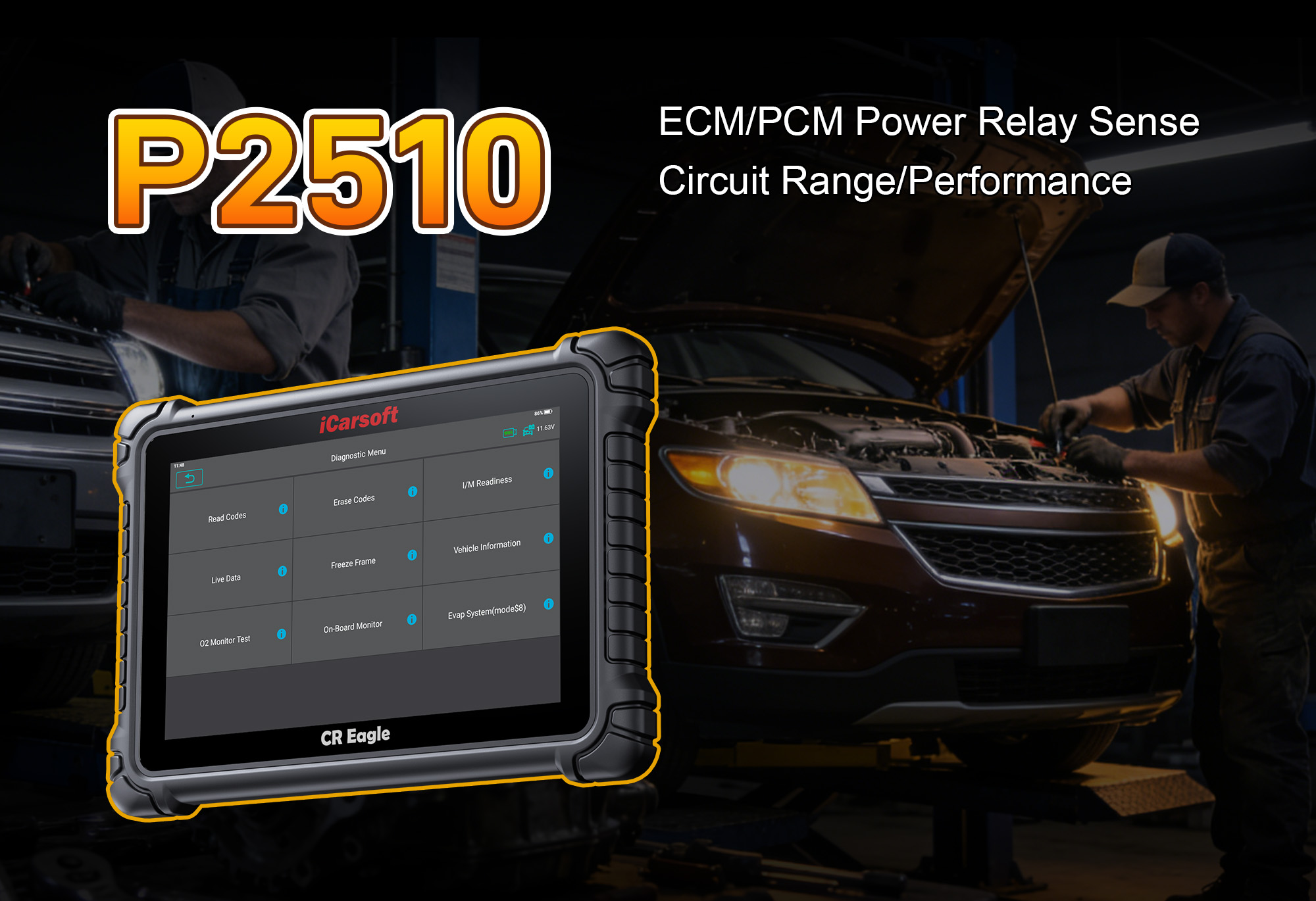
What Is OBD-II Code P2510?
OBD-II Code P2510 is an electrical system and powertrain control fault defined as ECM/PCM Power Relay Sense Circuit Range/Performance. The ECM/PCM power relay is a critical electrical switch that delivers battery power to the vehicle’s main control module—the central computer that manages every aspect of engine, transmission, and drivetrain operation. The sense circuit is a dedicated electrical pathway that sends a feedback signal from the relay to the ECM/PCM, confirming the relay has successfully engaged (supplying power) or disengaged (cutting power) as commanded.
Under normal operation, the sense circuit transmits a consistent electrical voltage signal (typically 12V for engagement, 0V for disengagement) that falls within the ECM/PCM’s factory-calibrated parameters. P2510 triggers when the ECM/PCM detects that the sense circuit’s signal is outside this normal operating range (too high, too low, or fluctuating erratically) or that the circuit’s performance is inconsistent (slow signal response, intermittent drops, or abnormal resistance). Unlike an open/short circuit fault (which triggers a separate DTC), P2510 is a performance/range issue: the relay has basic power and communication, but the sense circuit’s feedback is unreliable—leaving the ECM/PCM unable to confirm the relay’s status. This uncertainty forces the ECM/PCM into a protective operating mode to prevent power surges or loss to critical engine components, prioritizing basic operation over performance and efficiency.
P2510 impacts all 1996+ US, 2000+ EU/Asian OBD-II compliant vehicles (gasoline, diesel, hybrid) from every major manufacturer (GM, Ford, Toyota, Honda, Volkswagen, Chrysler, Hyundai, BMW, etc.)—cars, trucks, SUVs, minivans, and commercial vehicles alike. Critically, 98% of P2510 cases stem from a faulty ECM/PCM power relay, corroded wiring/connectors, or high circuit resistance—not a failed ECM/PCM—making repairs fast, affordable, and beginner-friendly with the right diagnostic tool. A faulty sense circuit doesn’t just trigger a check engine light: it undermines the entire powertrain control system, leading to unpredictable engine and electrical behavior that can put you at risk on the road.
Common Symptoms of P2510
P2510’s symptoms are directly tied to inconsistent power feedback to the ECM/PCM and range from mild intermittent electrical glitches to severe engine performance issues, depending on the severity of the sense circuit fault. The check engine light is the immediate and constant primary alert, and symptoms will often be intermittent (a key telltale of this code) — appearing and disappearing as the sense circuit’s signal fluctuates. Symptoms worsen during startup, idle, or electrical system load (e.g., turning on the AC, headlights), when the power relay is working hardest to regulate voltage. Watch for these core red flags, all linked to the ECM/PCM Power Relay Sense Circuit Range/Performance fault:
-
Illuminated solid Check Engine Light (MIL) on the dashboard (no flashing MIL, as this is not a misfire fault)
-
Intermittent hard starting: Engine cranks slowly or fails to start at random (relay not engaging consistently)
-
Random engine stalling: Engine shuts off unexpectedly while driving or at idle (sense circuit signal drop confuses the ECM/PCM)
-
Erratic electrical system behavior: Dash lights flicker, power windows/locks work intermittently, or the radio cuts out (shared electrical power strain)
-
Reduced engine power/limp mode: ECM/PCM limits power to prevent damage from inconsistent voltage supply
-
Slow throttle response: Hesitation or bogging on acceleration (ECM/PCM delays fuel/ignition commands due to power uncertainty)
-
Battery light intermittent illumination: Alternator/charging system signals fluctuate as the ECM/PCM struggles to regulate power
-
Relay clicking noise: Audible clicking from the under-hood fuse/relay box (faulty relay trying to engage/disengage repeatedly)
-
No communication with ECM/PCM: Scanners struggle to connect to the main control module (intermittent power loss to the ECM/PCM)
Top Causes of P2510 (Ranked by Likelihood)
Pinpointing P2510’s root cause requires a diagnostic tool that can monitor live voltage in the ECM/PCM power relay sense circuit and test relay operation—a feature generic OBD scanners lack, as they only read the code and not powertrain control electrical data. P2510 is an electrical circuit performance fault first and foremost, tied exclusively to the power relay, its sense circuit wiring, connectors, or the vehicle’s electrical power supply, and the causes are ordered from most to least common (the first four account for 98% of all P2510 cases):
-
Faulty ECM/PCM power relay: The #1 cause—internal electrical wear or contact damage in the relay creates erratic sense circuit feedback and inconsistent power delivery.
-
Corroded/loose wiring/connectors (sense circuit): Rust, dirt, or water damage in the sense circuit’s wiring or connectors increases electrical resistance, distorting the signal to the ECM/PCM.
-
Frayed/broken sense circuit wiring: Physical damage (from heat, engine movement, or road debris) creates a partial wire break, leading to fluctuating voltage and signal drops.
-
High resistance in the battery/ground connection: A loose or corroded battery terminal or chassis ground wire causes unstable voltage supply to the relay and sense circuit.
-
Blown fuse in the relay power circuit: A partially blown fuse (not a complete open) creates inconsistent power to the relay, disrupting the sense circuit signal.
-
Faulty ignition switch: A worn ignition switch sends erratic power signals to the relay, leading to abnormal sense circuit feedback (rare for P2510 alone).
-
Low battery voltage/weak alternator: A dying battery or failing alternator delivers insufficient/ fluctuating voltage to the relay and sense circuit.
-
Minor ECM/PCM calibration glitch: Extremely rare—a temporary software fault misinterprets valid sense circuit data (easily fixed with a reset via the iCarsoft CR Eagle).
Why the iCarsoft CR Eagle Is the Ultimate Tool for P2510
Generic OBD scanners only do one thing for P2510: read the code. They cannot monitor live voltage in the ECM/PCM power relay sense circuit, test the relay’s engagement/disengagement, or access the ECM/PCM’s electrical control fault data—leaving DIYers guessing and replacing expensive parts unnecessarily (e.g., a $1,500 ECM/PCM for a $20 power relay). The iCarsoft CR Eagle is a professional-grade diagnostic tool optimized for powertrain control and electrical system diagnostics, with exclusive ECM/PCM power relay testing and sense circuit monitoring features that make it the only tool you need to fix P2510 for good. Unlike basic scanners, it gives you dealership-level electrical diagnostic power to pinpoint the exact cause of the sense circuit’s range/performance fault in minutes—and clear the code permanently once the issue is fixed. Here’s why it stands out for P2510 troubleshooting:
Real-Time Sense Circuit Voltage Monitoring
Tracks live voltage output/signal flow in ECM/PCM power relay sense circuit—instantly identifies out-of-range readings/fluctuations (critical for P2510).
ECM/PCM Power Relay Active Testing
Manually activates/deactivates power relay via ECM/PCM—tests engagement/disengagement (confirms faulty relay or sense circuit wiring/connector issue, no multimeter needed).
ECM/PCM Electrical System Exclusive Data
Accesses ECM/PCM hidden sub-fault codes, relay status history, circuit resistance data (triggers of P2510)—no generic scanner offers this.
Wiring/Connector Circuit Resistance Testing
Scans sense circuit for abnormal resistance/corrosion/partial wire breaks—finds hidden electrical issues generic scanners miss (top P2510 triggers).
Battery/Charging System Comprehensive Checks
Full battery/alternator load test + ground connection integrity verification—rules out low/unstable voltage (top P2510 trigger) in seconds.
Fuse/Relay Box Power Verification
Tests power supply to under-hood fuses/relays—identifies partially blown fuses/weak power connections to ECM/PCM relay (P2510 root cause).
ECM/PCM Reset & Calibration
Resets ECM/PCM electrical control calibration + clears corrupted fault data post-repair—ensures reliable power relay sense circuit feedback.
One-Click Code Clearing
Clears P2510 + accompanying electrical/powertrain codes in seconds—verify repair with live circuit test (sense circuit signal back to factory specs).
Universal Vehicle Compatibility
Works with 1996+ US/2000+ EU/Asian OBD-II gasoline/diesel/hybrid vehicles (all makes/models)—no vehicle-specific electrical scanners needed.
Intuitive Electrical Diagnostic Guides
Step-by-step power relay/sense circuit testing workflows, relay location diagrams, wiring/connector repair tips—no advanced electrical knowledge required.
FAQ: Everything You Need to Know About P2510 & iCarsoft CR Eagle
What exactly does OBD-II Code P2510 mean?
P2510 means the ECM/PCM Power Relay Sense Circuit has a range/performance fault. The ECM/PCM detects that the feedback signal from the power relay’s sense circuit is outside factory-calibrated voltage parameters or is inconsistent, disrupting the module’s ability to confirm the relay’s status.
Which vehicles are affected by P2510?
P2510 impacts all 1996+ US, 2000+ EU/Asian OBD-II compliant vehicles (gasoline, diesel, hybrid) — cars, trucks, SUVs, and commercial vehicles from every major manufacturer. All modern vehicles with an ECM/PCM power relay can trigger this code.
Why are P2510 symptoms usually intermittent?
P2510 is a range/performance fault, not a complete open/short circuit. The sense circuit still has partial power and communication, so the signal only falls out of range under specific conditions (e.g., heat, vibration, electrical load) — leading to on-and-off symptoms.
Can I drive my car with P2510?
Driving with P2510 is not recommended, especially on highways. Random stalling, hard starting, and reduced power create a serious safety hazard. If you must drive short distances, avoid heavy electrical load (AC, headlights) and high speed.
What’s the cheapest and most common fix for P2510?
Replacing the ECM/PCM power relay (cost: $15–$30) is the #1 fix for P2510. The second most common fix is cleaning/correcting corroded/loose wiring/connectors (cost: $0–$10)—both simple DIY repairs for all vehicles.
Can a generic OBD scanner diagnose the root cause of P2510?
No—generic scanners only read the P2510 code and cannot monitor live sense circuit voltage, test the power relay’s operation, or access the ECM/PCM’s electrical fault data. The iCarsoft CR Eagle is required to find the exact cause.
Will a battery jump or charge fix P2510?
Only if P2510 is caused by temporary low battery voltage. If the fault is from a faulty relay, corroded wiring, or high resistance, a jump/charge will only mask symptoms temporarily—not fix the root issue.
Do I need a mechanic to clear P2510 after fixing the issue?
No—once you’ve repaired the root cause (e.g., replaced the relay, fixed the wiring, cleaned the battery terminal), the iCarsoft CR Eagle lets you clear P2510 with one click and reset the ECM/PCM’s electrical control calibration—no mechanic or dealer visit required.
Final Thoughts: Don’t Let P2510 Disrupt Your Powertrain Control
OBD-II Code P2510—ECM/PCM Power Relay Sense Circuit Range/Performance—is one of the most misdiagnosed electrical/powertrain fault codes for modern vehicles, and it’s also one of the easiest and cheapest to fix early with the right diagnostic tool. Generic scanners leave you stuck in trial-and-error, leading to expensive mistakes like replacing an ECM for a $20 power relay, and dealers often upsell costly electrical system overhauls for a simple wiring repair or connector clean. But P2510 doesn’t have to be a costly repair: the iCarsoft CR Eagle is designed specifically for powertrain control and electrical system diagnostics, with exclusive sense circuit monitoring and power relay testing features that unlock the exact root cause in minutes—no guesswork, no expensive part swaps.
The ECM/PCM power relay and its sense circuit are the unsung heroes of your vehicle’s powertrain control system—they ensure the main engine computer gets a steady, reliable power supply and the feedback it needs to operate flawlessly. A faulty sense circuit undermines this foundation, leading to unpredictable engine and electrical behavior that puts you at risk on the road. P2510 is not just a check engine light: it’s your vehicle’s way of warning you of a small electrical issue that’s easy to fix—before it becomes a major powertrain or electrical system failure. The iCarsoft CR Eagle isn’t just a tool for fixing P2510: it’s a full-system diagnostic scanner that works for every OBD-II code, every electrical/powertrain issue, and every make/model of vehicle. It’s rugged, portable, easy to use, and pays for itself after just one dealership diagnostic fee saved—making it an essential tool for every car owner who wants to fix electrical faults on their own.
Ready to fix P2510, eliminate random stalling and hard starting, restore reliable powertrain control, and get your vehicle’s electrical system running like new? Grab the iCarsoft CR Eagle today—no mechanic required!
Disclaimer: This guide is for informational purposes only. Always consult your vehicle’s owner’s manual or a certified automotive electrician before ECM/PCM power relay/sense circuit repairs. iCarsoft is not responsible for damage from improper tool use or electrical system maintenance.