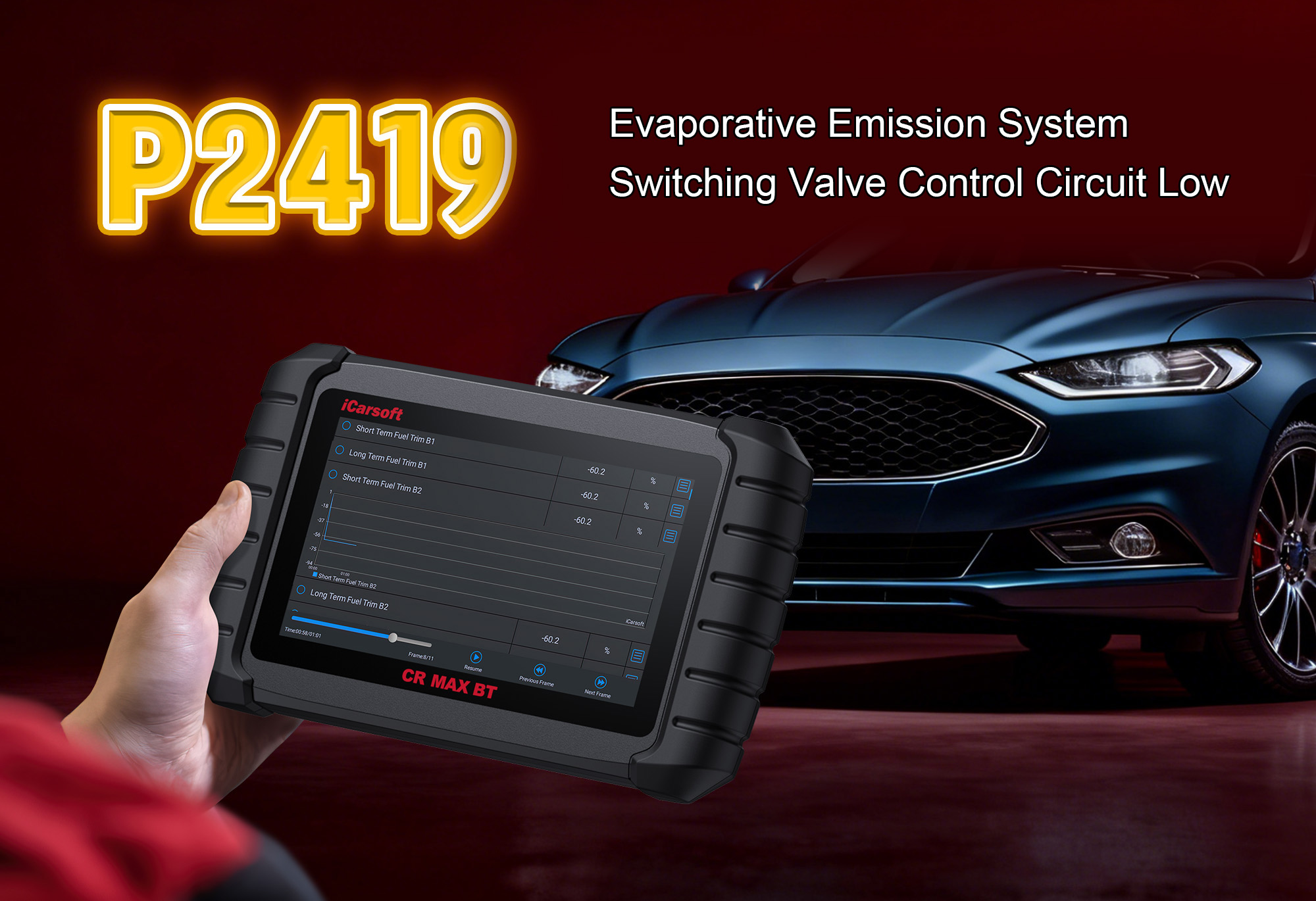
OBD-II Code P2419: EVAP System Switching Valve Circuit Low – Fix with iCarsoft CR MAX BT
If your check engine light ignites, you smell strong fuel fumes near your vehicle, or you fail an emissions test with OBD-II Code P2419—defined as EVAP System Switching Valve Control Circuit Low—you’re dealing with a critical fault in your vehicle’s Evaporative Emission (EVAP) system. The EVAP switching valve regulates the flow of fuel vapor from the gas tank to the engine for safe combustion, and a “circuit low” error means its electrical voltage falls below the Engine Control Module (ECM)’s expected range. This fault lets harmful fuel vapors leak into the air, triggers emissions failures, and can even cause erratic engine performance. But you don’t need to overpay for dealer EVAP system diagnostics: this guide breaks down everything about P2419, plus why the iCarsoft CR MAX BT diagnostic tool is the DIYer’s ultimate solution to detect, troubleshoot, and clear this error code with professional precision—no advanced mechanical skills required.
What Is OBD-II Code P2419?
OBD-II codes alert to powertrain and emissions system malfunctions, and P2419 zeroes in on a low-voltage fault in the EVAP system’s switching valve control circuit—a core component of your vehicle’s emissions control system, mandated by law to prevent fuel vapor pollution. Here’s a jargon-free breakdown for all drivers:
-
EVAP System Switching Valve: An electrically controlled solenoid valve that manages the flow of gasoline vapor from the fuel tank’s charcoal canister to the engine’s intake manifold. It opens and closes based on ECM signals to burn fuel vapors during normal operation, eliminating harmful hydrocarbon emissions.
-
Control Circuit Low: The electrical voltage in the valve’s control circuit drops below the manufacturer’s pre-set threshold (typically 12V for most vehicles). This means the ECM can’t send or receive a valid signal to operate the valve—causing it to stick open/closed or fail to activate entirely.
-
Emissions Impact: A non-functional switching valve lets unburned fuel vapors escape into the atmosphere, violating emissions regulations and leading to failed state/local emissions tests (a major consequence for most drivers).
-
P2419 is a common EVAP system fault across all 1996+ US, 2000+ EU/Asian OBD-II compliant cars, trucks, SUVs, and vans—gas and hybrid models alike. It’s not just an emissions issue: unresolved P2419 can cause fuel odor inside/outside the vehicle, minor fuel efficiency drops, and even rough idling as unregulated vapor disrupts the air-fuel mixture.
Common Symptoms of P2419
P2419’s symptoms are tied directly to EVAP system failure, with the check engine light as the primary alert. You’ll likely notice one or more of these telltale signs, which worsen as the fault persists:
-
Illuminated solid Check Engine Light (MIL) on the dashboard (the most consistent indicator)
-
Strong gasoline fumes inside the vehicle or near the gas tank/fuel filler neck
-
Failed state/local emissions tests (the #1 practical consequence for most drivers)
-
Erratic engine idling or slight hesitation (unregulated fuel vapor disrupts air-fuel combustion)
-
Minor increase in fuel consumption (fuel vapors escape instead of being burned for power)
-
Illuminated emissions system warning light (on newer vehicle models)
-
Stuck EVAP canister (overfilled with fuel vapor from a non-functional switching valve)
-
Difficulty refueling the gas tank (unusual pressure buildup from blocked vapor flow, in severe cases)
Top Causes of P2419
Pinpointing P2419’s root cause is straightforward with the right diagnostic tool, and the fault is almost always an electrical issue (not a complex EVAP system failure). The most common triggers (in order of likelihood—90% of P2419 cases are the first four causes) are:
-
Faulty EVAP switching valve/solenoid: Internal electrical failure of the valve (the #1 cause) – the solenoid can’t activate due to a burnt coil or broken wiring inside the valve.
-
Corroded/loose control circuit wiring/connector: Rust, dirt, or loose pins in the valve’s electrical connector disrupt voltage flow, causing a low-voltage signal to the ECM.
-
Broken/shorted circuit wiring: Damaged insulation or a frayed wire in the valve’s control circuit (from engine bay heat, vibration, or rodent damage) creates a voltage drop.
-
Blown EVAP system fuse: A blown fuse in the under-hood/cabin fuse box cuts power to the switching valve circuit, leading to 0V and a P2419 code.
-
EVAP system vacuum leak: A cracked vacuum hose or loose fitting connected to the switching valve causes it to malfunction, triggering a circuit fault code (indirect cause).
-
Valve mechanical jamming: Dirt, debris, or fuel residue clogs the switching valve, preventing it from opening/closing and causing the ECM to register a circuit performance fault.
-
Low vehicle battery voltage: A weak 12V battery (below 11.5V) reduces voltage to the entire EVAP circuit, triggering P2419 (common in older vehicles).
-
ECM signal interpretation fault (extremely rare): The ECM fails to read a valid signal from the valve (only after all other electrical/mechanical issues are ruled out).
Why the iCarsoft CR MAX BT Is Ideal for P2419
Generic OBD scanners only read the P2419 code—they cannot test the EVAP switching valve’s circuit voltage, check valve functionality, or distinguish between a faulty solenoid and a corroded wire. This leaves many DIYers guessing and replacing expensive EVAP parts unnecessarily (e.g., a new canister when the real issue is a blown fuse). The iCarsoft CR MAX BT (bluetooth-enabled, professional-grade) is optimized for emissions and EVAP system diagnostics, with exclusive features that make it the perfect tool for resolving P2419 quickly and affordably. Here’s why it stands out from basic scanners:
EVAP System Exclusive Diagnostics
Reads real-time voltage and resistance in the switching valve control circuit to confirm if the fault is electrical (wiring/fuse) or a faulty valve itself.
Switching Valve Functionality Testing
Lets you activate/deactivate the EVAP valve via the tool to verify if it opens/closes properly—critical for ruling out mechanical jamming vs. electrical failure.
Circuit Continuity Testing
Runs dedicated electrical tests to detect open/short circuits and corroded connectors in the EVAP control circuit (a feature missing from all basic scanners).
EVAP System Vacuum & Pressure Monitoring
Tracks real-time EVAP system vacuum and fuel tank pressure to identify leaks or pressure buildup that trigger indirect P2419 faults.
Wireless Bluetooth Connectivity
Syncs seamlessly with your smartphone/tablet for hands-free diagnostics—monitor the EVAP circuit while testing the valve in the engine bay (no tangled cables).
One-Click Code Clearing & ECM Reset
After fixing the fault, clear P2419 and reset the ECM’s EVAP system parameters in seconds—verify your repair instantly with live circuit and pressure data.
Universal Vehicle Compatibility
Works with all 1996+ US, 2000+ EU/Asian OBD-II compliant cars, trucks, SUVs, and vans (Ford, Toyota, Honda, BMW, Chevrolet, Volkswagen, and more) with EVAP systems.
Intuitive App Integration
The iCarsoft app includes EVAP system troubleshooting guides, fuse box location references, and vacuum hose diagram snippets—tailored for DIYers with no emissions system experience.
Rugged, Compact Design
Built with durable, heat-resistant plastic for engine bay/roadside use; small enough to store in your glove box for emergency emissions system diagnostics.
FAQ: Everything You Need to Know About P2419 & iCarsoft CR MAX BT
What exactly does OBD-II Code P2419 mean?
P2419 indicates a low-voltage fault in the EVAP System Switching Valve control circuit—the valve’s electrical voltage falls below the ECM’s expected range, preventing it from regulating fuel vapor flow properly.
What is the EVAP system switching valve’s main job?
It controls the flow of fuel vapor from the fuel tank’s charcoal canister to the engine, burning the vapor for power and preventing harmful hydrocarbon emissions from leaking into the air.
Is it safe to drive with P2419?
Short-term driving is safe, but long-term use causes fuel vapor leaks, failed emissions tests, and minor fuel efficiency drops. Fix it promptly—especially if you have an upcoming emissions inspection.
Can a generic OBD scanner diagnose P2419’s root cause?
No—generic scanners only read the P2419 code and cannot test the valve’s circuit voltage, check valve functionality, or monitor EVAP system pressure. The CR MAX BT is required to find the real issue.
Does the iCarsoft CR MAX BT test EVAP system vacuum/pressure?
Yes—its dedicated EVAP diagnostics track real-time vacuum and fuel tank pressure, letting you identify leaks or pressure buildup that trigger indirect P2419 faults.
Will the CR MAX BT work with my hybrid vehicle for P2419?
Yes—it’s compatible with all 1996+ US, 2000+ EU/Asian OBD-II compliant hybrid models, as hybrid EVAP systems function the same as gas-powered ones for fuel vapor control.
Will clearing P2419 with the CR MAX BT make the code go away permanently?
Yes—if you repair the underlying root cause (e.g., replace a blown fuse, clean a corroded connector, unclog the valve). The tool resets the ECM’s EVAP parameters for proper operation.
How much money can I save with the CR MAX BT for P2419?
Dealer diagnostics for P2419 cost $200–$450, and unnecessary EVAP valve/canister replacements cost $300–$800+. The CR MAX BT lets you fix 90% of P2419 causes for under $20 (parts) and pays for itself after one use.
Final Thoughts: Don’t Let P2419 Ruin Your Emissions Test & Fuel System
OBD-II Code P2419 is one of the most common EVAP system faults—and one of the easiest to fix if you have the right diagnostic tool. Generic scanners leave you stuck in trial-and-error, leading to expensive, unnecessary part replacements and dealer markup. But the iCarsoft CR MAX BT gives you professional-grade EVAP system and circuit diagnostics to pinpoint the exact cause of P2419 in minutes: a blown fuse, corroded wire, faulty valve, or vacuum leak.
For every driver, passing emissions tests and preventing fuel vapor leaks is non-negotiable—both for legal compliance and environmental responsibility. The CR MAX BT isn’t just a solution for P2419: it diagnoses all EVAP and emissions system faults, monitors your vehicle’s fuel tank pressure, and reads every other OBD-II code for your engine, transmission, and brake systems. It’s a must-have tool for your garage, saving you hundreds (or thousands) in dealer repairs over time.
Ready to fix P2419, stop fuel vapor leaks, and pass your emissions test with ease? Grab the iCarsoft CR MAX BT today and take complete control of your vehicle’s EVAP system and emissions health—with wireless convenience and professional diagnostic precision!
Disclaimer: This guide is for informational purposes only. Always consult your vehicle’s service manual or a certified mechanic before EVAP system, emissions control, or electrical circuit repairs. iCarsoft is not responsible for damage from improper tool use or vehicle maintenance.