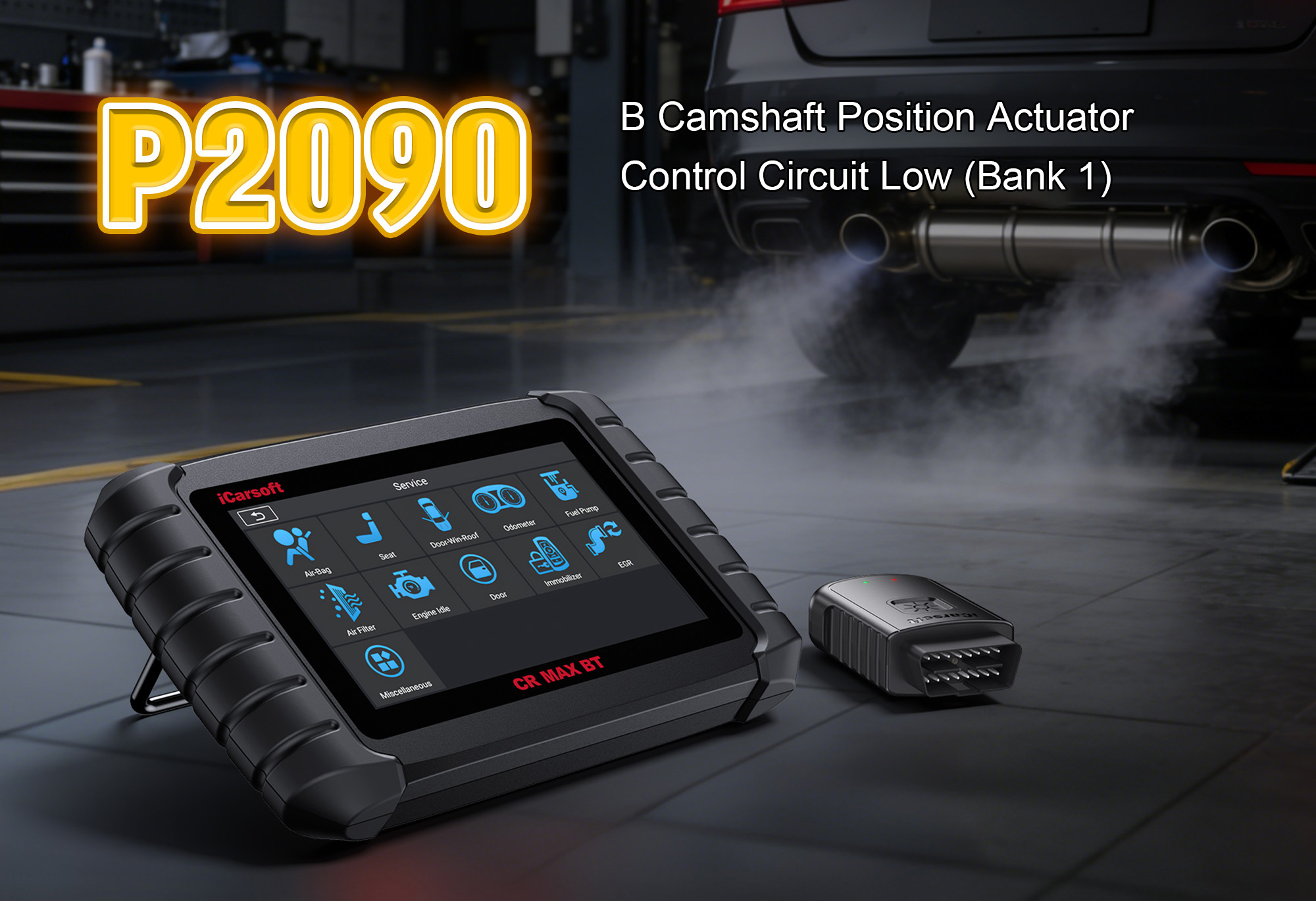
OBD-II Code P2090: B Camshaft Position Actuator Control Circuit Low (Bank 1) – Fix with iCarsoft CR MAX BT
If your check engine light illuminates, your engine idles rough, loses power on acceleration, or has reduced fuel efficiency with OBD-II Code P2090—B Camshaft Position Actuator Control Circuit Low (Bank 1)—you’re facing a critical electrical fault in your engine’s variable valve timing (VVT) system. The Bank 1 B camshaft position actuator is the heart of precise valve timing adjustment, and a low-voltage control circuit robs it of the power needed to regulate camshaft movement, disrupting engine performance and efficiency. Left unaddressed, P2090 leads to increased engine wear, poor fuel economy, and even failed emissions tests—but you don’t need to pay steep dealer VVT system diagnostics fees for a fixable issue. This guide breaks down everything you need to know about P2090, and why the iCarsoft CR MAX BT diagnostic tool is the DIYer’s ultimate solution to detect, troubleshoot, and clear this error code with professional precision—no advanced mechanical or electrical skills required.
What Is OBD-II Code P2090?
OBD-II codes are the Engine Control Module (ECM)’s universal alert for powertrain and engine management malfunctions, and P2090 specifically flags a low-voltage fault in the control circuit for the B Camshaft Position Actuator on Engine Bank 1—a VVT system-specific error that impacts nearly all modern gas-powered and mild hybrid vehicles with variable valve timing. Here’s a jargon-free breakdown for all drivers:
-
Engine Bank 1: The cylinder bank that contains the #1 cylinder (the primary bank in V-config engines like V6/V8; the only bank in inline 4/6-cylinder engines).
-
B Camshaft Position Actuator: A solenoid-driven hydraulic component that adjusts the position of the exhaust camshaft (labeled B, with the intake camshaft labeled A) in the VVT system. It works with the ECM to modify valve opening/closing times for optimal power, efficiency, and emissions at all engine speeds.
-
Control Circuit Low: The ECM monitors the voltage in the actuator’s electrical control circuit in real time; P2090 triggers when this voltage drops below the manufacturer’s pre-set threshold (typically below 9-10V). This low voltage prevents the actuator from receiving enough power to operate, halting or limiting camshaft timing adjustments.
-
VVT System Impact: Without proper actuator operation, the camshaft can’t adjust timing, leading to a fixed valve timing state. This disrupts the engine’s air-fuel mixture and combustion process, causing rough idle, power loss, and reduced fuel efficiency.
-
P2090 is a common VVT system fault across all 1996+ US, 2000+ EU/Asian OBD-II compliant vehicles with variable valve timing (Toyota, Honda, Ford, Chevrolet, BMW, Volkswagen, and Hyundai top the list). Crucially, 95% of P2090 cases stem from electrical circuit issues or a faulty actuator solenoid—not major engine or VVT system failure—making repairs fast and affordable with the right diagnostic data.
Common Symptoms of P2090
P2090’s symptoms are directly tied to a non-functional Bank 1 B camshaft position actuator and disrupted variable valve timing, and they’re most noticeable during acceleration or low-speed idle (when the VVT system is most active). The check engine light is the permanent primary alert, and symptoms worsen with engine load (e.g., climbing hills, towing) if the fault is unaddressed. Watch for these core red flags:
-
Illuminated solid Check Engine Light (MIL) on the dashboard (the universal indicator)
-
Rough engine idle or engine shaking/vibration (the most noticeable symptom)
-
Loss of engine power and hesitation on acceleration (VVT can’t adjust for optimal power)
-
Reduced fuel economy (10-20% MPG drop is common—the ECM can’t optimize combustion)
-
Slow engine warm-up (disrupted valve timing impacts coolant heat transfer)
-
Mild engine misfires (uneven combustion from fixed valve timing)
-
Reduced throttle response (delayed power when pressing the gas pedal)
-
Failed state/local emissions tests (poor combustion increases harmful exhaust emissions)
-
No severe driveability issues at high speed (VVT has less impact at steady RPMs—key P2090 trait)
Top Causes of P2090
Pinpointing P2090’s root cause requires a diagnostic tool that can test the camshaft actuator’s electrical circuit voltage and VVT system performance—generic scanners only read the code, not the critical electrical and engine data behind it. The causes are all tied to the Bank 1 B actuator’s control circuit, the actuator itself, or the vehicle’s electrical system, ordered by likelihood (the first four causes account for 95% of P2090 cases):
-
Corroded/loose wiring/connectors in the actuator circuit: The #1 cause—rust, dirt, water damage, or loose pins in the wiring between the ECM and Bank 1 B actuator create high resistance, dropping circuit voltage.
-
Open/short circuit in the actuator control wiring: A broken wire (open circuit) or a wire touching metal/ground (short circuit) saps voltage from the circuit, leading to a low-voltage fault.
-
Faulty Bank 1 B camshaft position actuator solenoid: Internal electrical failure (burnt coil, faulty valve) in the actuator solenoid causes excessive current draw, lowering circuit voltage.
-
Low vehicle battery/charging system voltage: A weak battery (below 12V), faulty alternator, or bad ground wire delivers insufficient power to the actuator’s control circuit.
-
Clogged actuator oil passage/hydraulic port: Dirty engine oil or sludge clogs the actuator’s hydraulic passages, causing it to work harder and draw more current (indirectly lowering circuit voltage).
-
Faulty camshaft position sensor (CPS): A defective CPS sends false camshaft position data to the ECM, which misregulates the actuator’s circuit voltage (rare secondary cause).
-
ECM internal fault: A failing ECM’s voltage regulator sends insufficient power to the actuator circuit (extremely rare—only ruled out after all other issues are fixed).
-
Worn VVT system components: Mild wear on camshaft phasers or timing chains creates extra resistance for the actuator, causing increased current draw (indirect low-voltage trigger).
Why the iCarsoft CR MAX BT Is Ideal for P2090
Generic OBD scanners only read the P2090 code—they cannot test the camshaft actuator’s circuit voltage, monitor VVT system performance, or isolate the fault to wiring, the actuator, or the battery—leaving many DIYers guessing and replacing parts unnecessarily (e.g., a $200 actuator when the real issue is a $5 corroded connector). The iCarsoft CR MAX BT (bluetooth-enabled, professional-grade) is optimized for VVT system and engine electrical diagnostics, with exclusive features that make it the perfect tool for resolving P2090 quickly and affordably. Here’s why it stands out from basic scanners:
Actuator Circuit Voltage Testing
Measures real-time voltage in the Bank 1 B camshaft position actuator’s control circuit to confirm low voltage and identify the exact drop (critical for pinpointing the root cause).
VVT System Real-Time Monitoring
Tracks camshaft position, actuator solenoid operation, and valve timing adjustment data in real time—showing how the low-voltage fault disrupts the VVT system.
Actuator Solenoid Functional Testing
Lets you manually activate/deactivate the Bank 1 B actuator solenoid via the tool to verify if it operates correctly and draws normal current (no disassembly required).
Electrical Circuit Continuity Testing
Runs dedicated tests on the actuator’s wiring/connector to detect corrosion, high resistance, open circuits, or short circuits—eliminating trial-and-error for electrical faults.
Battery/Charging System Voltage Check
Monitors the vehicle’s battery and alternator voltage to rule out a weak battery or faulty charging system as the cause of low circuit voltage.
Wireless Bluetooth Connectivity
Syncs seamlessly with your smartphone/tablet for hands-free diagnostics—monitor the actuator circuit and VVT data while test-driving, no tangled cables in the engine bay.
One-Click Code Clearing & ECM Reset
After fixing the fault, clear P2090 and reset the ECM’s VVT system and camshaft timing parameters in seconds—verify your repair instantly with live engine data.
Universal Vehicle Compatibility
Works with all 1996+ US, 2000+ EU/Asian OBD-II compliant gas-powered and mild hybrid vehicles with VVT systems (inline 4/6, V6/V8—all engine configurations).
Intuitive App Integration
The iCarsoft app includes VVT actuator replacement guides, Bank 1 location diagrams, and engine oil change tips—tailored for DIYers with no VVT or electrical repair experience.
FAQ: Everything You Need to Know About P2090 & iCarsoft CR MAX BT
What exactly does OBD-II Code P2090 mean?
P2090 is a B Camshaft Position Actuator Control Circuit Low (Bank 1) fault—the ECM detects voltage in the Bank 1 exhaust camshaft actuator’s control circuit drops below manufacturer specs, halting proper VVT operation.
What is Engine Bank 1, and which camshaft is B?
Bank 1 is the cylinder bank with the #1 cylinder (only bank for inline engines); Camshaft B is the exhaust camshaft (Camshaft A is the intake camshaft) in the VVT system.
Does P2090 affect diesel or electric vehicles?
No—P2090 is exclusive to gas-powered and mild hybrid vehicles with a variable valve timing (VVT) system. Diesel engines (no VVT in most models) and fully electric vehicles (no camshafts) never throw this code.
Is it safe to drive with P2090?
Yes—short-term driving is safe, as P2090 causes no severe engine damage. However, it leads to rough idle, power loss, and reduced fuel economy; fixing it promptly restores performance and prevents unnecessary engine wear.
Can a generic OBD scanner diagnose P2090’s root cause?
No—generic scanners only read the P2090 code and cannot test the actuator’s circuit voltage, monitor VVT performance, or detect electrical faults like corroded wiring. The CR MAX BT is required to find the real issue.
Will changing engine oil fix P2090?
It can—if P2090 is caused by dirty oil/sludge clogging the actuator’s hydraulic passages, which causes increased current draw and low circuit voltage. The CR MAX BT will confirm if this is the root cause.
Do I need to replace the entire VVT system for P2090?
95% of the time, no—P2090 is an electrical circuit or single actuator solenoid fault. Full VVT system replacement is only needed for severe mechanical wear (extremely rare and only after all electrical issues are fixed).
How much money can I save with the CR MAX BT for P2090?
Dealer diagnostics for P2090 cost $200–$500, and unnecessary repairs (VVT system service, full actuator replacement) cost $800–$1,500+. The CR MAX BT lets you fix 95% of P2090 causes for under $50 (parts) and pays for itself after one use.
Final Thoughts: Don’t Let P2090 Rob Your Engine of Power & Efficiency
OBD-II Code P2090 is one of the most common variable valve timing system fault codes for modern vehicle owners—and one of the easiest to fix if you have the right diagnostic tool. Generic scanners leave you stuck in trial-and-error, leading to expensive unnecessary part replacements, and dealers often upsell costly VVT system services for a simple electrical issue that costs just a few dollars to resolve. The iCarsoft CR MAX BT changes this by giving you professional-grade VVT system and electrical circuit diagnostics to pinpoint the exact cause of P2090 in minutes: a corroded connector, broken wire, faulty actuator solenoid, or weak battery.
For every driver with a VVT-equipped vehicle, a functional camshaft position actuator is non-negotiable for optimal engine power, fuel efficiency, and emissions compliance. A low-voltage circuit fault like P2090 may not cause severe damage, but it turns a smooth, efficient engine into one that idles rough, loses power, and burns more gas—all avoidable with a quick fix. The CR MAX BT isn’t just a solution for P2090: it diagnoses all VVT and engine electrical fault codes, monitors live camshaft and actuator data, and reads every other OBD-II code for your engine, transmission, and emissions systems. It’s a compact, durable tool that fits in your glove box, saves you hundreds (or thousands) in dealer repairs over time, and ensures your modern engine runs at peak performance—all with wireless Bluetooth convenience and professional diagnostic precision.
Ready to fix P2090, restore your engine’s power and fuel efficiency, and eliminate rough idle? Grab the iCarsoft CR MAX BT today and take complete control of your vehicle’s VVT system and engine health!
Disclaimer: This guide is for informational purposes only. Always consult your vehicle’s service manual or a certified mechanic before VVT system, camshaft actuator, or electrical circuit repairs. iCarsoft is not responsible for damage from improper tool use or vehicle maintenance.