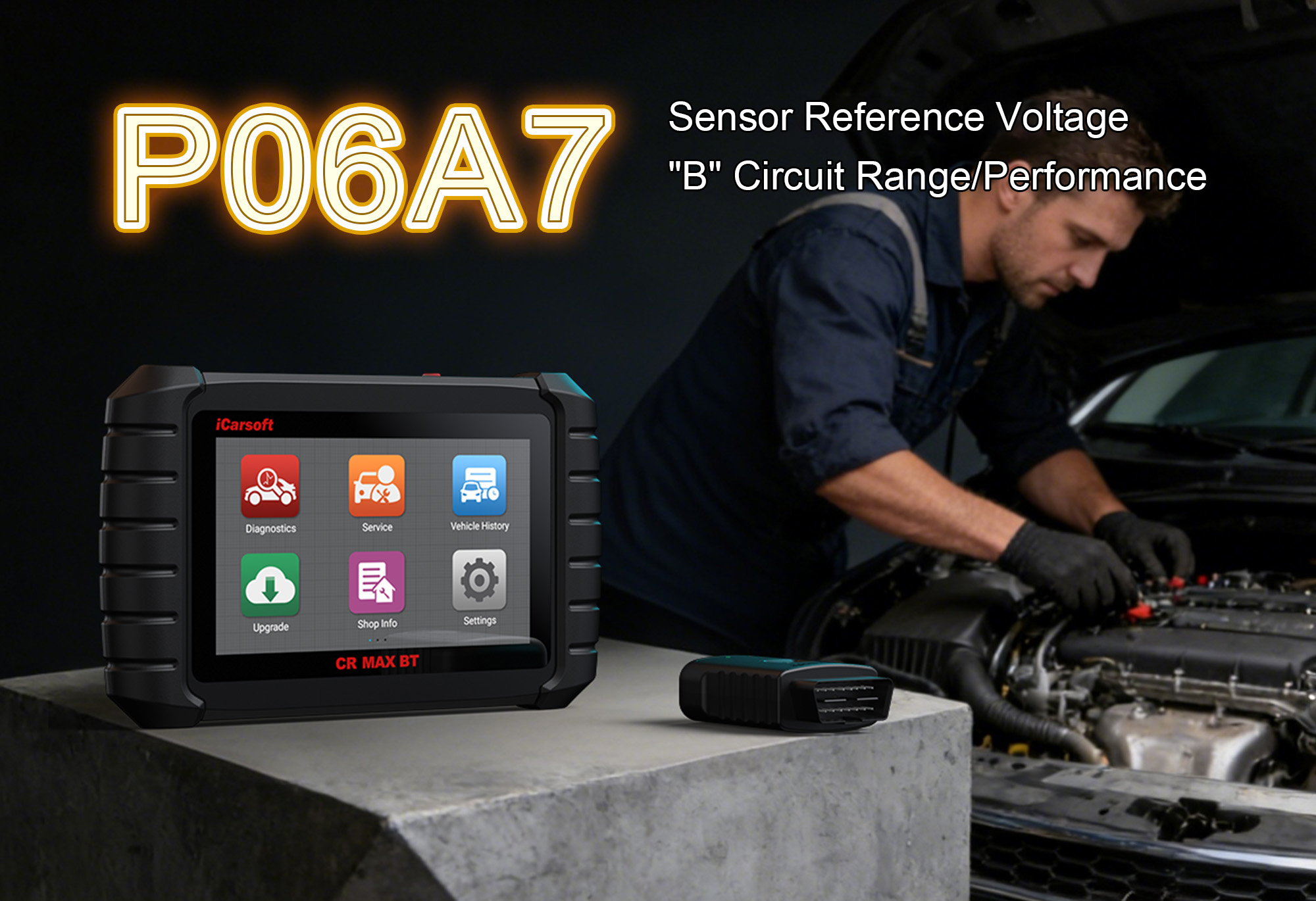
OBD-II Code P06A7: Sensor Reference Voltage B Circuit Range/Performance – Fix with iCarsoft CR MAX BT
If your check engine light illuminates, your vehicle’s gauges act erratically, and critical engine sensors stop working properly with OBD-II Code P06A7—Sensor Reference Voltage B Circuit Range/Performance—you’re facing a core electrical fault in your vehicle’s engine control system. The Sensor Reference Voltage (SRV) B circuit is the lifeline for powering a suite of vital engine and powertrain sensors, and a range/performance fault means its voltage falls outside the manufacturer’s precise specs, robbing sensors of the stable power they need to send accurate data to the Engine Control Module (ECM). Left unaddressed, P06A7 leads to misfiring, poor fuel efficiency, limp mode, and even failed emissions tests—but you don’t need to pay steep dealer electrical diagnostics fees for a fixable circuit issue. This guide breaks down everything you need to know about P06A7, and why the iCarsoft CR MAX BT diagnostic tool is the DIYer’s ultimate solution to detect, troubleshoot, and clear this error code with professional precision—no advanced electrical or mechanical skills required.
What Is OBD-II Code P06A7?
OBD-II codes are the ECM’s universal alert for powertrain and electrical system malfunctions, and P06A7 specifically flags that the Sensor Reference Voltage B circuit has a range/performance fault—an electrical system error that impacts nearly all modern 1996+ OBD-II compliant vehicles (gas, diesel, mild hybrid). Unlike sensor-specific fault codes, P06A7 is a power supply fault that affects the entire SRV B circuit, not just a single sensor. Here’s a jargon-free breakdown for all drivers:
-
Sensor Reference Voltage (SRV) B Circuit: A dedicated 5V (or 3.3V) regulated power circuit from the ECM that supplies stable voltage to a cluster of critical engine/powertrain sensors (e.g., coolant temperature, oil pressure, throttle position, camshaft position, and fuel pressure sensors—varies by make/model). It works alongside SRV A/C circuits to split power load across the vehicle’s sensor network.
-
Range/Performance Fault: The ECM monitors the SRV B circuit’s voltage in real time; P06A7 triggers when the voltage drifts too high, too low, or fluctuates erratically outside the manufacturer’s pre-set range (typically 4.5–5.5V for 5V circuits). This unstable power means sensors on the circuit send inaccurate or no data to the ECM.
-
ECM Data Blind Spot: Without accurate sensor data from the SRV B circuit, the ECM cannot properly calibrate fuel delivery, ignition timing, or engine load—leading to poor performance, inefficient combustion, and protective limp mode activation.
-
P06A7 is a common electrical control system fault across all US, EU, and Asian OBD-II vehicles (Ford, Toyota, Chevrolet, BMW, Honda, Volkswagen, Hyundai top the list). Crucially, 98% of P06A7 cases stem from a short/open circuit, corroded wiring, or a faulty sensor (not a failed ECM)—making repairs fast, affordable, and beginner-friendly with the right diagnostic data.
Common Symptoms of P06A7
P06A7’s symptoms are tied to the failure of all sensors powered by the SRV B circuit, and they vary based on which sensors are on the circuit (make/model specific) but are always easy to spot while driving or idling. The check engine light is the permanent primary alert, and symptoms worsen with acceleration, engine load, or temperature changes (when sensor data is most critical). Watch for these core red flags:
-
Illuminated solid or flashing Check Engine Light (MIL) on the dashboard
-
Erratic or non-functional dashboard gauges (e.g., oil pressure, coolant temp, fuel pressure)—the most noticeable symptom
-
Engine misfires, rough idle, or hesitation on acceleration (ECM lacks accurate sensor data for fuel/ignition calibration)
-
Reduced fuel efficiency (10-25% MPG drop—ECM overcompensates for bad data)
-
Vehicle entering limp mode (ECM limits power to protect the engine from incorrect calibration)
-
Hard starting (no accurate crankshaft/camshaft position or fuel pressure data)
-
Non-functional warning lights for critical systems (e.g., low oil pressure, overheating)
-
Failed state/local emissions tests (poor combustion from incorrect ECM calibration)
-
Intermittent electrical glitches (fluctuating voltage causes sensors to cut in/out)
Top Causes of P06A7
Pinpointing P06A7’s root cause requires a diagnostic tool that can test the SRV B circuit’s voltage and isolate faulty sensors/wiring—a feature generic OBD scanners lack, as they only read the code and not electrical circuit performance data. The causes are all tied to the SRV B circuit’s wiring, connectors, or the sensors it powers (a failed ECM is extremely rare), ordered by likelihood (the first four causes account for 98% of P06A7 cases):
-
Short circuit in the SRV B wiring: The #1 cause—a wire in the circuit touches the engine block/metal frame (short to ground) or another 12V wire, causing voltage to spike/drop and trigger the fault.
-
Open circuit in the SRV B wiring: A broken or frayed wire in the circuit cuts power to all sensors on SRV B, leading to a complete loss of voltage and a range fault.
-
Corroded/loose wiring/connectors: Rust, dirt, water damage, or loose pins in the SRV B circuit’s connectors create high resistance, causing voltage to fluctuate erratically.
-
Faulty sensor on the SRV B circuit: A shorted internal circuit in a sensor (e.g., coolant temp, oil pressure) draws excess current from the SRV B circuit, dragging down voltage.
-
Water/moisture in the ECM connector: Moisture seeps into the ECM’s SRV B power port, causing corrosion and intermittent voltage drops in the circuit.
-
Damaged wiring harness: Physical damage (e.g., from a rock, rodent chews, or improper maintenance) to the SRV B wiring harness creates short/open circuits.
-
Faulty voltage regulator (in ECM): A weak internal voltage regulator in the ECM fails to supply stable 5V/3.3V power to the SRV B circuit (rare—only after all other issues are ruled out).
-
Aftermarket electrical modifications: Poorly installed accessories (e.g., fog lights, audio systems) tap into the SRV B circuit, causing excessive current draw and voltage fluctuations.
Why the iCarsoft CR MAX BT Is Ideal for P06A7
Generic OBD scanners only read the P06A7 code—they cannot test the SRV B circuit’s voltage, isolate faulty sensors, or detect short/open circuits—leaving many DIYers guessing and replacing the ECM unnecessarily (a $1,000+ part) for a simple wiring or sensor issue. The iCarsoft CR MAX BT (bluetooth-enabled, professional-grade) is optimized for vehicle electrical control system and ECM diagnostics, with exclusive circuit testing features that make it the perfect tool for resolving P06A7 quickly and affordably. Here’s why it stands out from basic scanners:
SRV B Circuit Voltage Testing
Measures real-time voltage in the Sensor Reference Voltage B circuit to confirm if it’s too high, too low, or fluctuating—the most critical feature for P06A7.
Sensor Isolation Diagnostics
Tests each sensor powered by the SRV B circuit individually to identify a faulty sensor (the root cause of 30% of P06A7 cases) without trial-and-error part replacement.
Electrical Circuit Continuity Testing
Runs dedicated tests on the SRV B wiring/connectors to detect short circuits, open circuits, and high resistance from corrosion—eliminating guesswork for electrical faults.
ECM Sensor Data Monitoring
Reads live data from all SRV B-powered sensors to show which sensors are sending inaccurate/no data (a quick way to map the fault to the circuit).
Wireless Voltage Tracking
Monitors the SRV B circuit’s voltage while driving/testing the vehicle to catch intermittent faults (e.g., voltage drops from heat/vibration) that only happen on the road.
Wireless Bluetooth Connectivity
Syncs seamlessly with your smartphone/tablet for hands-free diagnostics—test the SRV B circuit while inspecting the wiring harness, no tangled cables in the engine bay.
One-Click Code Clearing & ECM Reset
After fixing the fault, clear P06A7 and reset the ECM’s voltage regulation and sensor calibration parameters in seconds—verify your repair instantly with live circuit/sensor data.
Universal Vehicle Compatibility
Works with all 1996+ US, 2000+ EU/Asian OBD-II compliant gas, diesel, and mild hybrid vehicles (cars, trucks, SUVs, vans)—all engine/transmission configurations.
Intuitive App Integration
The iCarsoft app includes SRV circuit wiring diagrams, sensor location guides, and electrical repair tips—tailored for DIYers with no automotive electrical experience.
FAQ: Everything You Need to Know About P06A7 & iCarsoft CR MAX BT
What exactly does OBD-II Code P06A7 mean?
P06A7 is a Sensor Reference Voltage B Circuit Range/Performance fault—the ECM detects the SRV B circuit’s voltage is too high, too low, or fluctuates outside specs, robbing connected sensors of stable power and accurate data transmission.
Which vehicles are affected by P06A7?
P06A7 impacts all 1996+ US, 2000+ EU/Asian OBD-II compliant vehicles (gas, diesel, mild hybrid) with a dedicated SRV B circuit—cars, trucks, SUVs, and vans of all makes and models. No vehicle is immune to this electrical circuit fault.
Is P06A7 a sensor fault or a wiring fault?
P06A7 is a circuit power supply fault (not a single sensor fault), but it can be triggered by a faulty sensor (shorted internal circuit) drawing excess current from the SRV B circuit, or a wiring/connector issue (short/open/corrosion) in the circuit itself.
Is it safe to drive with P06A7?
Short-term low-speed driving only—the ECM lacks accurate sensor data for critical systems (coolant temp, oil pressure, fuel pressure), so it can’t detect overheating/low oil pressure. Prolonged driving risks severe engine damage; limp mode is a critical warning to stop.
Can a generic OBD scanner diagnose P06A7’s root cause?
No—generic scanners only read the P06A7 code and cannot test the SRV B circuit’s voltage, isolate faulty sensors, or detect electrical wiring issues. The CR MAX BT is required to find the real cause (wiring, sensor, connector).
Will replacing a single sensor fix P06A7?
It can—if P06A7 is caused by a shorted sensor on the SRV B circuit drawing excess current. The CR MAX BT will test each sensor on the circuit to confirm which one is the root cause, avoiding unnecessary part replacements.
Is a failed ECM the main cause of P06A7?
No—an ECM failure is responsible for less than 2% of P06A7 cases. The fault is almost always a wiring/connector issue or a faulty sensor on the SRV B circuit; never replace the ECM first (it’s a costly mistake).
How much money can I save with the CR MAX BT for P06A7?
Dealer diagnostics for P06A7 cost $300–$600, and unnecessary repairs (ECM replacement, full sensor set swap) cost $1,000–$3,000+. The CR MAX BT lets you fix 98% of P06A7 causes for under $100 (parts) and pays for itself after one use.
Final Thoughts: Don’t Let P06A7 Blind Your Vehicle’s ECM
OBD-II Code P06A7 is one of the most common electrical control system fault codes for modern vehicle owners—and one of the easiest to fix if you have the right diagnostic tool. Generic scanners leave you stuck in trial-and-error, leading to expensive mistakes like replacing the ECM for a $5 corroded connector, and dealers often upsell costly electrical system services for a simple wiring or sensor repair. The iCarsoft CR MAX BT changes this by giving you professional-grade electrical circuit and ECM diagnostics to pinpoint the exact cause of P06A7 in minutes: a short/open circuit, corroded wiring, faulty sensor, or loose connector.
For every driver, a functional Sensor Reference Voltage B circuit is non-negotiable—its stable power keeps critical engine/powertrain sensors working, and those sensors are the ECM’s “eyes and ears” for optimal engine performance, fuel efficiency, and safety. A P06A7 fault doesn’t just cause rough idle or poor MPG—it robs you of the ability to detect serious engine issues like overheating or low oil pressure, putting your vehicle at risk of severe damage. The CR MAX BT isn’t just a solution for P06A7: it diagnoses all vehicle electrical and powertrain fault codes, tests all SRV circuits, and monitors live sensor/ECM data—making it an essential tool for every DIYer. It’s a compact, durable tool that fits in your glove box, saves you thousands in dealer repairs over time, and ensures your vehicle’s electrical and engine systems run at peak performance—all with wireless Bluetooth convenience and professional diagnostic precision.
Ready to fix P06A7, restore accurate sensor data, and give your ECM back its full visibility of your engine? Grab the iCarsoft CR MAX BT today and take complete control of your vehicle’s electrical and engine health!
Disclaimer: This guide is for informational purposes only. Always consult your vehicle’s service manual or a certified automotive electrical specialist before SRV circuit, wiring, or sensor repairs. iCarsoft is not responsible for damage from improper tool use or vehicle maintenance.