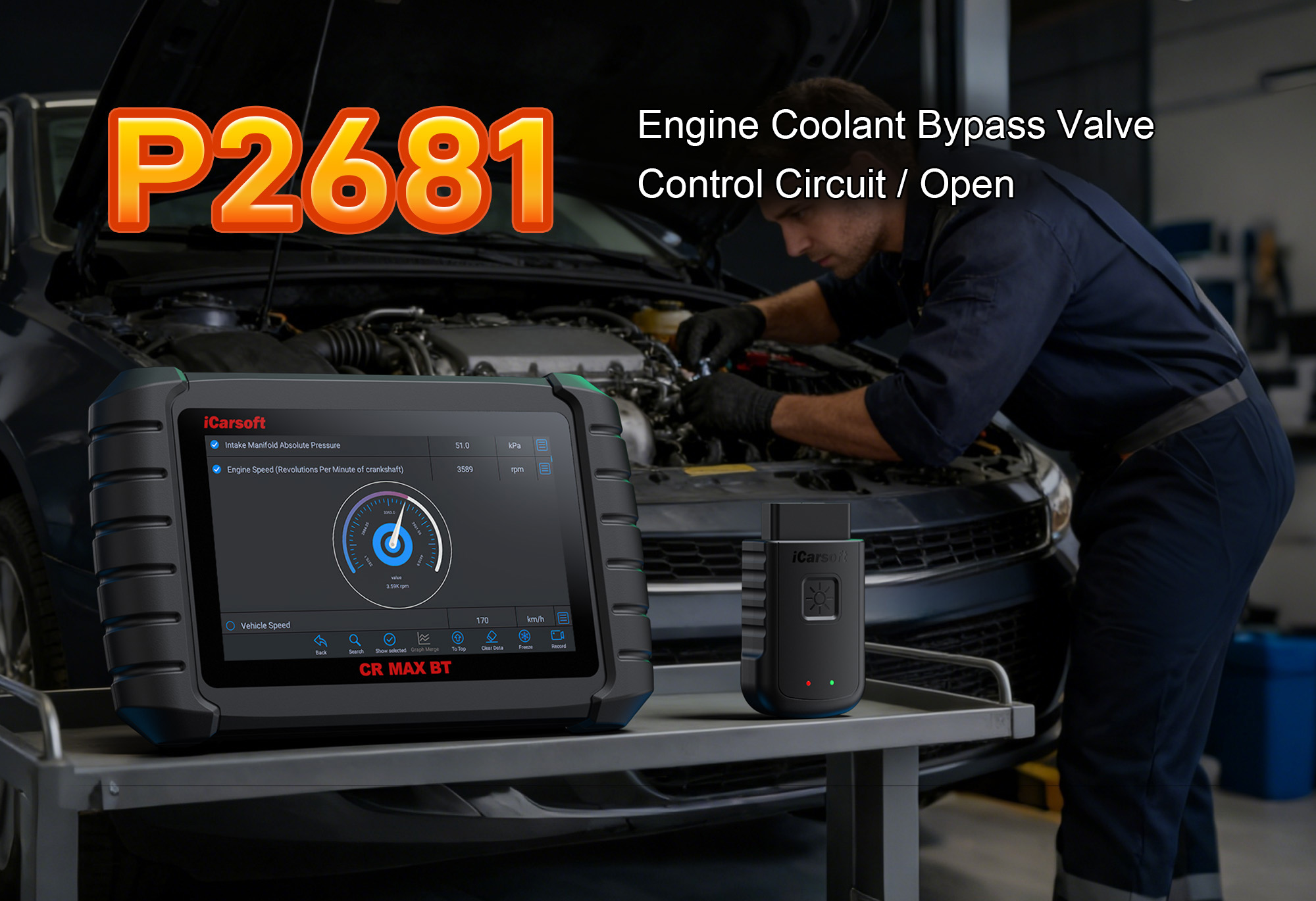
OBD-II Code P2681: Engine Coolant Bypass Valve Control Open Circuit – Fix with iCarsoft CR MAX BT
If your check engine light turns on, your engine overheats at idle, or your cabin heat fails to kick in with OBD-II Code P2681—Engine Coolant Bypass Valve Control Open Circuit—you’re facing a critical electrical and cooling system fault. The engine coolant bypass valve is a core component of your vehicle’s cooling system, regulating coolant flow to maintain optimal engine temperature (especially at idle and warm-up), and an open circuit in its control system robs it of the power needed to operate. Left unaddressed, P2681 leads to engine overheating, poor fuel efficiency, damaged gaskets, and even catastrophic engine failure—but you don’t need to pay steep dealer cooling system diagnostics fees for a fixable valve or wiring issue. This guide breaks down everything you need to know about P2681, and why the iCarsoft CR MAX BT diagnostic tool is the DIYer’s ultimate solution to detect, troubleshoot, and clear this error code with professional precision—no advanced mechanical or electrical skills required.
What Is OBD-II Code P2681?
OBD-II codes are the Engine Control Module (ECM)’s universal alert for powertrain and cooling system malfunctions, and P2681 specifically flags an open circuit in the control system of the engine coolant bypass valve—a cooling system-exclusive fault that impacts nearly all modern 1996+ OBD-II compliant gas and diesel vehicles. An open circuit means a break in the electrical path that powers and controls the bypass valve, rendering it inoperable. Here’s a jargon-free breakdown for all drivers:
-
Engine Coolant Bypass Valve: An electrically or vacuum-operated valve (ECM-controlled) that diverts engine coolant flow during cold starts, idle, and low-load operation. It bypasses the radiator to speed up engine warm-up, maintains stable idle temperature, and ensures consistent cabin heat—critical for engine efficiency and comfort.
-
Control Open Circuit: The ECM monitors the valve’s electrical control circuit (voltage, current, and continuity) in real time; P2681 triggers when the ECM detects a complete break in this circuit (e.g., a broken wire, disconnected connector, or faulty valve solenoid). This break cuts power to the valve, leaving it stuck in either open or closed position.
-
Cooling System Impact: A stuck bypass valve disrupts proper coolant flow. If stuck closed, the engine overheats at idle (coolant flows constantly through the radiator); if stuck open, the engine takes too long to warm up, leading to rich fuel mixtures, poor MPG, and no cabin heat in cold weather.
-
P2681 is a common cooling system electrical fault across all US, EU, and Asian OBD-II vehicles (Ford, Toyota, Chevrolet, BMW, Honda, Volkswagen, Hyundai top the list). Crucially, 98% of P2681 cases stem from a faulty bypass valve, corroded wiring, or loose connector—not a failed ECM or major cooling system failure—making repairs fast, affordable, and beginner-friendly with the right diagnostic data.
Common Symptoms of P2681
P2681’s symptoms are directly tied to an inoperable coolant bypass valve and disrupted coolant flow, and they’re most noticeable during cold starts, idle, or low-speed driving (when the valve is most active). The check engine light is the permanent primary alert, and symptoms worsen in extreme temperatures (hot or cold) or stop-and-go traffic. Watch for these core red flags:
-
Illuminated solid Check Engine Light (MIL) on the dashboard
-
Engine overheating at idle/low speed (the most common symptom—valve stuck closed, coolant overcools or circulates too quickly)
-
Slow engine warm-up (valve stuck open—coolant bypasses the engine, takes 10+ minutes to reach operating temp)
-
No or weak cabin heat (even when the engine is “warm”—insufficient hot coolant flow to the heater core)
-
Rough idle during warm-up (ECM overcompensates for a cold engine with a rich fuel mixture)
-
Reduced fuel efficiency (10-20% MPG drop—cold engine runs inefficiently until it finally warms up)
-
Coolant temperature gauge fluctuations (erratic needle movement at idle, no stable reading)
-
Hissing or clicking from the engine bay (a faulty valve solenoid or disconnected vacuum line, if applicable)
-
Damaged engine gaskets/hoses (long-term overheating causes rubber components to crack or fail)
Top Causes of P2681
Pinpointing P2681’s root cause requires a diagnostic tool that can test the bypass valve’s control circuit continuity and voltage—a feature generic OBD scanners lack, as they only read the code and not cooling system electrical data. The causes are all tied to the valve’s electrical control circuit or the valve itself (mechanical cooling system issues are a rare secondary cause), ordered by likelihood (the first four causes account for 98% of P2681 cases):
-
Faulty Engine Coolant Bypass Valve Solenoid/Actuator: The #1 cause—an internal electrical failure in the valve’s solenoid (electric valves) or vacuum actuator (vacuum-operated) creates an open circuit, cutting power to the valve.
-
Broken/open wiring in the valve control circuit: A frayed, cut, or broken wire between the ECM and the bypass valve creates a complete break in the electrical path, triggering the open circuit fault.
-
Corroded/loose/disconnected electrical connector: Rust, dirt, water damage, or a loose fit at the valve’s electrical connector breaks circuit continuity—one of the most common easy fixes for P2681.
-
Blown fuse in the bypass valve circuit: A blown fuse (often in the under-hood fuse box) cuts power to the valve’s control system, creating an open circuit (easily overlooked by basic diagnostics).
-
Moisture in the valve control circuit: Water or condensation seeps into the wiring or connector, causing corrosion and a gradual break in circuit continuity (common in wet climates or after car washes).
-
Damaged valve housing: Physical damage to the bypass valve housing (e.g., from a rock or improper maintenance) severs the internal electrical connections, creating an open circuit.
-
Faulty vacuum line (vacuum-operated valves): A cracked, disconnected, or clogged vacuum line robs the valve of vacuum pressure, and the ECM registers this as a control circuit fault (for vacuum/electric hybrid valves).
-
ECM wiring harness damage: A broken wire in the ECM’s cooling system wiring harness disrupts power to the bypass valve (rare—only after all other issues are ruled out).
Why the iCarsoft CR MAX BT Is Ideal for P2681
Generic OBD scanners only read the P2681 code—they cannot test the bypass valve’s control circuit continuity, measure voltage, or verify valve functionality—leaving DIYers guessing and replacing parts unnecessarily (e.g., a $300 radiator for a $50 bypass valve or $5 corroded connector). The iCarsoft CR MAX BT (bluetooth-enabled, professional-grade) is optimized for cooling system and electrical circuit diagnostics, with exclusive bypass valve control features that make it the perfect tool for resolving P2681 quickly and affordably. Here’s why it stands out from basic scanners:
Bypass Valve Control Circuit Testing
Measures real-time voltage and tests circuit continuity for the engine coolant bypass valve to confirm an open circuit—the most critical feature for P2681.
Valve Solenoid/Actuator Functional Testing
Lets you manually activate the coolant bypass valve via the tool to verify if it operates (opens/closes) as commanded by the ECM—no disassembly or multimeter required.
Cooling System Live Data Monitoring
Tracks engine coolant temperature (ECT), idle temperature, and coolant flow data in real time to see how the stuck valve disrupts temperature regulation.
Fuse and Relay Circuit Testing
Scans the vehicle’s fuse and relay systems to detect a blown fuse in the bypass valve circuit—an often-missed root cause of P2681.
Electrical Connector and Wiring Diagnostics
Runs dedicated tests to detect corrosion, loose fits, or broken wiring in the valve’s control circuit, eliminating trial-and-error for electrical faults.
Wireless Bluetooth Connectivity
Syncs seamlessly with your smartphone/tablet for hands-free diagnostics—test the valve circuit while inspecting the engine bay, no tangled cables or awkward positioning.
One-Click Code Clearing & ECM Reset
After fixing the fault, clear P2681 and reset the ECM’s cooling system and temperature calibration parameters in seconds—verify your repair instantly with an idle/warm-up test.
Universal Vehicle Compatibility
Works with all 1996+ US, 2000+ EU/Asian OBD-II compliant gas and diesel vehicles (cars, trucks, SUVs, vans) with an engine coolant bypass valve—all makes and models.
Intuitive App Integration
The iCarsoft app includes bypass valve location diagrams, wiring harness guides, and cooling system maintenance tips—tailored for DIYers with no cooling system experience.
FAQ: Everything You Need to Know About P2681 & iCarsoft CR MAX BT
What exactly does OBD-II Code P2681 mean?
P2681 indicates an open circuit in the control system of the engine coolant bypass valve. The ECM detects a complete break in the valve’s electrical path, cutting power and leaving the valve stuck—disrupting coolant flow and engine temperature regulation.
Which vehicles are affected by P2681?
P2681 impacts all 1996+ US, 2000+ EU/Asian OBD-II compliant gas and diesel vehicles (cars, trucks, SUVs, vans) equipped with an engine coolant bypass valve—nearly all modern vehicles have this critical cooling system component.
What’s the main job of the engine coolant bypass valve?
The bypass valve diverts coolant flow to speed up engine warm-up (cold starts), maintain stable idle temperature, and ensure consistent cabin heat. It bypasses the radiator when the engine is cold and opens to allow full coolant flow once operating temp is reached.
Is it safe to drive with P2681?
Only short-term low-speed driving—prolonged use causes engine overheating (which leads to blown head gaskets, warped cylinders, or total engine failure) or inefficient cold engine operation (damaging fuel system components). Stop driving if the temp gauge spikes to hot.
Can a generic OBD scanner diagnose P2681’s root cause?
No—generic scanners only read the P2681 code and cannot test the bypass valve’s control circuit continuity, measure voltage, or verify valve functionality. The CR MAX BT is required to find the real issue (wiring, valve, fuse, connector).
Will replacing the thermostat fix P2681?
No—P2681 is an electrical control circuit fault for the bypass valve, not a mechanical thermostat issue. The thermostat regulates overall coolant temp, while the bypass valve controls flow—they are separate components.
Are P2681 issues only electrical, or can they be mechanical?
P2681 is exclusively an electrical control circuit fault (open circuit). Mechanical issues with the bypass valve (e.g., a stuck valve from debris) trigger different OBD codes—P2681 only relates to broken wiring, faulty solenoids, or blown fuses.
How much money can I save with the CR MAX BT for P2681?
Dealer diagnostics for P2681 cost $300–$500, and unnecessary repairs (radiator replacement, cooling system rebuild, thermostat swap) cost $800–$1,500+. The CR MAX BT lets you fix 98% of P2681 causes for under $100 (parts) and pays for itself after one use.
Final Thoughts: Don’t Let P2681 Wreck Your Cooling System & Engine
OBD-II Code P2681 is one of the most common cooling system electrical fault codes for modern vehicle owners—and one of the easiest to fix if you have the right diagnostic tool. Generic scanners leave you stuck in trial-and-error, leading to expensive unnecessary part replacements, and dealers often upsell costly cooling system rebuilds for a simple $50 bypass valve, $2 fuse, or $5 corroded connector. The iCarsoft CR MAX BT changes this by giving you professional-grade cooling system and electrical circuit diagnostics to pinpoint the exact cause of P2681 in minutes: a broken wire, faulty solenoid, blown fuse, or loose connector.
For every driver, a functional engine coolant bypass valve is non-negotiable for protecting your engine and maintaining comfort. It ensures your engine warms up quickly (boosting fuel efficiency), runs at a stable temperature (preventing overheating), and delivers reliable cabin heat (critical in cold weather). A single open circuit in its control system doesn’t just cause a check engine light—it puts your engine at risk of catastrophic overheating damage that costs thousands to repair. The CR MAX BT isn’t just a solution for P2681: it diagnoses all cooling system and powertrain fault codes, monitors live engine temperature data, and tests all vehicle electrical circuits—making it an essential tool for every DIYer. It’s a compact, durable tool that fits in your glove box, saves you hundreds (or thousands) in dealer repairs over time, and protects your engine from avoidable cooling system failure—all with wireless Bluetooth convenience and professional diagnostic precision.
Ready to fix P2681, restore proper coolant flow, protect your engine from overheating, and get your cabin heat back? Grab the iCarsoft CR MAX BT today and take complete control of your vehicle’s cooling system health!
Disclaimer: This guide is for informational purposes only. Always consult your vehicle’s service manual or a certified automotive technician before coolant bypass valve, wiring, or cooling system repairs. iCarsoft is not responsible for damage from improper tool use or vehicle maintenance.