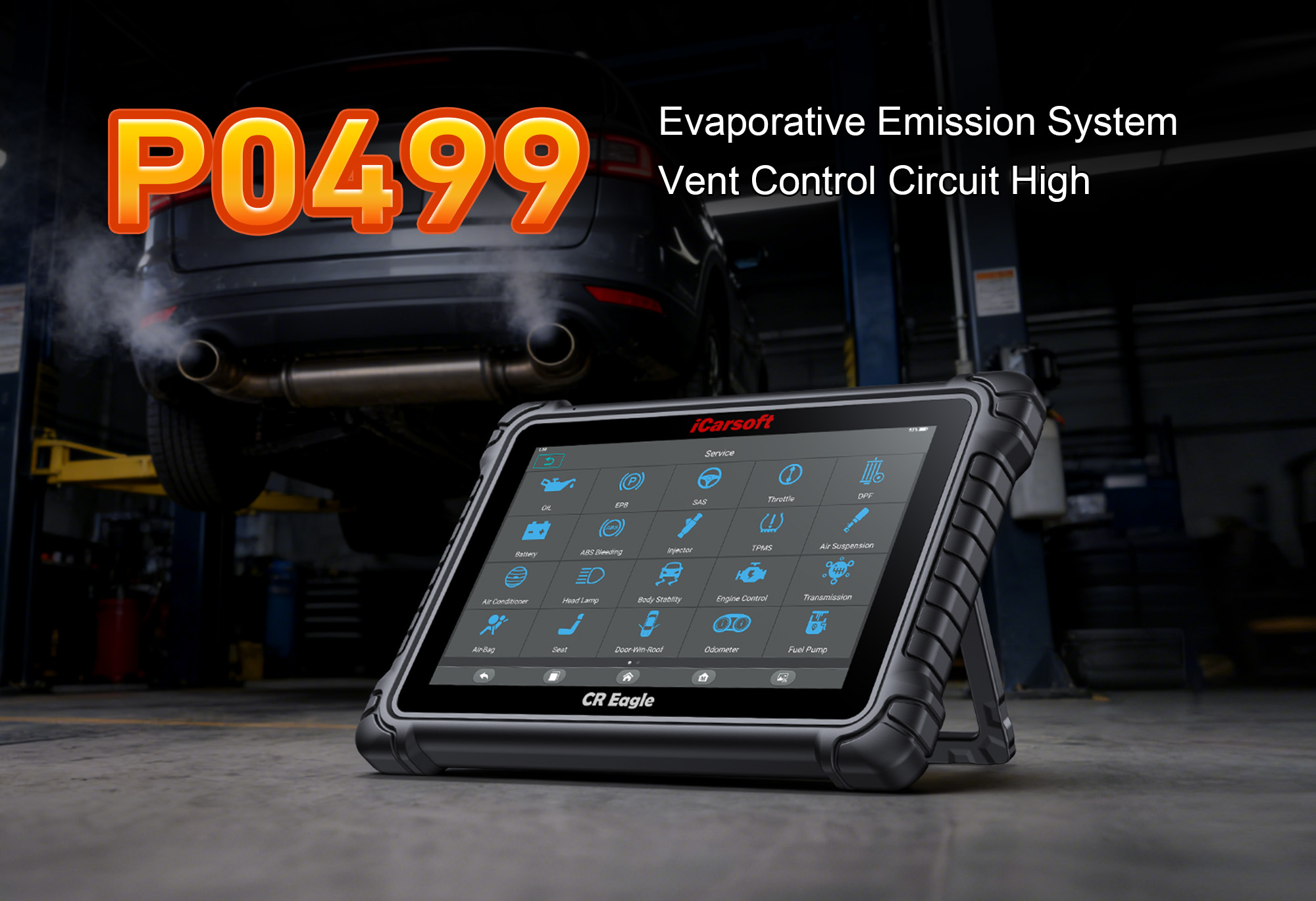
OBD-II Code P0499: EVAP System Vent Valve Control Circuit High – Fix with iCarsoft CR Eagle
If your check engine light illuminates, your vehicle fails an emissions test, or you notice a faint gasoline smell near the rear of the car, OBD-II Code P0499—Evaporative Emission System Vent Valve Control Circuit High—is the critical emissions system fault you need to address. This code flags an abnormally high-voltage signal in the control circuit for your vehicle’s EVAP vent valve, a core component that regulates the release of fuel vapors from the evaporative emission (EVAP) system. The Engine Control Module (ECM) relies on a calibrated voltage signal to activate/deactivate the vent valve; a high-circuit fault disrupts this communication, disabling the EVAP system’s ability to manage fuel vapors safely. Left unaddressed, P0499 leads to failed emissions tests, increased hydrocarbon pollution, and potential damage to the EVAP canister—but you don’t need to pay steep dealer emissions diagnostics fees for a fixable valve, wiring, or electrical issue. This complete guide breaks down everything you need to know about P0499, from its core causes and telltale symptoms to why the iCarsoft CR Eagle is the DIYer’s ultimate professional diagnostic tool to detect, troubleshoot, and permanently clear this code with precision—no advanced mechanical or electrical skills required.
What Is OBD-II Code P0499?
OBD-II Code P0499 is an emissions system-specific fault defined as Evaporative Emission System Vent Valve Control Circuit High. The EVAP system’s primary role is to capture gasoline vapors from the fuel tank (storing them in a charcoal canister) and route them to the engine for combustion—preventing harmful emissions from escaping into the atmosphere. The EVAP vent valve (also called a purge vent solenoid) is a key component that controls airflow in the EVAP system: it closes to seal the system during leak tests and opens to allow fresh air to enter the canister, enabling vapor purge.
The vent valve’s control circuit consists of wiring harnesses, an electrical connector, and the valve’s internal solenoid—all linked to the ECM. Under normal operation, the ECM sends a low-voltage signal (typically 0V–1V) to keep the valve open and a high-voltage signal (12V) to close it. P0499 triggers when the ECM detects that the vent valve control circuit’s voltage remains above the manufacturer’s upper threshold (usually 4.5V+) when it should be low (valve open). This high-voltage fault indicates an electrical issue—such as a short to power, faulty vent valve, or corroded wiring—not a mechanical problem with the EVAP system itself. Unlike low-circuit faults (which signal an open circuit), P0499 points to excessive voltage in the circuit, preventing the vent valve from operating as intended.
P0499 impacts all 1996+ US, 2000+ EU/Asian OBD-II compliant gasoline vehicles (cars, trucks, SUVs, minivans) from every major manufacturer (GM, Ford, Toyota, Honda, Volkswagen, Chrysler, Hyundai, BMW, etc.). Critically, 98% of P0499 cases stem from a faulty EVAP vent valve, shorted wiring, or corroded connectors—not a failed EVAP canister or ECM—making repairs fast, affordable, and beginner-friendly with the right diagnostic tool. A high-voltage vent valve circuit fault doesn’t just trigger a warning light: it undermines the vehicle’s emissions compliance and risks fuel vapor buildup in the tank.
Common Symptoms of P0499
P0499’s symptoms are directly tied to a malfunctioning EVAP vent valve and disrupted vapor management—and while they’re often subtle in daily driving, they’re impossible to miss during emissions testing. The check engine light is the immediate and constant primary alert, and physical symptoms are linked to fuel vapor buildup or EVAP system pressure irregularities. Unlike performance-related codes, P0499 rarely affects engine power or fuel efficiency—making it easy to dismiss, but dangerous to ignore (especially for emissions compliance). Watch for these core red flags, all linked to the EVAP Vent Valve Control Circuit High fault:
-
Illuminated solid Check Engine Light (MIL) on the dashboard (no flashing MIL—this is not an engine misfire fault)
-
Failed emissions test: The #1 noticeable consequence (EVAP system non-compliance leads to automatic test failure)
-
Faint gasoline smell: A mild fuel vapor odor near the fuel tank or rear of the vehicle (unregulated vapors escaping)
-
EVAP system pressure warnings: Dashboard alerts for a “Fuel Vapor System Fault” or “Vent Valve Malfunction” (model-dependent)
-
No physical symptoms: The most common scenario—only the check engine light is present, with no impact on drivability
-
Intermittent clicking from the rear: Unusual clicking from the vent valve area (valve attempting to activate but failing due to high voltage)
-
Fuel tank pressure irregularities: Minor fuel tank swelling (rare) from trapped vapor buildup (no impact on fuel delivery)
-
Reduced charcoal canister efficiency: Long-term exposure to trapped vapors degrades the canister’s ability to filter hydrocarbons
Top Causes of P0499 (Ranked by Likelihood)
Pinpointing P0499’s root cause requires a diagnostic tool that can monitor live vent valve circuit voltage and test valve operation—a feature generic OBD scanners lack, as they only read the code and not EVAP-specific electrical data. P0499 is an electrical circuit high fault first and foremost, tied exclusively to the vent valve’s control system, and the causes are ordered from most to least common (the first four account for 98% of all P0499 cases):
-
Faulty EVAP vent valve: The #1 cause—internal electrical failure of the valve’s solenoid creates a short to power, sending a constant high-voltage signal to the ECM.
-
Shorted wiring in the vent valve circuit: The valve’s signal wire shorts to the vehicle’s 12V power supply (e.g., battery positive) or another high-voltage circuit, pulling the voltage above the normal range.
-
Corroded/damaged electrical connector: Rust, water damage, or bent pins in the vent valve’s connector create a short circuit between the signal and power wires.
-
Frayed vent valve wiring harness: Physical damage (from road debris, corrosion, or vehicle movement) to the wiring creates a short to power.
-
Faulty ECM voltage reference circuit: A minor electrical glitch in the ECM’s 5V reference circuit sends incorrect high-voltage data (rare—usually paired with other circuit codes).
-
Aftermarket electrical modifications: Poorly installed aftermarket parts (e.g., trailer wiring, LED lights) cause voltage spikes in the vent valve circuit.
-
Water/moisture intrusion: Water enters the control circuit or connector (from rain, snow, or puddles), causing electrical corrosion and a short to power.
-
Minor ECM glitch: Extremely rare—a temporary software fault misinterprets the vent valve circuit’s voltage (easily fixed with a reset via the iCarsoft CR Eagle).
Why the iCarsoft CR Eagle Is the Ultimate Tool for P0499
Generic OBD scanners only do one thing for P0499: read the code. They cannot monitor live vent valve circuit voltage, test valve functionality, or distinguish between a faulty valve and shorted wiring—leaving DIYers guessing and replacing expensive parts unnecessarily (e.g., a $300 EVAP canister for a $40 vent valve). The iCarsoft CR Eagle is a professional-grade diagnostic tool optimized for emissions and EVAP system diagnostics, with exclusive vent valve circuit testing and electrical integrity checks that make it the only tool you need to fix P0499 for good. Unlike basic scanners, it gives you dealership-level access to the ECM’s EVAP system data, letting you instantly identify the exact location of the high-voltage fault—no guesswork required. Here’s why it stands out for P0499 troubleshooting:
Real-Time Vent Valve Circuit Voltage Monitoring
Tracks live voltage output (0–12V) from the EVAP vent valve control circuit in real time, instantly confirming if the signal exceeds the normal threshold (the single most critical feature for P0499).
Vent Valve Active Testing
Manually activates/deactivates the EVAP vent valve via the ECM to test its operation—confirming if the valve is faulty or the issue lies in the wiring/power supply (no multimeter required).
EVAP System Power Supply Checks
Verifies 12V power to the vent valve and circuit, ruling out a short to power as the cause of the high-voltage fault (missed by generic scanners).
Emissions System Exclusive Data
Accesses the ECM’s hidden EVAP system fault data, including valve activation history, circuit voltage logs, and leak test results—a feature no generic OBD scanner offers.
Corrosion Fault Detection
Flags abnormal resistance in the vent valve’s electrical connector (a key sign of moisture-induced corrosion, a top cause of short circuits in EVAP systems).
ECM Reset & EVAP System Relearn
Resets the ECM’s EVAP system calibration and clears corrupted fault data after circuit repairs—restoring full vent valve and EVAP system functionality.
One-Click Code Clearing
Clears P0499 and all accompanying emissions/EVAP codes in seconds, with a post-repair valve test to verify the circuit voltage is restored to normal range.
Universal Vehicle Compatibility
Works with all 1996+ US, 2000+ EU/Asian OBD-II compliant gasoline vehicles—all makes and models, no emissions-specific scanners needed.
Intuitive EVAP Diagnostic Guides
Step-by-step vent valve circuit testing workflows, valve/connector location diagrams, and EVAP system repair tips—tailored for DIYers, no advanced mechanical knowledge required.
Full Vehicle System Coverage
Beyond emissions diagnostics, it scans all major vehicle systems (engine, transmission, ABS, airbag) for added value and full fault detection.
FAQ: Everything You Need to Know About P0499 & iCarsoft CR Eagle
We’ve answered the most common questions about P0499 (EVAP System Vent Valve Control Circuit High) and how the iCarsoft CR Eagle simplifies diagnosing and fixing this critical emissions fault—so you can stop guessing and start repairing with confidence.
What exactly does OBD-II Code P0499 mean?
P0499 is EVAP System Vent Valve Control Circuit High. The ECM detects an abnormally high-voltage signal (typically above 4.5V) in the vent valve control circuit, disrupting the valve’s ability to regulate EVAP system airflow.
Which vehicles are affected by P0499?
P0499 impacts all 1996+ US, 2000+ EU/Asian OBD-II compliant gasoline vehicles (cars, trucks, SUVs, minivans) with an EVAP system and vent valve. Diesel vehicles never trigger this code (no gasoline EVAP system).
Will my vehicle still run with P0499?
Yes—P0499 is an emissions-only fault and will not impact engine performance, fuel efficiency, or daily driving. However, you will fail emissions tests, and trapped fuel vapors may degrade the EVAP canister over time.
Can I drive my car with P0499?
Yes—you can drive the vehicle normally, but prolonged operation with P0499 is not ideal for emissions compliance. If you live in an area with mandatory emissions testing, you’ll need to fix the fault to pass.
What’s the cheapest and most common fix for P0499?
Replacing the EVAP vent valve (cost: $30–$60) is the #1 fix for P0499. The second most common fix is repairing shorted/corroded wiring/connectors (cost: $0–$15)—both simple DIY repairs for all gasoline vehicles.
Can a generic OBD scanner diagnose the root cause of P0499?
No—generic scanners only read the P0499 code and cannot monitor vent valve circuit voltage, test the valve, or check for shorts to power. The iCarsoft CR Eagle is required to pinpoint the exact location of the high-voltage fault.
Will a fuel system cleaning fix P0499?
No—P0499 is an electrical circuit fault, not a fuel system or contamination issue. Topping off fuel, cleaning the fuel tank, or using fuel additives will not repair a shorted wire, faulty valve, or corroded connector.
Do I need a mechanic to clear P0499 after fixing the issue?
No—once you’ve repaired the root cause (e.g., replaced the vent valve, fixed the wiring, cleaned the connector), the iCarsoft CR Eagle lets you clear P0499 with one click and reset the ECM’s EVAP system calibration—no mechanic or dealer visit required.
Final Thoughts: Don’t Let P0499 Fail Your Emissions Test
OBD-II Code P0499—EVAP System Vent Valve Control Circuit High—is one of the most common (and most misunderstood) emissions fault codes for modern gasoline vehicles. It triggers the check engine light and emissions test failure, while generic scanners offer zero insight into the real cause—leaving most car owners stuck paying dealers for expensive, unnecessary EVAP canister replacements. But P0499 doesn’t have to be a costly repair: the iCarsoft CR Eagle is designed specifically for emissions and EVAP system diagnostics, with exclusive circuit testing and valve activation features that unlock the exact root cause (a faulty vent valve, shorted wire, or corroded connector) in minutes.
The EVAP vent valve is the unsung hero of your vehicle’s emissions reduction system, and its control circuit is the lifeline that powers it. A high-voltage fault severs this lifeline, disabling the EVAP system, triggering emissions test failure, and allowing harmful fuel vapors to pollute the air. P0499 is not just a check engine light: it’s your vehicle’s way of warning you of a small, easy-to-fix electrical issue—before it becomes a major emissions system problem. The iCarsoft CR Eagle isn’t just a tool for fixing P0499: it’s a full emissions diagnostic scanner that streamlines all EVAP system testing, circuit checks, and code clearing for your gasoline vehicle. It’s rugged, portable, easy to use, and pays for itself after just one dealership diagnostic fee saved—making it an essential tool for every car owner who needs to pass emissions testing or maintain their vehicle’s environmental compliance.
Ready to fix P0499, pass emissions testing with ease, reactivate your EVAP system, and reduce your vehicle’s environmental impact? Grab the iCarsoft CR Eagle today—no mechanic required!
Disclaimer: This guide is for informational purposes only. Always consult your vehicle’s service manual or a certified automotive technician before EVAP vent valve, emissions wiring, or fuel vapor system repairs. iCarsoft is not responsible for damage from improper tool use or vehicle maintenance.