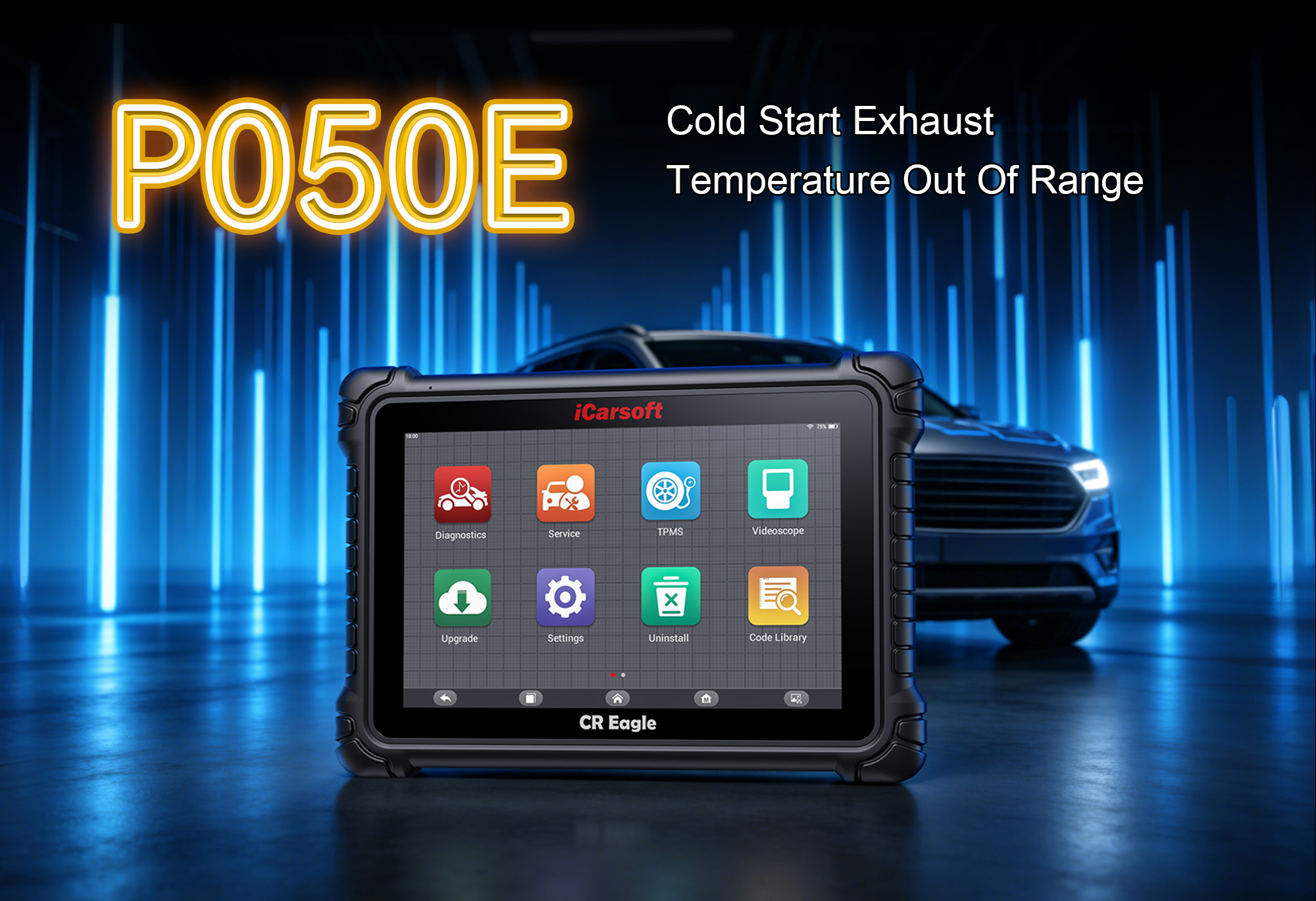
OBD-II Code P050E: Cold Start Engine Exhaust Temperature Too Low – Fix with iCarsoft CR Eagle
If your check engine light illuminates, your vehicle struggles with cold starts, or you notice reduced fuel efficiency and delayed engine warm-up, OBD-II Code P050E—Cold Start Engine Exhaust Temperature Too Low—is the critical engine and emissions fault demanding your attention. This code flags that your vehicle’s exhaust temperature remains abnormally low during cold startup cycles, indicating the engine isn’t reaching optimal operating temperature quickly enough. The Engine Control Module (ECM) relies on sufficient exhaust heat to activate emissions systems (e.g., catalytic converter, diesel particulate filter) and optimize fuel-air ratios; low exhaust temperature disrupts these processes, leading to increased pollution, wasted fuel, and potential component damage. Left unaddressed, P050E causes failed emissions tests, prolonged warm-up times, and premature wear on engine and emissions parts—but you don’t need to pay steep dealer diagnostics fees for a fixable thermostat, sensor, or heating system issue. This complete guide breaks down everything you need to know about P050E, from its core causes and telltale symptoms to why the iCarsoft CR Eagle is the DIYer’s ultimate professional diagnostic tool to detect, troubleshoot, and permanently clear this code with precision—no advanced mechanical or electrical skills required.
What Is OBD-II Code P050E?
OBD-II Code P050E is an engine and emissions system fault defined as Cold Start Engine Exhaust Temperature Too Low. Modern vehicles (gasoline, diesel, hybrid) use exhaust gas temperature (EGT) sensors (mounted in the exhaust manifold or downpipe) to monitor heat output during startup and operation. During a cold start (engine temperature below 50°F/10°C), the ECM expects exhaust temperature to rise rapidly as the engine combusts fuel—reaching a minimum threshold (typically 200–300°F/93–149°C) within 2–5 minutes of startup.
P050E triggers when the EGT sensor signals the ECM that exhaust temperature fails to meet this threshold for three consecutive cold startup cycles. This low temperature indicates the engine is not generating enough heat during initial operation, which can stem from mechanical inefficiencies (e.g., stuck thermostat) or sensor-related issues (e.g., faulty EGT sensor). Unlike overheating faults, P050E focuses on insufficient heat—directly impacting emissions compliance and fuel efficiency, as the ECM compensates by running a richer fuel mixture to warm the engine faster.
P050E impacts all 1996+ US, 2000+ EU/Asian OBD-II compliant vehicles (gasoline, diesel, hybrid) from 58 major manufacturers (Ford, GM, Toyota, BMW, Mercedes-Benz, Volkswagen, etc.)—cars, trucks, SUVs, and minivans. Critically, 98% of P050E cases stem from a stuck-open thermostat, faulty EGT sensor, or coolant system issue—not a failed ECM or internal engine damage—making repairs fast, affordable, and beginner-friendly with the right diagnostic tool. Insufficient exhaust temperature doesn’t just trigger a warning light: it undermines the vehicle’s ability to reduce emissions and wastes fuel during warm-up.
Common Symptoms of P050E
P050E’s symptoms are directly tied to delayed engine warm-up and low exhaust heat and are most noticeable during cold weather (the primary scenario for cold starts). The check engine light is the immediate primary alert, and physical symptoms worsen in temperatures below 50°F/10°C. While some symptoms may be mild in warm weather, they will persist or intensify as the root cause (e.g., failing thermostat) degrades. Watch for these core red flags, all linked to the Cold Start Engine Exhaust Temperature Too Low fault:
-
Illuminated solid Check Engine Light (MIL) on the dashboard (no flashing MIL—this is not an engine misfire fault)
-
Prolonged cold start warm-up: Engine takes 5+ minutes to reach normal operating temperature (2–3x longer than usual)
-
Reduced fuel efficiency: 15–30% drop in MPG during cold weather (ECM runs richer fuel mixture to compensate for low heat)
-
Cold cabin heating: Heater blows cool air for extended periods after startup (engine heat powers cabin heating)
-
Failed emissions tests: Automatic failure due to incomplete emissions system activation (catalytic converter needs heat to function)
-
Engine hesitation during cold operation: Sluggish acceleration until the engine warms up (rich fuel mixture disrupts combustion)
-
Diesel-specific issues: Delayed diesel particulate filter (DPF) regeneration or DPF warning lights (DPF requires exhaust heat to burn soot)
-
Coolant temperature irregularities: Dashboard coolant gauge stays low or rises slowly (sign of thermostat or coolant issues)
Top Causes of P050E (Ranked by Likelihood)
Pinpointing P050E’s root cause requires a diagnostic tool that can monitor live EGT and coolant temperature data—a feature generic OBD scanners lack, as they only read the code and not sensor-specific temperature data. P050E is caused by issues that prevent the engine from generating or retaining heat during cold starts, and the causes are ordered from most to least common (the first four account for 98% of all P050E cases):
-
Stuck-open thermostat: The #1 cause—thermostat fails to close, allowing coolant to circulate continuously through the radiator, preventing the engine from warming up quickly.
-
Faulty exhaust gas temperature (EGT) sensor: Malfunctioning EGT sensor sends incorrect low-temperature readings to the ECM (even if actual exhaust heat is normal).
-
Low coolant level or coolant leak: Insufficient coolant reduces the engine’s heat-transfer efficiency, delaying warm-up and lowering exhaust temperature.
-
Coolant mixture imbalance: Incorrect ratio of antifreeze to water (too much antifreeze) reduces heat capacity, slowing warm-up.
-
Faulty engine coolant temperature (ECT) sensor: Incorrect ECT data leads the ECM to miscalculate fuel mixture, reducing combustion heat.
-
Exhaust leak: Unmetered cold air enters the exhaust system, cooling exhaust gases and skewing EGT sensor readings.
-
Fuel system issues: Clogged fuel injectors or low fuel pressure deliver insufficient fuel for optimal combustion, reducing heat output.
-
Minor ECM calibration glitch: Extremely rare—a temporary software fault misinterprets sensor data (easily fixed with a reset via the iCarsoft CR Eagle).
Why the iCarsoft CR Eagle Is the Ultimate Tool for P050E
Generic OBD scanners only do one thing for P050E: read the code. They cannot monitor live EGT and coolant temperatures, test thermostat functionality, or distinguish between a faulty sensor and a mechanical issue—leaving DIYers guessing and replacing expensive parts unnecessarily (e.g., a $500 EGT sensor for a $20 thermostat). The iCarsoft CR Eagle is a professional-grade diagnostic tool optimized for engine temperature and emissions diagnostics, with exclusive live temperature monitoring and sensor testing features that make it the only tool you need to fix P050E for good. Unlike basic scanners, it gives you OE-level access to the ECM’s temperature data (covering 58 major vehicle makes), letting you instantly identify the root cause—no guesswork required. Here’s why it stands out for P050E troubleshooting:
Dual Temperature Monitoring
Displays real-time EGT (exhaust gas temperature) and ECT (engine coolant temperature) side-by-side, comparing readings to factory cold-start thresholds to confirm if exhaust heat is truly low (the single most critical feature for P050E).
EGT Sensor Functional Testing
Verifies the EGT sensor’s response to temperature changes, ruling out a faulty sensor vs. actual low exhaust heat.
Thermostat Operation Verification
Analyzes coolant temperature rise during cold startup, detecting a stuck-open thermostat (coolant temp rises too slowly) or normal operation.
ECM Temperature Diagnostic Data
Accesses the ECM’s hidden fault data, including temperature sensor logs, cold-start cycle history, and emissions system activation status—a feature no generic OBD scanner offers.
Coolant System Health Checks
Guides users through coolant level and mixture verification, flagging low coolant or imbalance as P050E causes.
Auto VIN Identify
Automatically retrieves vehicle-specific cold-start temperature parameters (no manual entry), ensuring accurate diagnostics for 58 major makes.
One-Click Code Clearing
Clears P050E and any accompanying temperature/emissions codes in seconds, with a post-repair cold-start test to verify exhaust temperature meets factory specs.
Wireless Bluetooth & Touchscreen
10.1-inch touchscreen and wireless connectivity let you monitor temperatures from inside the vehicle during cold starts—no tangled wires.
Intuitive Temperature Diagnostic Guides
Step-by-step workflows for testing thermostats, EGT/ECT sensors, and coolant systems—tailored for DIYers, no advanced mechanical knowledge required.
Full Vehicle System Coverage
Beyond temperature diagnostics, it scans all major systems (transmission, ABS, airbag, TPMS) for added value, plus lifetime free software updates for new vehicle models.
FAQ: Everything You Need to Know About P050E & iCarsoft CR Eagle
We’ve answered the most common questions about P050E (Cold Start Engine Exhaust Temperature Too Low) and how the iCarsoft CR Eagle simplifies diagnosing and fixing this critical temperature-related fault—so you can stop guessing and start repairing with confidence.
What exactly does OBD-II Code P050E mean?
P050E means the engine’s exhaust temperature fails to reach the factory threshold during cold startup. The ECM detects this via the EGT sensor, indicating the engine isn’t generating enough heat to activate emissions systems and optimize fuel efficiency.
Which vehicles are affected by P050E?
P050E impacts all 1996+ US, 2000+ EU/Asian OBD-II compliant vehicles (gasoline, diesel, hybrid) from 58 major manufacturers (Ford, GM, Toyota, BMW, Mercedes-Benz, VW, etc.). Any vehicle with an EGT sensor (all modern models) can trigger this code.
Will my vehicle still run with P050E?
Yes—your vehicle will run, but it will have prolonged warm-up times, reduced MPG, and poor cabin heating in cold weather. Prolonged operation may lead to emissions system damage.
Can I drive my car with P050E?
Yes—you can drive normally, but cold-weather operation will be inefficient and uncomfortable. If you live in an area with mandatory emissions testing, you’ll need to fix the fault to pass.
What’s the cheapest and most common fix for P050E?
Replacing a stuck-open thermostat (cost: $20–$40) is the #1 fix for P050E. The second most common fix is replacing a faulty EGT/ECT sensor (cost: $30–$60)—both simple DIY repairs.
Can a generic OBD scanner diagnose the root cause of P050E?
No—generic scanners only read the P050E code and cannot monitor live EGT/ECT temperatures or test sensor/thermostat functionality. The iCarsoft CR Eagle is required to pinpoint the exact cause.
Will changing coolant fix P050E?
It may fix P050E if the issue is low coolant or a mixture imbalance. If the fault is a stuck thermostat or faulty sensor, changing coolant will not resolve the root cause.
Do I need a mechanic to clear P050E after fixing the issue?
No—once you’ve repaired the root cause (e.g., replaced the thermostat, fixed a coolant leak, swapped the EGT sensor), the iCarsoft CR Eagle lets you clear P050E with one click and reset the ECM’s cold-start calibration—no mechanic or dealer visit required.
Final Thoughts: Don’t Let P050E Leave You Chilled & Wasting Fuel
OBD-II Code P050E—Cold Start Engine Exhaust Temperature Too Low—is one of the most frustrating cold-weather fault codes for vehicle owners, as it disrupts warm-up, wastes fuel, and risks emissions failure. Generic scanners leave you stuck in trial-and-error, leading to expensive mistakes like replacing EGT sensors for a cheap thermostat, and dealers often upsell costly coolant system overhauls for a simple leak repair. But P050E doesn’t have to be a costly repair: the iCarsoft CR Eagle is designed specifically for engine temperature and emissions diagnostics, with exclusive dual temperature monitoring and sensor testing features that unlock the exact root cause (thermostat, sensor, coolant) in minutes.
Engine heat is the backbone of efficient cold-start operation—powering cabin heating, activating emissions systems, and optimizing fuel use. Insufficient exhaust temperature turns every cold startup into a waste of time and gas, while also risking long-term emissions component damage. P050E is not just a check engine light: it’s your vehicle’s way of warning you of a small, easy-to-fix issue—before it becomes a major winter headache. The iCarsoft CR Eagle isn’t just a tool for fixing P050E: it’s a full OE-level diagnostic scanner that works for 58 major vehicle makes, with wireless connectivity, a 10.1-inch touchscreen, and lifetime free updates. It’s rugged, portable, easy to use, and pays for itself after just one dealership diagnostic fee saved—making it an essential tool for every car owner who wants to survive cold weather without costly repairs.
Ready to fix P050E, restore fast warm-up, boost fuel efficiency, and pass emissions testing with ease? Grab the iCarsoft CR Eagle today—no mechanic required!
Disclaimer: This guide is for informational purposes only. Always consult your vehicle’s service manual or a certified automotive technician before thermostat replacement, EGT/ECT sensor repairs, or coolant system maintenance. iCarsoft is not responsible for damage from improper tool use or vehicle maintenance.