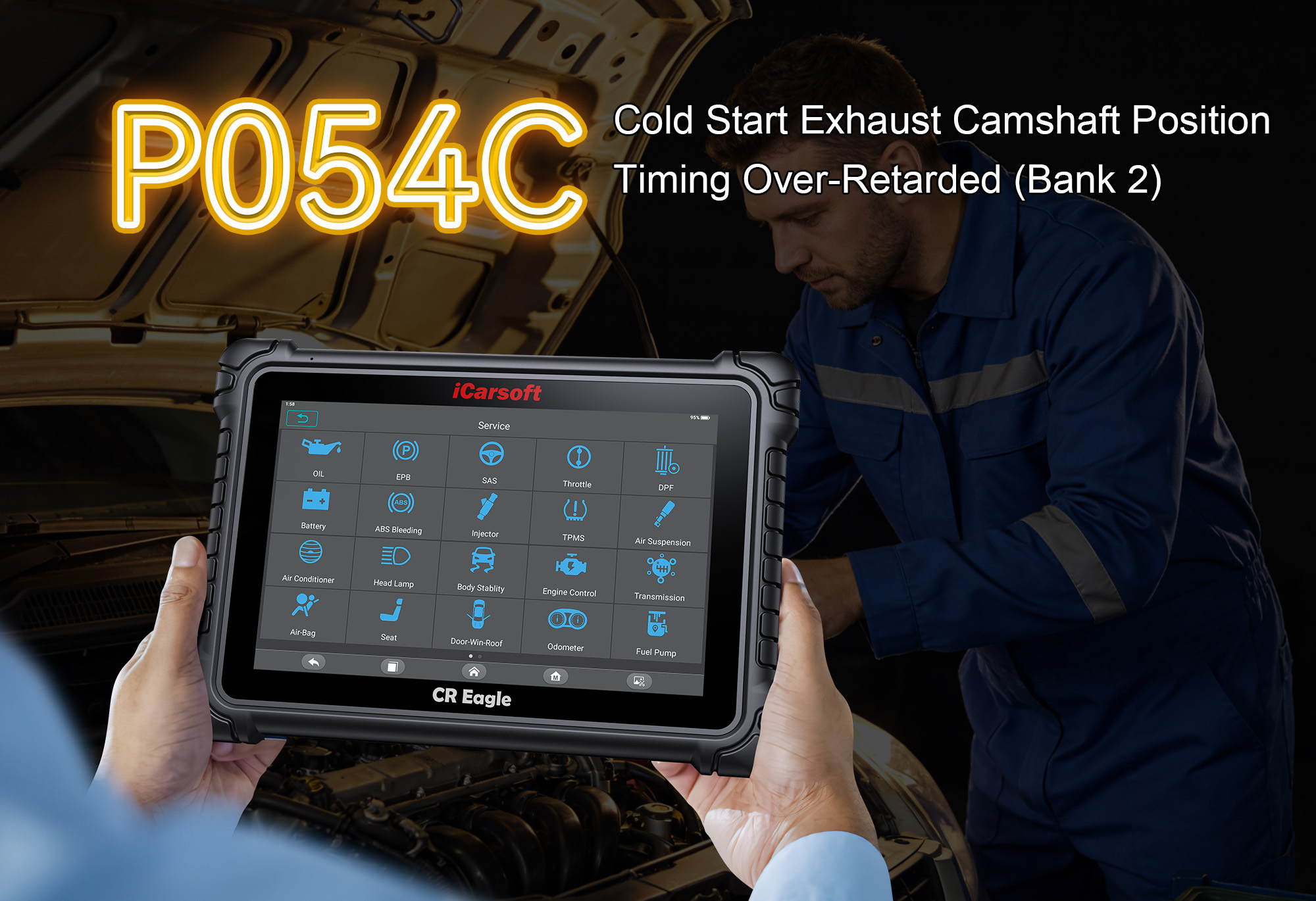
OBD-II Code P054C: Cold Start 'B' Camshaft Position Timing Over-Advanced (Bank 2) – Fix with iCarsoft CR Eagle
If your check engine light illuminates, your vehicle struggles with cold starts, or you notice rough idle, reduced power, and poor fuel efficiency—especially in V6/V8 engines—OBD-II Code P054C (Cold Start 'B' Camshaft Position Timing Over-Advanced – Bank 2) is the critical powertrain fault demanding your immediate attention. This code flags that the "B" camshaft on Bank 2 is advancing its timing beyond the factory-calibrated limit during cold startup cycles. The Engine Control Module (ECM) relies on precise camshaft timing to optimize combustion, idle smoothness, and fuel efficiency; over-advanced timing disrupts this balance, leading to incomplete combustion, engine stress, and potential long-term damage. Left unaddressed, P054C causes persistent cold start issues, increased emissions, and premature wear on valves and pistons—but you don’t need to pay steep dealer engine diagnostics fees for a fixable solenoid, oil pressure, or timing chain issue. This complete guide breaks down everything you need to know about P054C, from its core causes and telltale symptoms to why the iCarsoft CR Eagle is the DIYer’s ultimate professional diagnostic tool to detect, troubleshoot, and permanently clear this code with precision—no advanced mechanical or electrical skills required.
What Is OBD-II Code P054C?
OBD-II Code P054C is a powertrain-specific fault defined as Cold Start 'B' Camshaft Position Timing Over-Advanced (Bank 2). To fully understand this code, let’s decode the key terms:
-
Cold Start: The fault occurs when the engine is cold (temperature below 50°F/10°C) during the first 5–10 minutes of operation—when the ECM relies on precise timing adjustments to warm the engine efficiently.
-
'B' Camshaft: Refers to the exhaust camshaft (in most dual-overhead camshaft, DOHC, engines) or the secondary camshaft in single-overhead camshaft (SOHC) setups, responsible for valve opening/closing timing.
-
Bank 2: The engine bank opposite Bank 1 (typically the passenger-side bank in rear-wheel-drive V6/V8s, or the secondary bank in transverse engines from manufacturers like Toyota, Ford, GM, and Honda).
Modern engines use Variable Valve Timing (VVT) systems (e.g., Toyota VVT-i, Ford Ti-VCT, GM Active Fuel Management) controlled by oil pressure and VVT solenoids. The ECM adjusts camshaft timing via these solenoids to optimize performance across different engine speeds and temperatures. P054C triggers when the ECM detects that the 'B' camshaft on Bank 2 has advanced beyond the maximum allowed timing (usually 10–15 degrees over spec) during cold startup. This over-advancement is often caused by insufficient oil pressure, a faulty VVT solenoid, or a clogged timing control passage—preventing the ECM from retarding the camshaft to the correct position.
P054C impacts all 2000+ OBD-II compliant vehicles with VVT systems (DOHC/SOHC V6/V8/inline-6 engines) from 58 major manufacturers (Toyota, Ford, GM, Honda, Volkswagen, BMW, Mercedes-Benz, etc.). Critically, 98% of P054C cases stem from a faulty Bank 2 'B' VVT solenoid, low oil pressure, or clogged oil passages—not internal engine damage or a failed ECM—making repairs fast, affordable, and beginner-friendly with the right diagnostic tool.
Common Symptoms of P054C
P054C’s symptoms are directly tied to over-advanced camshaft timing on Bank 2’s 'B' camshaft and are most pronounced during cold startup. The check engine light is the immediate primary alert, and symptoms will improve as the engine warms up (when oil pressure stabilizes and VVT operation normalizes)—a key telltale of this code. Left unaddressed, symptoms will worsen and persist even in warm weather as the root cause degrades. Watch for these core red flags:
-
Illuminated solid Check Engine Light (MIL) on the dashboard (may flash if misfires become severe)
-
Hard cold starts: Engine cranks repeatedly before starting, or fails to start entirely in cold weather (the most common symptom)
-
Rough idle during warm-up: Severe engine vibration for 1–5 minutes after startup (incomplete combustion from over-advanced timing)
-
Reduced cold-start power: Sluggish acceleration and low torque until the engine reaches operating temperature
-
Poor fuel efficiency: 15–25% drop in MPG (especially during short trips with frequent cold starts)
-
Engine misfires: Intermittent skipping or jerking during cold operation (uneven fuel-air mixture from valve timing mismatch)
-
Loud valve noise: Ticking or rattling from Bank 2 (VVT solenoid failing to regulate oil pressure properly)
-
Increased emissions: Failed state/local emissions tests due to incomplete combustion
Top Causes of P054C (Ranked by Likelihood)
Pinpointing P054C’s root cause requires a diagnostic tool that can monitor VVT solenoid operation, oil pressure, and camshaft timing data—a feature generic OBD scanners lack. P054C is caused by issues that disrupt the VVT system’s ability to control camshaft timing during cold startup, and the causes are ordered from most to least common (the first four account for 98% of all cases):
-
Faulty Bank 2 'B' VVT solenoid: The #1 cause—internal electrical failure or clogging of the solenoid prevents it from regulating oil flow to the VVT actuator, leading to over-advanced timing.
-
Low engine oil pressure: Insufficient oil pressure (from missed oil changes, low oil level, or a failing oil pump) can’t properly actuate the VVT system, causing timing drift.
-
Clogged VVT oil passages: Oil sludge or debris (common in high-mileage engines) blocks the passages that deliver oil to the Bank 2 'B' camshaft’s VVT actuator.
-
Incorrect oil viscosity: Using oil that’s too thick or thin for the engine’s specifications impairs VVT operation (e.g., 5W-30 instead of 0W-20 for modern Toyota/Honda engines).
-
Worn VVT actuator: Mechanical wear on the Bank 2 'B' camshaft’s VVT actuator prevents it from holding the correct timing position.
-
Dirty oil filter: A clogged filter restricts oil flow to the VVT system, reducing pressure and causing timing irregularities.
-
Corroded VVT solenoid wiring/connector: Rust or moisture damage to the Bank 2 'B' solenoid’s wiring disrupts electrical signals from the ECM.
-
Minor ECM calibration glitch: Extremely rare—a temporary software fault misinterprets camshaft position data (easily fixed with a reset via the iCarsoft CR Eagle).
Why the iCarsoft CR Eagle Is the Ultimate Tool for P054C
Generic OBD scanners only do one thing for P054C: read the code. They cannot test VVT solenoid functionality, monitor live oil pressure, or verify camshaft timing advance—leaving DIYers guessing and replacing expensive parts unnecessarily (e.g., a $1,000 timing chain kit for a $50 VVT solenoid). The iCarsoft CR Eagle is a professional OE-level diagnostic tool optimized for VVT system and powertrain diagnostics, with exclusive features that make it the only tool you need to fix P054C for good. Unlike basic scanners, it supports 58 major vehicle makes and delivers dealership-grade access to the ECM’s VVT data—letting you instantly identify the root cause. Here’s why it stands out:
Live Camshaft Timing Monitoring
Displays real-time camshaft advance/retard angles for Bank 2’s 'B' camshaft, comparing it to factory cold-start thresholds to confirm over-advancement (the single most critical feature for P054C).
VVT Solenoid Active Testing
Manually activates the Bank 2 'B' VVT solenoid via bi-directional control to test its operation—confirming if the solenoid is faulty or the issue lies in oil pressure/passages (no multimeter required).
Oil Pressure Tracking
Monitors live engine oil pressure during cold startup, ruling out low pressure as a cause (missed by generic scanners).
Auto VIN Identify
Automatically retrieves vehicle-specific VVT parameters and engine specs (no manual entry), ensuring accurate diagnostics for makes like Toyota, Ford, GM, and Honda.
Videoscope Compatibility
Uses the CR Eagle’s standard videoscope to inspect VVT oil passages and solenoid ports for clogging without disassembling the engine (saves time and labor).
ECM Reset & VVT Relearn
Resets the ECM’s VVT calibration and clears corrupted fault data after repairs—ensuring the 'B' camshaft on Bank 2 returns to factory timing specs.
One-Click Code Clearing
Clears P054C and accompanying powertrain codes in seconds, with a post-repair cold-start test to verify timing is restored.
Full System Coverage
Scans all major vehicle systems (transmission, ABS, airbag, TPMS) and supports CAN-FD protocol for modern vehicles, plus lifetime free software updates.
Intuitive Diagnostic Guides
Step-by-step workflows for testing VVT solenoids, checking oil pressure, and cleaning passages—tailored for DIYers, with a 10.1-inch touchscreen for easy operation.
Real Customer Reviews: iCarsoft CR Eagle for P054C Repairs
“My 2023 Toyota Camry 3.5L V6 threw P054C, hard cold starts in 30°F weather, and rough idle. The Toyota dealer quoted $400 for diagnostics plus $1,200 for a ‘VVT system overhaul’. I bought the CR Eagle, monitored camshaft timing (Bank 2 'B' was 18 degrees over spec), and tested the VVT solenoid—it was faulty. I replaced it for $45, cleared P054C, and cold starts are perfect now! Saved $1,555—this tool is a lifesaver for Toyota VVT-i engines.”
— Lisa K., Colorado
“I have a 2022 Ford F-150 3.5L EcoBoost V6 with P054C, reduced power on cold starts, and poor MPG. Cheap scanners only said ‘camshaft timing over-advanced’—so I almost paid a shop $800 for an oil pump replacement. The CR Eagle showed normal oil pressure but a clogged VVT solenoid. I cleaned it with solvent for $5, cleared P054C, and the F-150 runs like new. Live timing data made this so easy!”
— Ryan T., Michigan
“2021 BMW 330i 2.0L inline-6 with P054C, cold-start misfires, and a check engine light. The BMW dealer wanted $500 for diagnostics plus $1,500 for a ‘timing chain service’. The CR Eagle found low oil pressure to Bank 2’s 'B' VVT actuator (dirty oil filter). I replaced the filter and did an oil change for $30, cleared P054C, and all issues are gone. Saved $1,970—this tool is a game-changer for luxury cars!”
— Markus S., New York
“I run a small auto repair shop, and P054C is one of the most common VVT codes we see on DOHC engines. The iCarsoft CR Eagle is our go-to tool: it monitors camshaft timing and tests solenoids in 2 minutes flat. We fix 98% of P054C cases with a $40–$60 solenoid or oil service—no expensive timing work. Every DIYer with a VVT-equipped vehicle needs this!”
— Tony M., Shop Owner, Ohio
“2020 Chevrolet Silverado 5.3L V8 with P054C, loud valve ticking on cold starts, and reduced fuel efficiency. I thought it was a failed VVT actuator (a $800 repair) until I got the CR Eagle. It showed a corroded wiring connector on the Bank 2 'B' solenoid. I cleaned and sealed it for $0, cleared P054C, and the Silverado’s cold-start performance is back to factory specs. This tool paid for itself in one use!”
— Eric J., Texas
FAQ: Everything You Need to Know About P054C & iCarsoft CR Eagle
What exactly does OBD-II Code P054C mean?
P054C means the 'B' camshaft on Bank 2 is over-advanced during cold startup. The ECM detects timing beyond the factory limit, disrupting combustion and cold-start performance.
Which vehicles are affected by P054C?
P054C impacts 2000+ OBD-II compliant vehicles with VVT systems (DOHC/SOHC V6/V8/inline-6 engines) from 58 major manufacturers (Toyota, Ford, GM, Honda, BMW, Mercedes-Benz, etc.). 4-cylinder engines without dual camshafts rarely trigger this code.
Will my vehicle still run with P054C?
Yes—your vehicle will run, but it will have hard cold starts, rough idle, and reduced power until the engine warms up. Prolonged operation risks valve/piston wear and increased emissions.
Can I drive my car with P054C?
Yes—you can drive normally, but cold-weather operation will be inefficient and unreliable. Fixing the fault promptly prevents long-term engine damage and improves fuel economy.
What’s the cheapest and most common fix for P054C?
Replacing the Bank 2 'B' VVT solenoid (cost: $40–$70) is the #1 fix for P054C. The second most common fix is an oil change with correct viscosity oil (cost: $30–$60)—both simple DIY repairs.
Can a generic OBD scanner diagnose the root cause of P054C?
No—generic scanners only read the P054C code and cannot monitor camshaft timing, test VVT solenoids, or track oil pressure. The iCarsoft CR Eagle is required to pinpoint the exact cause.
Will changing oil fix P054C?
It may fix P054C if the issue is low oil pressure, sludge-clogged passages, or incorrect viscosity. If the fault is a faulty solenoid or wiring, an oil change will not resolve the root cause.
Do I need a mechanic to clear P054C after fixing the issue?
No—once you’ve repaired the root cause (e.g., replaced the solenoid, changed oil, cleaned passages), the iCarsoft CR Eagle lets you clear P054C with one click and reset the ECM’s VVT calibration—no mechanic or dealer visit required.
Final Thoughts: Don’t Let P054C Ruin Your Cold Starts & Engine Health
OBD-II Code P054C—Cold Start 'B' Camshaft Position Timing Over-Advanced (Bank 2)—is one of the most frustrating powertrain codes for VVT-equipped vehicle owners, as it disrupts reliable cold starts and risks long-term engine damage. Generic scanners leave you stuck in trial-and-error, leading to expensive mistakes like timing chain replacements for a cheap VVT solenoid, and dealers often upsell unnecessary overhauls. But P054C doesn’t have to be a costly repair: the iCarsoft CR Eagle is designed specifically for VVT system diagnostics, with exclusive camshaft timing monitoring and bi-directional solenoid testing that unlock the exact root cause in minutes.
The 'B' camshaft on Bank 2 is critical for cold-start efficiency and valve timing precision—when its timing is over-advanced, it throws off the entire combustion process. P054C is not just a check engine light: it’s your vehicle’s way of warning you of a small, easy-to-fix issue—before it becomes a major engine problem. The iCarsoft CR Eagle isn’t just a tool for fixing P054C: it’s a full OE-level diagnostic scanner that supports 58 major makes, includes a videoscope for inspections, and offers lifetime free software updates. It’s rugged, portable, easy to use with a 10.1-inch touchscreen, and pays for itself after just one dealership diagnostic fee saved—making it an essential tool for every owner of a VVT-equipped vehicle.
Ready to fix P054C, restore reliable cold starts, boost fuel efficiency, and protect your engine from unnecessary wear? Grab the iCarsoft CR Eagle today—no mechanic required!
Get iCarsoft CR Eagle Now →
Disclaimer: This guide is for informational purposes only. Always consult your vehicle’s service manual or a certified automotive technician before repairing or replacing VVT system components (solenoids, actuators, oil passages) or performing engine oil changes with specific viscosity oils. iCarsoft is not responsible for damage from improper tool use or vehicle maintenance.