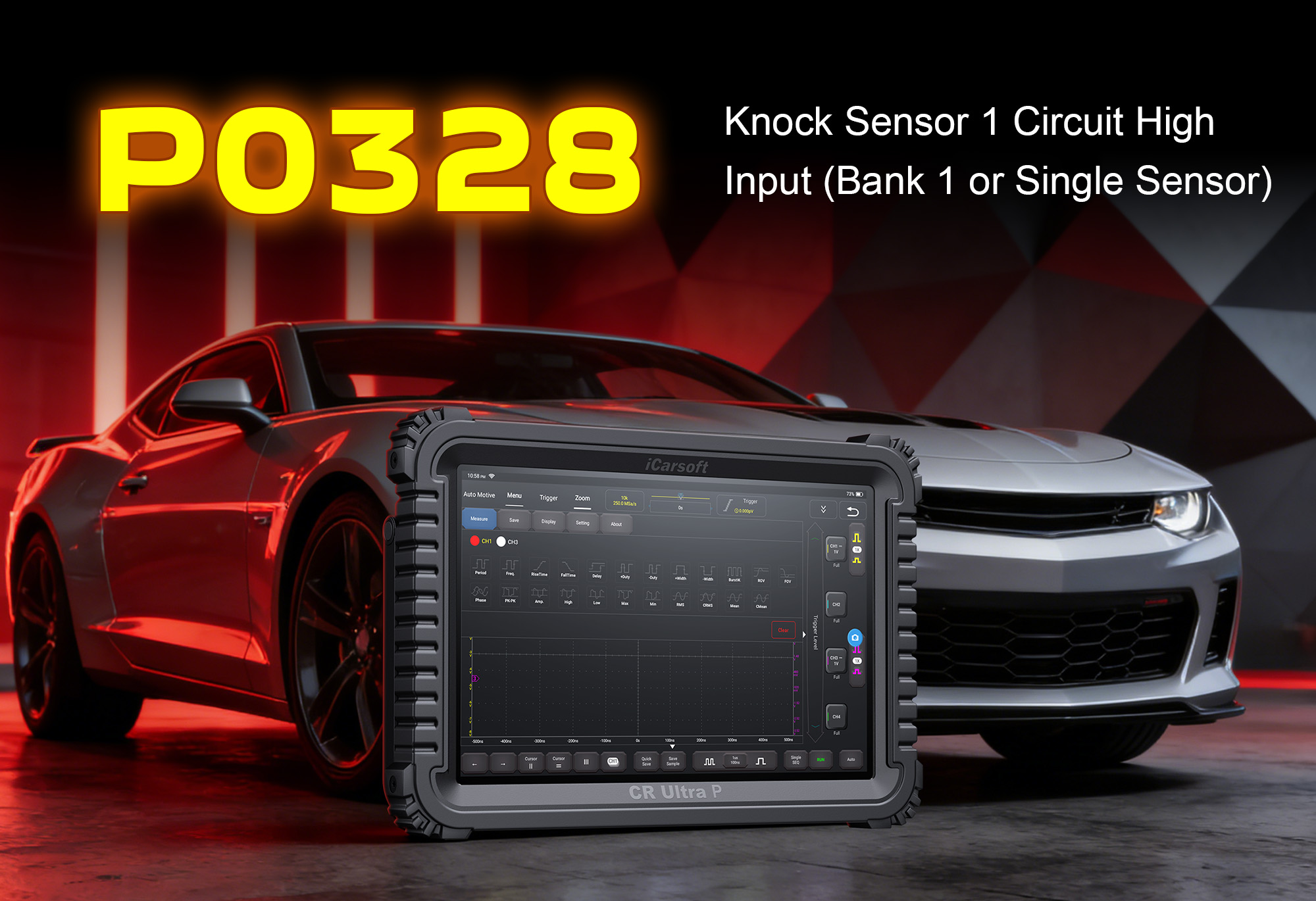
P0328 Code: Fix Knock Sensor 1 Circuit High Input (Bank 1) With iCarsoft CR Ultra P
If your check engine light illuminates, you experience engine knock under load, or notice reduced performance with OBD2 code P0328, you’re dealing with a critical knock sensor fault. P0328 stands for “Knock Sensor 1 Circuit High Input (Bank 1)”—a problem where the knock sensor on Bank 1 sends an abnormally high voltage signal to the Engine Control Module (ECM). Ignore it, and you’ll face poor fuel efficiency, increased emissions, and potential piston or rod damage from unregulated engine knock. In this guide, we’ll decode P0328 thoroughly and explain why the iCarsoft CR Ultra P OBD2 Scanner is the ultimate tool for diagnosing and clearing this fault—built for both DIYers and professionals.
What Exactly Is the P0328 Code?
The P0328 code is a generic OBD-II diagnostic trouble code (DTC) officially defined as Knock Sensor 1 Circuit High Input (Bank 1). Knock sensors detect abnormal combustion (engine knock/detonation) by monitoring vibrations, sending voltage signals (typically 0.5V–4.5V) to the ECM. The ECM uses this data to adjust ignition timing and fuel delivery, preventing engine damage.
P0328 triggers when the ECM detects the Bank 1 knock sensor’s circuit voltage exceeds the normal range (often above 5V) for an extended period. This false or stuck-high signal confuses the ECM, leading to overly conservative timing adjustments that reduce performance. The code is prevalent in vehicles like Toyota Camry, Honda Accord, Ford F-150, Chevrolet Silverado, and Volkswagen Jetta—especially models with 70,000+ miles or exposure to engine overheating.
Common Symptoms of the P0328 Code
P0328 causes noticeable drivability and efficiency issues that worsen over time—act fast to avoid costly repairs:
-
Illuminated check engine light (steady, rarely flashing)
-
Engine knock/pinging under acceleration or heavy load
-
10-20% drop in fuel efficiency (conservative timing wastes fuel)
-
Reduced engine power and sluggish acceleration
-
Rough idling or hesitation at low RPMs
-
Failed emissions tests (unoptimized timing increases NOx levels)
-
ECM goes into “limp mode” (severe cases, limiting speed to protect the engine)
Top Causes of the P0328 Code
Diagnosing P0328 requires targeting the knock sensor and related systems. Here are the most frequent culprits (sorted by likelihood):
-
Faulty Knock Sensor (Bank 1): The #1 cause (65% of cases)—internal electrical failure or contamination from oil/carbon buildup triggers high voltage signals.
-
Wiring/Connector Damage: Frayed wires, corroded pins, or loose connections between the sensor and ECM cause voltage spikes.
-
Sensor Mounting Issues: A loose or damaged sensor bracket prevents proper vibration detection, leading to false high signals.
-
Engine Overheating: Excessive engine heat damages the knock sensor’s internal components, disrupting signal output.
-
ECM Malfunction: Rare, but a faulty ECM may misinterpret sensor signals or fail to process voltage correctly.
-
Oil Leaks: Engine oil seeping onto the sensor corrodes electrical connections and impairs functionality.
Why the iCarsoft CR Ultra P Is Ideal for P0328 Diagnostics
Basic OBD scanners can read P0328, but they can’t test knock sensor functionality or verify circuit integrity—where the iCarsoft CR Ultra P excels. Packed with sensor-specific features, this scanner simplifies P0328 troubleshooting:
Wide Vehicle Compatibility
Works with 99% of 1996+ gasoline/diesel vehicles (Europe, Asia, America), including P0328-prone Toyota, Honda, Ford, Chevrolet, and Volkswagen models.
OE-Level Knock Sensor Data
Reads P0328 and related codes (P0325, P0329, P0330) + freeze-frame data (sensor voltage, engine RPM, coolant temperature) to pinpoint triggers.
Real-Time Circuit Monitoring
Displays live knock sensor voltage in a 4-in-1 graph—confirms if readings exceed 5V (high input) and tracks fluctuations under load.
Knock Sensor Active Tests
Sends commands to test the sensor’s responsiveness, verifying if it’s faulty without disassembling engine components.
Dual Connectivity
Bluetooth 5.0 (30m range) for cable-free operation under the hood, plus wired VCI for stable diagnostics in harsh conditions.
One-Click Code Clear & Verification
Safely erases P0328 post-repair and allows test drive rescans to confirm sensor functionality.
Intuitive Interface
Large touchscreen, AutoVIN identification, and 15-language support make it beginner-friendly—no advanced mechanical knowledge needed.
Lifetime Free Updates
Stays compatible with new vehicle models and updated knock sensor protocols, ensuring long-term value.
Step-by-Step P0328 Diagnosis with iCarsoft CR Ultra P
Fix P0328 like a pro with these targeted steps:
Step 1: Prep & Initial Inspection
Park on level ground, turn off the engine, and let it cool. Visually inspect the Bank 1 knock sensor wiring for fraying, corrosion, or loose connections. Plug the CR Ultra P’s VCI dongle into the OBD-II port.
Step 2: Run Auto Scan for P0328
Connect via Bluetooth or use the built-in touchscreen. Select your vehicle make/model and run an Auto Scan to detect P0328 and related sensor codes.
Step 3: Analyze Live Data
Access Live Data to monitor:
-
Knock Sensor 1 (Bank 1) voltage (readings above 5V confirm P0328)
-
Engine RPM and load (verifies when high input occurs)
-
Coolant temperature (rules out overheating-related issues)
Step 4: Run Knock Sensor Active Test
Use the Knock Sensor Active Test—if the sensor doesn’t respond to vibration (tap gently with a rubber mallet), it’s faulty; if it responds, check wiring or mounting.
Step 5: Inspect Sensor & Wiring
Inspect the sensor’s connector for corrosion, test wiring continuity, and ensure the sensor is securely mounted.
Step 6: Repair & Reset ECM
Replace the faulty sensor or repair wiring. Perform an ECM reset via the scanner to clear adaptive timing maps.
Step 7: Verify Fix
Clear P0328 with Quick Erase, take a 30-mile test drive (include highway acceleration), and rescan to ensure no recurrence.
Real Customer Reviews: iCarsoft CR Ultra P for P0328
“My 2019 Toyota Camry threw P0328, and the dealer quoted $380 for knock sensor replacement + labor. Bought the iCarsoft CR Ultra P, scanned in 45 seconds, and confirmed the Bank 1 sensor had high voltage. Replaced it myself for $60 and used the scanner to verify the fix. Saved over $320! The wireless feature let me monitor the sensor while testing—super convenient.”
— Ryan T., DIY Car Owner
“As an independent mechanic, P0328 is a common code in high-mileage vehicles. The CR Ultra P’s live voltage graph shows exactly when the sensor goes high, and the active test saves me from replacing good sensors. It’s compatible with all the makes I service (Honda, Ford, Chevy) and the touchscreen is way easier to use than basic scanners. My customers love the fast diagnosis.”
— Sophia L., Independent Mechanic
“I’m not mechanically inclined, but the CR Ultra P made P0328 simple. The step-by-step prompts walked me through scanning, and the live data showed my sensor was stuck at 6V. I watched a YouTube tutorial to replace the sensor, and the scanner confirmed the code was gone. Avoided a $550 shop bill—this tool is a game-changer for casual car owners.”
— David K., Daily Commuter
8 FAQs About the P0328 Code & iCarsoft CR Ultra P
1. How serious is the P0328 code?
P0328 is moderately serious. It won’t disable your vehicle immediately, but unregulated engine knock can damage pistons or rods (costing $1,000–$3,000 to repair). Fix it within 1–2 weeks.
2. Can I drive with P0328?
Short trips (under 10 miles) are safe, but avoid heavy acceleration or towing. Engine knock under load increases the risk of internal damage over time.
3. How much does it cost to fix P0328?
Costs range from $50–$150 (DIY knock sensor replacement) to $300–$600 (dealer labor + parts). The CR Ultra P avoids misdiagnosing expensive engine repairs.
4. Will P0328 clear on its own?
No—P0328 is a persistent electrical/mechanical fault caused by a faulty sensor, wiring issue, or mounting problem. It requires repair before permanent clearance.
5. Does the CR Ultra P work with my vehicle?
Yes—it’s compatible with 99% of 1996+ OBD-II vehicles, including cars, trucks, and SUVs from Toyota, Honda, Ford, Chevrolet, Volkswagen, and more. Check the official compatibility list for your model.
6. Can the CR Ultra P distinguish between a faulty sensor and wiring issue?
Absolutely—its active test confirms sensor responsiveness, while live voltage monitoring shows if high readings stem from wiring damage or a faulty sensor.
7. What other codes are related to P0328?
Related codes include P0325 (Knock Sensor 1 Circuit Malfunction), P0329 (Knock Sensor 1 Circuit Low Input), and P0330 (Knock Sensor 2 Circuit Malfunction).
8. Do I need mechanical experience to use the CR Ultra P?
No—the scanner’s intuitive touchscreen, AutoVIN, and step-by-step prompts make it beginner-friendly. Multilingual support and a built-in DTC library ensure confidence in diagnosing P0328.
Final Thoughts: Don’t Let P0328 Risk Engine Damage
The P0328 code is a clear warning of knock sensor issues that threaten engine health and performance. The iCarsoft CR Ultra P simplifies P0328 diagnosis with professional-grade features—from real-time voltage monitoring to active sensor tests—saving you time and money on dealer fees. Whether you’re a DIY enthusiast, daily commuter, or mechanic, this scanner is a long-term investment that protects your engine.
Ready to fix P0328, eliminate engine knock, and restore performance? Click below to get the iCarsoft CR Ultra P today!
Buy iCarsoft CR Ultra P Now →
Have questions about P0328 or the iCarsoft CR Ultra P? Drop a comment below—we’re here to help!
Disclaimer: This guide is for informational purposes only. Always consult your vehicle’s owner’s manual or a certified mechanic before major repairs. iCarsoft is not responsible for damage from improper tool use.