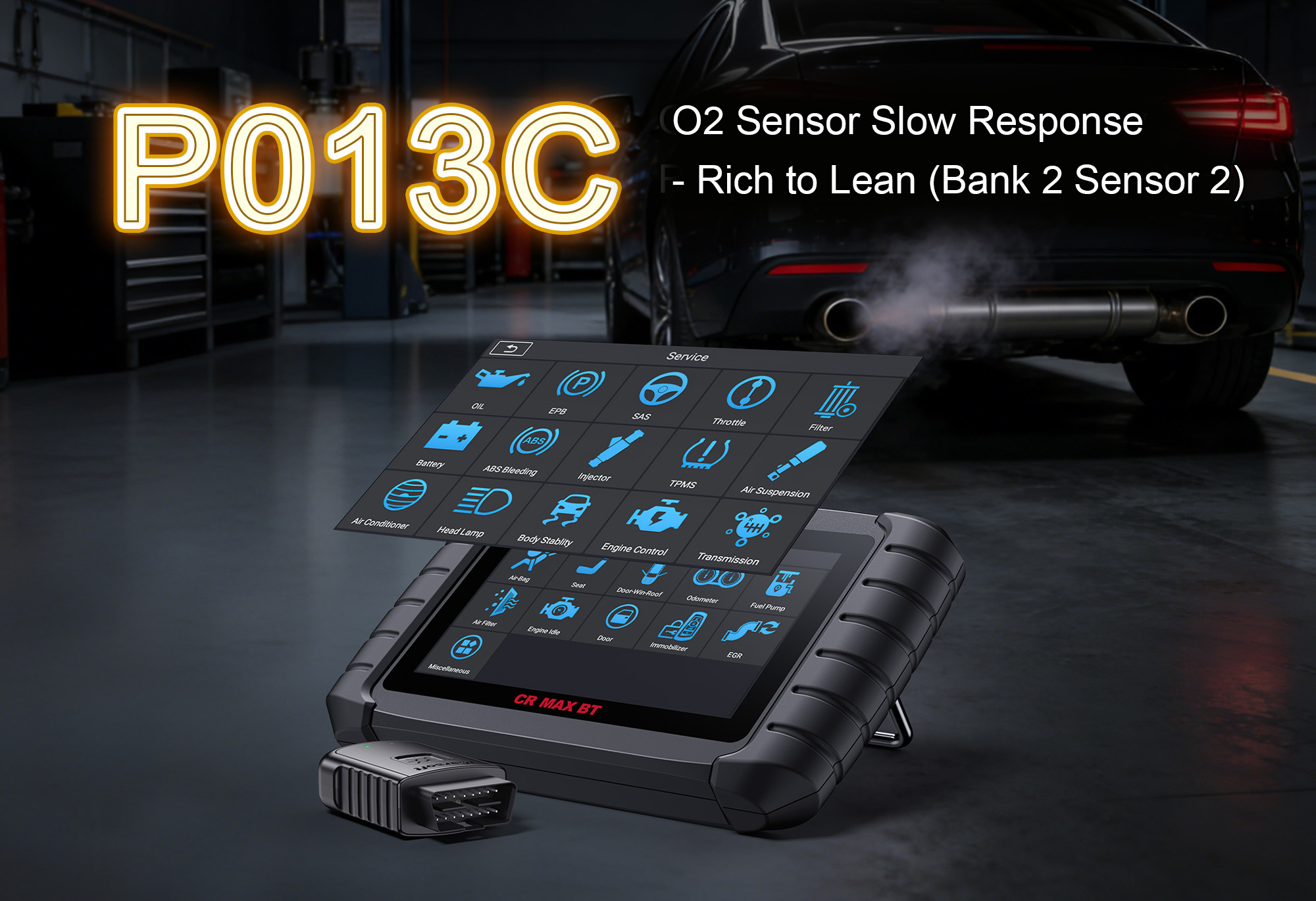
OBD-II Code P013C: O2 Sensor Slow Response – Rich to Lean (Bank 2 Sensor 2) | Fix with iCarsoft CR MAX BT
If your check engine light illuminates, your fuel efficiency drops, or you smell unburned fuel from your exhaust with OBD-II Code P013C—O2 Sensor Slow Response - Rich to Lean (Bank 2 Sensor 2)—you’re dealing with a faulty downstream oxygen sensor that’s critical to your vehicle’s emissions control and engine efficiency. This code means your Bank 2, Sensor 2 O2 sensor can’t quickly detect when your engine’s air-fuel mixture shifts from rich (too much fuel) to lean (too much air), robbing the Engine Control Module (ECM) of the data it needs to monitor catalytic converter performance. Left unaddressed, P013C leads to failed emissions tests, increased fuel consumption, catalytic converter damage, and even rough engine operation. You don’t need to overpay for dealer O2 sensor diagnostics, though: this guide breaks down everything about P013C, and why the iCarsoft CR MAX BT diagnostic tool is the DIYer’s ultimate solution to detect, troubleshoot, and clear this error code with professional precision—no advanced mechanical skills required.
What Is OBD-II Code P013C?
OBD-II codes are the ECM’s universal alert for powertrain and emissions malfunctions, and P013C specifically flags a slow rich-to-lean response in the Bank 2, Sensor 2 downstream oxygen sensor—a key component of your vehicle’s exhaust and emissions system, exclusive to V-config engines (V6, V8, V10) with two cylinder banks. Here’s a jargon-free breakdown for all drivers:
-
Bank 2: The cylinder bank that does not contain the #1 cylinder (inline engines have only one bank and will never throw P013C—this code is unique to V-config vehicles like Ford F-150 V6, Toyota Highlander V6, and BMW 3 Series V6).
-
Sensor 2 (Downstream): The O2 sensor mounted after the catalytic converter on Bank 2’s exhaust system (unlike the upstream Sensor 1, which adjusts the air-fuel mixture). Its sole job is to monitor the catalytic converter’s efficiency by measuring exhaust oxygen levels after the converter has processed them.
-
Slow Response - Rich to Lean: The sensor takes too long (beyond the manufacturer’s pre-set threshold, usually 100-300ms) to detect and signal the ECM when the exhaust’s air-fuel mixture shifts from fuel-heavy (rich) to air-heavy (lean). This slow response means the ECM can’t verify if the catalytic converter is reducing harmful emissions as it should.
-
ECM Impact: The ECM won’t immediately trigger severe engine performance issues, but it will illuminate the check engine light and may store additional emissions-related codes if the sensor fails completely. Over time, the ECM’s lack of accurate data leads to inefficient fuel delivery and catalytic converter stress.
-
P013C is a common O2 sensor fault across all 1996+ US, 2000+ EU/Asian OBD-II compliant V-config gas and mild hybrid vehicles. It’s almost always a sensor-related issue (age, contamination, or electrical failure) and is affordable to fix with the right diagnostic tool to confirm the root cause.
Common Symptoms of P013C
P013C’s symptoms are tied to a faulty downstream O2 sensor and impaired emissions system monitoring, with the check engine light as the most consistent primary alert. The symptoms are mild at first but worsen as the sensor’s response time slows further, and they’re often more noticeable during acceleration or steady highway driving (when the air-fuel mixture shifts most frequently). Watch for these telltale signs:
-
Illuminated solid Check Engine Light (MIL) on the dashboard (the universal indicator)
-
Increased fuel consumption (the most noticeable symptom—the ECM overcompensates for slow sensor data)
-
Strong unburned fuel fumes from the exhaust pipe (rich mixture not fully processed by the catalytic converter)
-
Failed state/local emissions tests (the #1 practical consequence for most drivers)
-
Slight rough engine idling or hesitation (ECM misadjusts fuel delivery over time)
-
Illuminated emissions system warning light (on newer models with dedicated catalytic converter alerts)
-
Reduced catalytic converter efficiency (detectable via diagnostic data, leads to costly replacement if unaddressed)
-
No immediate performance loss (a key trait of P013C—unlike upstream O2 sensor codes that cause severe driveability issues)
Top Causes of P013C
Pinpointing P013C’s root cause is straightforward with a diagnostic tool that can monitor the O2 sensor’s real-time response time—generic scanners only read the code, not the critical data behind it. The causes are all tied to the Bank 2, Sensor 2 O2 sensor or its supporting electrical/ exhaust components, ordered by likelihood (the first three causes account for 95% of P013C cases):
-
Aging/faulty Bank 2 Sensor 2 O2 sensor: The #1 cause—O2 sensors have a 60,000-100,000 mile lifespan, and the sensing element degrades over time, leading to slow rich-to-lean response.
-
Sensor contamination: Oil, carbon buildup, fuel residue, or coolant coats the sensor’s sensing element (from a leaking valve cover, faulty fuel injector, or blown head gasket), blocking it from detecting oxygen level changes quickly.
-
Corroded/loose sensor wiring/connector: Rust, dirt, or loose pins in the sensor’s electrical connector disrupt voltage flow between the sensor and ECM, causing slow signal transmission.
-
Faulty sensor heating element: The heating element warms the sensor to operating temperature (300-400°F) quickly; a failure causes the sensor to warm up slowly, leading to slow response (worse in cold weather).
-
Exhaust leak after the catalytic converter: A cracked exhaust pipe or loose gasket on Bank 2 lets fresh air into the exhaust, skewing the sensor’s oxygen readings and slowing its response.
-
Catalytic converter efficiency decline: A clogged or failing catalytic converter disrupts exhaust flow, making it harder for the sensor to detect mixture shifts (indirect cause).
-
Fuel system issues: Leaking fuel injectors or a faulty fuel pressure regulator create a persistently rich mixture, overwhelming the sensor’s ability to detect rich-to-lean shifts.
-
ECM signal interpretation fault (extremely rare): The ECM itself fails to process the sensor’s signals quickly—only after all other sensor/electrical issues are ruled out.
Why the iCarsoft CR MAX BT Is Ideal for P013C
Generic OBD scanners only read the P013C code—they cannot monitor the O2 sensor’s real-time rich-to-lean response time, test its heating element, or verify exhaust oxygen levels. This leaves many DIYers guessing and replacing the O2 sensor unnecessarily (e.g., replacing a clean sensor when the real issue is a corroded connector or exhaust leak). The iCarsoft CR MAX BT (bluetooth-enabled, professional-grade) is optimized for O2 sensor and emissions system diagnostics, with exclusive features that make it the perfect tool for resolving P013C quickly and affordably. Here’s why it stands out from basic scanners:
O2 Sensor Real-Time Response Monitoring
Tracks the Bank 2, Sensor 2 sensor’s rich-to-lean response time in milliseconds and displays live voltage data (0.1-0.9V)—the exact metric the ECM uses to trigger P013C.
Heating Element Functionality Testing
Runs dedicated tests on the sensor’s heating element to verify if a warm-up failure is the root cause of slow response (a feature missing from all basic scanners).
Bank 2 Exhaust Oxygen Level Analysis
Measures real-time exhaust oxygen content on Bank 2 (before and after the catalytic converter) to distinguish between a sensor fault and an exhaust leak/catalytic converter issue.
Circuit Continuity Testing
Detects open/short circuits, corroded connectors, and broken wiring in the sensor’s electrical circuit—eliminating trial-and-error for electrical faults.
Wireless Bluetooth Connectivity
Syncs seamlessly with your smartphone/tablet for hands-free diagnostics—monitor the sensor’s response time while accelerating or driving at highway speed, no tangled cables in the engine bay.
One-Click Code Clearing & ECM Reset
After fixing the fault, clear P013C and reset the ECM’s emissions system parameters in seconds—verify your repair instantly with live sensor response data.
V-Config Vehicle Optimization
Precisely identifies Bank 2 and Sensor 2 for all V6/V8/V10 models, eliminating confusion about sensor location (a common pain point for DIYers).
Universal Compatibility
Works with all 1996+ US, 2000+ EU/Asian OBD-II compliant V-config cars, trucks, SUVs, and mild hybrids (Ford, Toyota, BMW, Chevrolet, Volkswagen, Honda, and more).
Intuitive App Integration
The iCarsoft app includes O2 sensor replacement guides, sensor location diagrams, and emissions system troubleshooting tips—tailored for DIYers with no exhaust system experience.
FAQ: Everything You Need to Know About P013C & iCarsoft CR MAX BT
What exactly does OBD-II Code P013C mean?
P013C indicates the Bank 2, Sensor 2 downstream O2 sensor has a slow rich-to-lean response—the sensor takes too long to detect exhaust oxygen level shifts from fuel-heavy to air-heavy, robbing the ECM of catalytic converter efficiency data.
Where is Bank 2, Sensor 2 located on my vehicle?
Bank 2 is the cylinder bank without the #1 cylinder; Sensor 2 is the downstream O2 sensor mounted on Bank 2’s exhaust pipe after the catalytic converter (Sensor 1 is before the converter). The CR MAX BT provides model-specific location diagrams.
Will I get P013C on an inline 4/6-cylinder engine?
No—P013C is exclusive to V-config engines (V6, V8, V10) with two cylinder banks. Inline engines have only one bank and will throw single-bank downstream O2 sensor codes (e.g., P0137, P0138) instead.
Does P013C cause immediate engine performance issues?
No—P013C affects a downstream O2 sensor that monitors the catalytic converter, not the upstream sensor that adjusts the air-fuel mixture. You’ll notice increased fuel consumption and a check engine light, but no severe rough idling or acceleration issues (until the sensor fails completely).
Can a generic OBD scanner diagnose P013C’s root cause?
No—generic scanners only read the P013C code and cannot monitor the sensor’s rich-to-lean response time, test its heating element, or detect electrical faults like corroded connectors. The CR MAX BT is required to find the real issue.
Is it safe to drive with P013C?
Short-term driving is safe, but long-term use causes increased fuel consumption, catalytic converter damage (from ECM misadjustments), and failed emissions tests. Fix it promptly—especially if you have an upcoming emissions inspection.
Will a new O2 sensor always fix P013C?
90% of the time, yes—but only if the root cause is an aging/faulty sensor. If P013C is caused by a corroded connector, exhaust leak, or fuel system issue, a new sensor won’t solve the problem (the CR MAX BT identifies this before you buy a new part).
How much money can I save with the CR MAX BT for P013C?
Dealer diagnostics for P013C cost $200–$450, and unnecessary repairs (catalytic converter service, exhaust work) cost $500–$1,500+. The CR MAX BT lets you fix 95% of P013C causes for under $100 (parts) and pays for itself after one use.
Final Thoughts: Don’t Let P013C Wreck Your Fuel Economy & Catalytic Converter
OBD-II Code P013C is a frustrating but easily fixable emissions system fault for V-config vehicle owners—yet it’s one of the most common causes of dealer upsells for expensive catalytic converter repairs (when the real issue is a faulty $70 O2 sensor or a $5 corroded connector). Generic scanners leave you guessing and open to wasting money on unnecessary parts, but the iCarsoft CR MAX BT changes this by giving you professional-grade O2 sensor and emissions system diagnostics to pinpoint the exact cause of P013C in minutes.
For every V6/V8/V10 owner, a functional downstream O2 sensor is non-negotiable for fuel efficiency, emissions compliance, and protecting your costly catalytic converter (which costs $1,000+ to replace). The CR MAX BT isn’t just a solution for P013C: it diagnoses all O2 sensor and emissions system faults, monitors exhaust oxygen levels, and reads every other OBD-II code for your engine, transmission, and cooling systems. It’s a compact, durable tool that fits in your glove box, saves you hundreds (or thousands) in dealer repairs over time, and ensures your vehicle meets emissions regulations—all with wireless Bluetooth convenience and professional diagnostic precision.
Ready to fix P013C, restore your fuel efficiency, and protect your catalytic converter? Grab the iCarsoft CR MAX BT today and take complete control of your vehicle’s O2 sensor and emissions system health!
Disclaimer: This guide is for informational purposes only. Always consult your vehicle’s service manual or a certified mechanic before O2 sensor, exhaust, or emissions system repairs. iCarsoft is not responsible for damage from improper tool use or vehicle maintenance.